

Now Reading: Delhi’s Bulldozer Summer: Homes Gone, Votes Missing – Who’s Next?
-
01
Delhi’s Bulldozer Summer: Homes Gone, Votes Missing – Who’s Next?


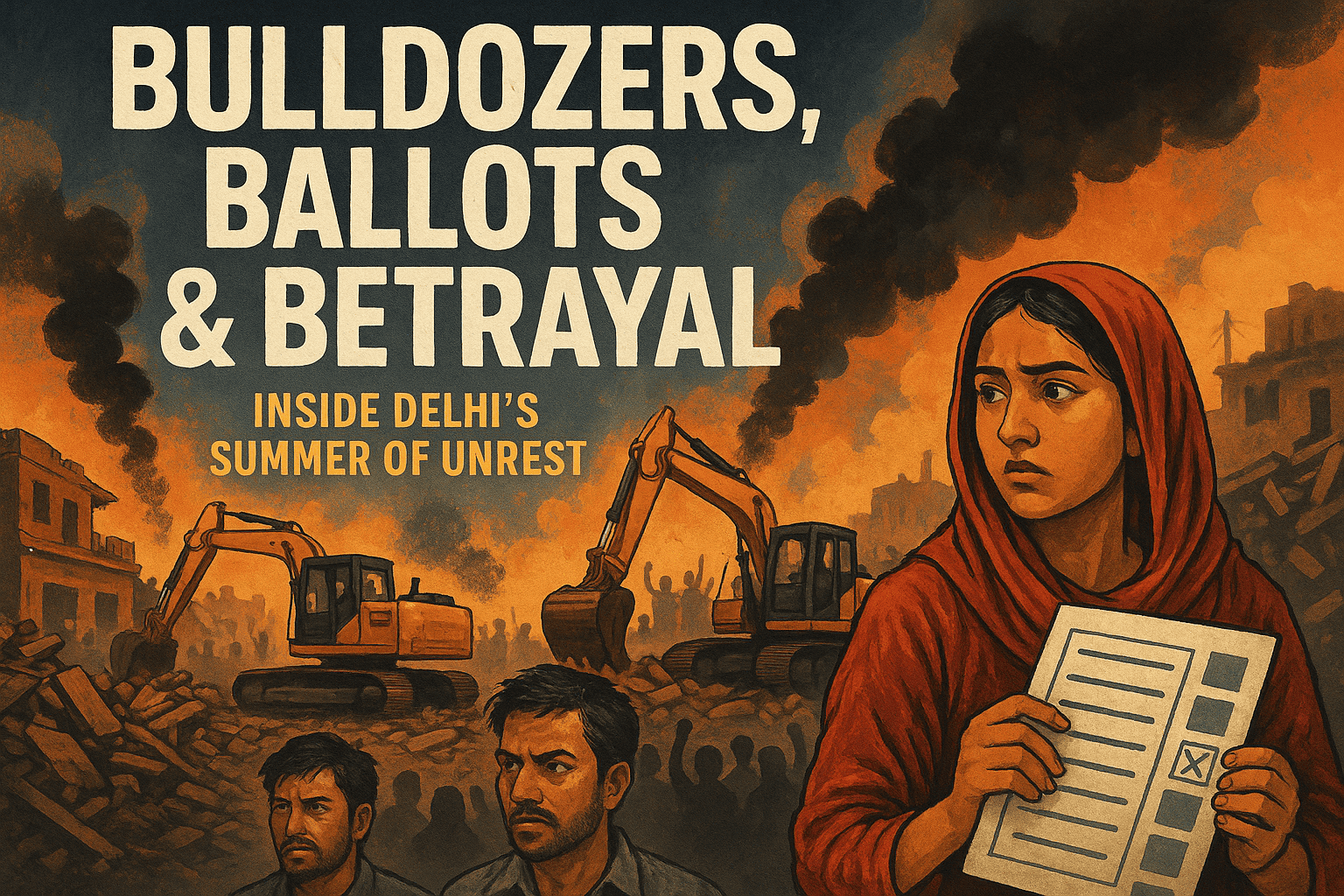
The summer of 2025 in Delhi has not just been about sweltering heat and monsoon delays — it has been about bulldozers, broken homes, and growing concerns over citizenship rights. The city, already struggling with infrastructure stress and socio-political tension, has witnessed a series of demolition drives that have left thousands displaced. Alongside, reports of disenfranchisement — voters finding their names missing from electoral rolls — have sparked political storms.
As our editorial team verified from multiple official records, eyewitness accounts, and civic authority statements, the events unfolding over the past few months have not been random administrative actions but a series of coordinated operations with deep political and social consequences.
The Demolition Drives: Who Was Affected and Why?
Starting in late May 2025, the Delhi Development Authority (DDA), municipal corporations, and other state agencies carried out large-scale demolition operations in several areas, including Mehrauli, Tughlakabad, Jahangirpuri, and parts of Yamuna floodplains. Officially, these were described as “anti-encroachment” measures to reclaim government and ecologically sensitive land.
However, as our field reporters observed, the bulldozers often arrived with little prior notice. Residents claimed eviction notices, when served at all, were given just hours before demolition began. In Tughlakabad, hundreds of families who had been living there for decades saw their homes razed, with many alleging that they were legal occupants with valid documents.
Community leaders have accused the authorities of selectively targeting certain areas — particularly those inhabited by economically weaker sections and minority communities. Officials, on the other hand, maintain that the actions were impartial and based on court orders or land-use violations.
Political Reactions and Protests
The demolitions quickly became a flashpoint in Delhi’s political landscape. Opposition leaders accused the government of using bulldozers as a political weapon to intimidate certain voter groups. Street protests erupted in several affected areas, with residents demanding rehabilitation and accusing authorities of human rights violations.
Delhi’s ruling party demanded an immediate halt to demolitions during peak summer and before the monsoon season, citing humanitarian concerns. The central government countered by emphasizing the need to enforce land laws and clear illegal encroachments, claiming that such actions are necessary for urban development and environmental restoration.
The Disenfranchisement Issue: Voters Missing from Rolls
While the dust from demolished homes was still settling, another controversy surfaced — allegations of mass voter list deletions in certain neighborhoods. Multiple residents reported that their names had vanished from the electoral rolls ahead of municipal and state-level preparations for the 2025 elections.
According to official data accessed by our team, over 2 lakh voters were marked as “inactive” or “deleted” in the latest revision of the rolls. The Election Commission has stated that these changes were part of a standard clean-up exercise to remove duplicate or invalid entries. But residents in several affected areas claim that their documents are valid and their removal is politically motivated.
Rahul Gandhi, along with other opposition figures, publicly questioned how such large-scale deletions occurred, especially in districts that had seen intense demolition activity. The Election Commission has promised to investigate individual complaints, but confidence among voters appears shaken.
Humanitarian Fallout
The combination of forced evictions and loss of voting rights has left many residents feeling not just displaced but also voiceless. Without stable housing, access to basic services such as electricity, water, and education becomes uncertain. Losing the right to vote only compounds the sense of exclusion from civic life.
Human rights groups have raised alarms about the legality and ethics of carrying out demolitions without comprehensive rehabilitation plans. Several NGOs have stepped in to provide temporary shelters, food, and legal aid to those affected.
Broader Political and Social Implications
From our analysis, the twin issues of demolitions and disenfranchisement appear intertwined in the public perception. Whether by design or coincidence, the targeting of vulnerable communities in both housing and voting rights debates has fueled narratives of systemic exclusion.
For the ruling establishment, the message is that strict urban regulation is essential to curb illegal land use and maintain civic order. For the opposition and rights groups, the message is that such actions are undermining democracy by marginalizing the poor and silencing dissenting voices.
With the Delhi Assembly elections on the horizon, these events are expected to play a central role in political campaigning. The ruling party may highlight urban renewal and law enforcement, while the opposition is likely to focus on the humanitarian and democratic costs of the current approach.
Looking Ahead
The coming months will be crucial. The Election Commission’s handling of voter deletion complaints, the courts’ response to demolition-related petitions, and the government’s rehabilitation efforts will shape public opinion. If unresolved, these issues could leave long-term scars on Delhi’s socio-political fabric.
For now, Delhi’s summer of demolitions and disenfranchisement serves as a stark reminder that urban development and democracy must go hand in hand — and when they don’t, the ones who suffer most are those with the least power to fight back.
Related Posts



Stay Informed With the Latest & Most Important News
Previous Post
Next Post


Advertisement








Advertisement
