

Now Reading: Blood Moon Over India 2025: Timings, Visibility and Cultural Beliefs Explained
-
01
Blood Moon Over India 2025: Timings, Visibility and Cultural Beliefs Explained

Blood Moon Over India 2025: Timings, Visibility and Cultural Beliefs Explained

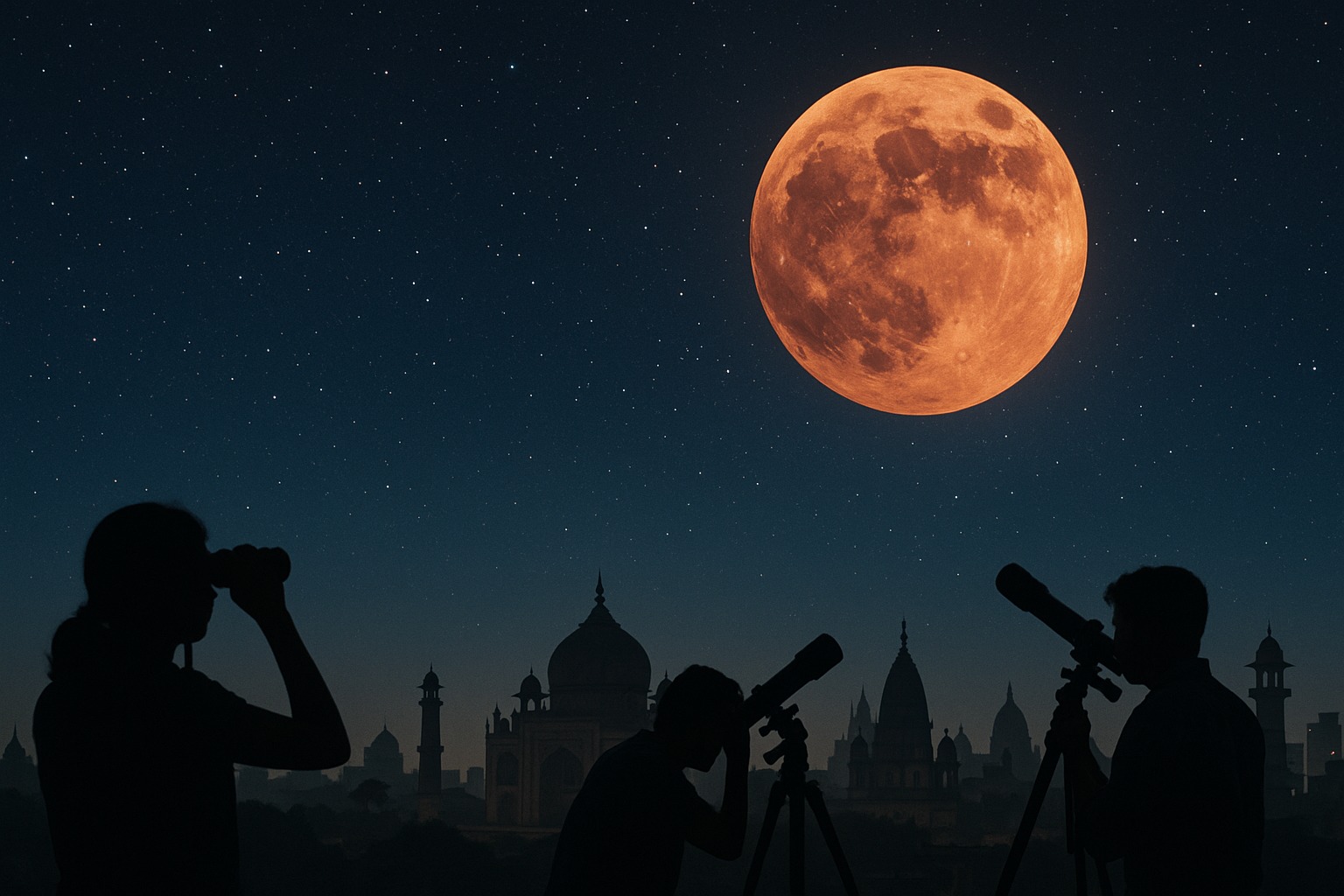
India is set to witness a celestial spectacle on the night of September 7, 2025, as a total lunar eclipse—popularly called a “blood moon”—will grace the skies. Astronomers, skywatchers, and cultural observers alike are preparing for this rare astronomical event that promises both scientific curiosity and age-old traditions.
The Editorial Team of Behind The Headlines has verified details from expert sources to bring readers a comprehensive guide to the upcoming eclipse, its timings, visibility, scientific importance, and cultural significance.
What Is a Blood Moon?
A blood moon occurs during a total lunar eclipse when the Earth comes directly between the Sun and the Moon. Instead of going completely dark, the Moon takes on a reddish or coppery hue. This happens because sunlight bends through Earth’s atmosphere, filtering shorter blue wavelengths and allowing only the red spectrum to reach the Moon’s surface.
This phenomenon has fascinated civilizations for centuries—sometimes seen as an omen, sometimes as a marvel of cosmic alignment.
Timings for India
According to astronomical calculations, the September 7 lunar eclipse will be visible across most of India, weather permitting.
- Eclipse Begins (Penumbral phase): Around 7:04 pm IST
- Partial Eclipse Begins: Around 8:12 pm IST
- Total Eclipse (Blood Moon): From approximately 9:16 pm IST to 10:41 pm IST
- Partial Eclipse Ends: Around 11:47 pm IST
- Eclipse Ends (Penumbral phase): Close to 12:55 am IST (September 8)
This means Indians can witness the blood moon in its peak form for about 85 minutes—a relatively long total eclipse compared to recent years.
Where Will It Be Visible?
- India: Entire country, with best views in areas with clear skies and minimal light pollution.
- Asia: Most of South and Southeast Asia will experience the total eclipse.
- Global View: Parts of Europe, Africa, and Australia will also see the phenomenon, though not always in its totality.
For Indian skywatchers, the timing is especially favorable since the eclipse occurs in the evening hours when the Moon is high in the sky.
Safety and Viewing Precautions
Unlike solar eclipses, lunar eclipses are completely safe to watch with the naked eye. No special glasses or equipment are required. However, experts recommend:
- Choosing open areas away from city lights for the clearest view.
- Using binoculars or telescopes for a closer, more detailed look.
- Capturing the event with cameras on long exposure settings for the best blood moon photographs.
- Following local weather forecasts to avoid cloud-obstructed views.
Some temples and communities may observe cultural restrictions during the eclipse, advising fasting or avoiding certain activities. These beliefs, while rooted in tradition, are optional for modern viewers.
Scientific Significance
Astronomers value total lunar eclipses for multiple reasons:
- Atmospheric Study: The color and brightness of the blood moon provide clues about Earth’s atmosphere and pollution levels.
- Celestial Mechanics: Eclipses help refine calculations of orbital dynamics.
- Public Engagement: Rare events like these encourage people, especially children, to develop interest in astronomy.
Space research organizations are expected to stream the eclipse online for global audiences.
Cultural and Religious Beliefs
In India, eclipses have deep cultural resonance. Ancient texts often describe them as moments of cosmic turbulence, traditionally linked to the mythological figures Rahu and Ketu. Many families observe rituals such as:
- Fasting before and during the eclipse.
- Avoiding cooking and eating until the eclipse concludes.
- Taking a ritual bath afterward for purification.
While modern science dismisses fears, cultural practices continue to be observed in many households, blending reverence with astronomy.
Why This Eclipse Stands Out
The September 2025 lunar eclipse is particularly special because:
- Duration: At nearly 85 minutes of totality, it is among the longest of this decade.
- Visibility: Clear and favorable timing for the entire Indian subcontinent.
- Cultural Timing: Occurs during the festive season, adding symbolic weight to traditions.
- Global Audience: Viewed across continents, making it one of the most discussed astronomical events of the year.
Preparing for the Event
For those eager to experience the blood moon, experts suggest:
- Planning viewing spots in advance to avoid crowded areas.
- Carrying essentials like mats, jackets, and binoculars for comfort.
- Encouraging children to observe and learn about celestial events.
- Using apps and astronomy websites to track the exact phases in real time.
Cities like Delhi, Mumbai, Bengaluru, and Kolkata are expected to see large groups of enthusiasts gathering at observatories, science parks, and rooftops.
Conclusion
The September 7, 2025 blood moon is more than just an astronomical event—it is a reminder of how science and culture converge in the Indian experience of the cosmos. For scientists, it’s a chance to study Earth’s atmosphere. For cultural observers, it is a moment steeped in tradition and symbolism. For everyday citizens, it is a rare chance to look up and marvel at the beauty of our skies.
As India prepares for this celestial show, the red glow of the Moon will unite millions in wonder, belief, and reflection.
The Editorial Team of Behind The Headlines will continue to bring fact-verified coverage of this event, ensuring our readers experience not only the spectacle but also the knowledge behind it.
Related Posts


Stay Informed With the Latest & Most Important News
Previous Post
Next Post


Advertisement








Advertisement