

Now Reading: Presidential Reference and Rau’s Forgotten Vision for India’s Constitution
-
01
Presidential Reference and Rau’s Forgotten Vision for India’s Constitution

Presidential Reference and Rau’s Forgotten Vision for India’s Constitution

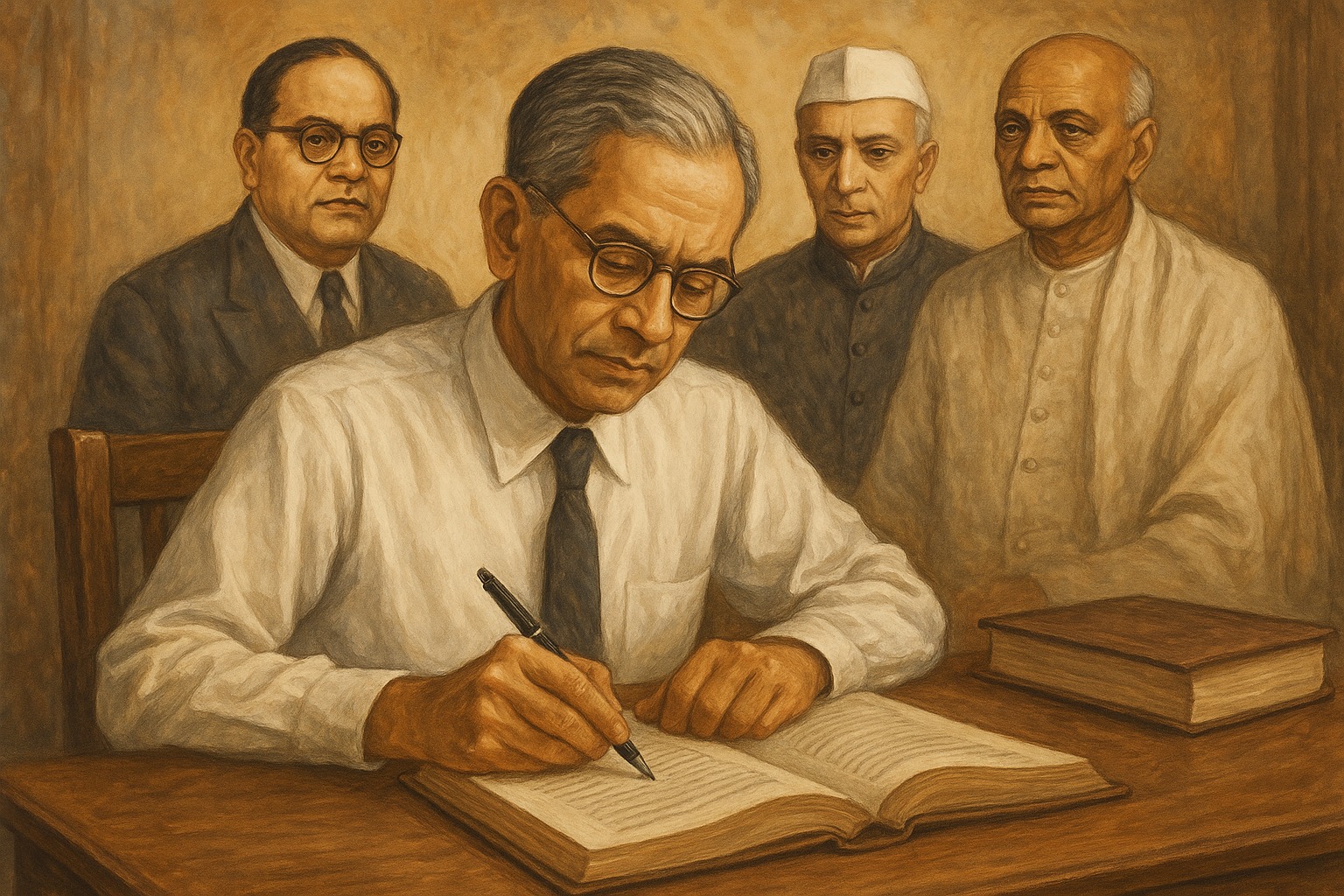
The ongoing Presidential reference before the Supreme Court on governors’ deadlines is being watched with intensity across India. Yet behind the heated arguments lies a forgotten moment in history: the vision of B.N. Rau, the Constitutional Adviser whose guidance shaped the foundations of India’s democratic framework. His choices, often overlooked in contemporary debates, remind us that constitutional silences were not accidents but deliberate guardrails to protect federal balance.
As the tricolor waves above the Supreme Court dome, this reference drags us back to Rau’s pragmatic approach. What he left unsaid may hold as much weight as what the Constituent Assembly finally codified. For India today, revisiting Rau’s forgotten choice is not nostalgia—it is necessity.
Who Was B.N. Rau?
B.N. Rau was appointed as the Constitutional Adviser to the Constituent Assembly in 1946. Tasked with preparing the initial draft, Rau studied global constitutions and worked closely with Dr. B.R. Ambedkar, Jawaharlal Nehru, and Sardar Patel. His draft provided the bedrock for debates that followed in the Assembly.
Unlike the fiery rhetoric of politicians, Rau’s contribution was methodical, rooted in comparative constitutional law. His emphasis on balancing executive authority with legislative primacy echoes in today’s disputes, including the controversy around governors’ powers that has led to the current Presidential reference.
(Earlier, we explored the role of advisers and framers in our feature on Constitutional Crises in India.)
Rau’s Deliberate Silences
One of Rau’s most striking decisions was not to prescribe rigid deadlines for constitutional authorities, including governors. His reasoning was simple: flexibility was essential in a diverse, federal system.
Critics now argue that this silence has enabled misuse, with governors delaying assent to bills. Yet Rau may have anticipated that binding every constitutional role with timelines could weaken the adaptability of governance. In his vision, constitutional morality, rather than mechanical deadlines, would guide high offices.
The Current Debate and Its Echoes
The Supreme Court bench, while examining whether governors should face mandatory deadlines, is essentially grappling with Rau’s forgotten choice. Should silence be filled by judicial guidelines, or does that risk rewriting the Constitution?
States complain of legislative paralysis when governors delay assent. The Centre insists governors are not ceremonial rubber stamps. These opposing arguments mirror Rau’s challenge: ensuring checks without stifling constitutional roles.
(In our analysis of Governor versus State Government Clashes, we highlighted how delays have sparked political crises in recent years.)
Reactions Beyond the Courtroom
- State Leaders: Many chief ministers welcome the idea of fixed timelines, calling it essential to protect democracy.
- Union Representatives: Argue that any reform must come through Parliament, not judicial fiat.
- Citizens: Increasingly frustrated, they view the issue less as legal nuance and more as governance failure.
This divergence underlines why Rau’s wisdom still matters. He believed that institutions would work if guided by good faith—a principle that seems fragile in today’s polarized politics.
The Bigger Picture: Federalism at the Crossroads
India’s federalism is defined by creative tension between states and the Centre. The Presidential reference is not just about governors; it is about whether constitutional silences can still serve as instruments of balance.
Rau’s decision to leave gaps was not weakness but foresight. Yet, the political misuse of such spaces has led to judicial intervention. The question now is whether India needs Rau’s flexibility or Ambedkar’s rigidity to safeguard democracy.
(For context, our editorial on Federal Balance in India showed how institutions adapt when politics strains constitutional boundaries.)
Editorial Perspective
At Behind The Headlines, we argue that the Supreme Court must walk a fine line. Filling every constitutional silence with judicial directions risks reducing the Constitution into an administrative manual. But ignoring misuse invites erosion of democracy.
Rau’s forgotten choice was a bet on constitutional morality. The Presidential reference today is a test of whether that bet still holds.
Conclusion
Day 9 of the hearings has done more than examine governors’ deadlines—it has resurrected the ghost of B.N. Rau. His silences were meant to inspire trust, not exploitation. Whether the Supreme Court honors or overrides that vision will determine how India’s democracy evolves in the coming decades.
Related Posts



Stay Informed With the Latest & Most Important News
Previous Post
Next Post


Advertisement







Advertisement
