

Now Reading: India-US Relations: Modi’s Praise for Trump’s Gaza Move Signals a New Diplomatic Balancing Act
-
01
India-US Relations: Modi’s Praise for Trump’s Gaza Move Signals a New Diplomatic Balancing Act

India-US Relations: Modi’s Praise for Trump’s Gaza Move Signals a New Diplomatic Balancing Act

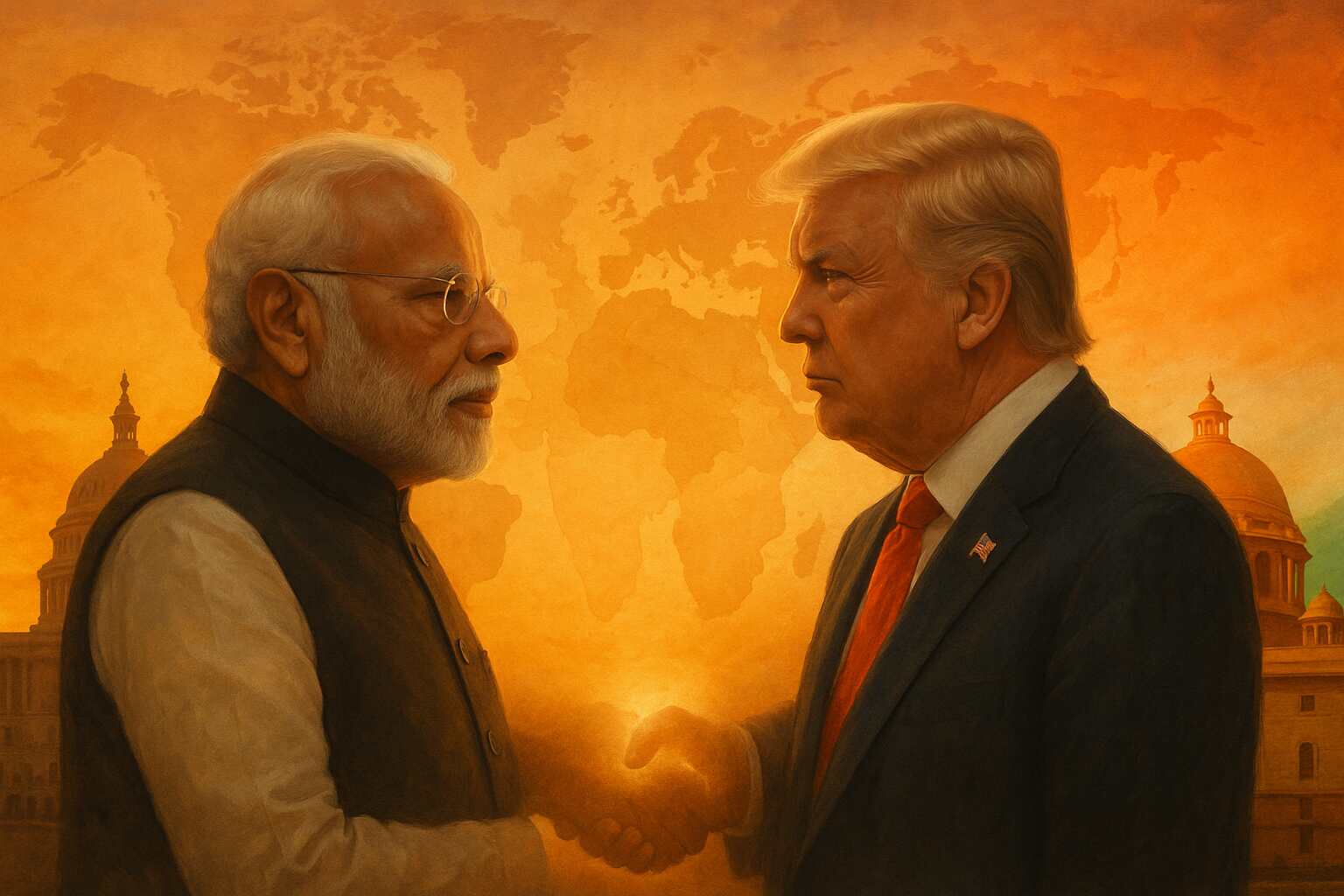
India’s diplomatic chessboard is once again witnessing a critical turn. As Prime Minister Narendra Modi publicly hailed former US President Donald Trump’s Gaza move during a recent address, it stirred both curiosity and speculation within political and strategic circles. The timing of the praise — amid fresh attempts to repair India-US ties strained by recent policy frictions — has added layers of meaning to India’s global outreach.
The remark, brief yet deliberate, came as India works to balance its relations with Washington while preserving its independent stance on international crises like Gaza and Ukraine. Modi’s comment was not just an appreciation of Trump’s policy; it was a strategic signal — one that blends diplomacy, domestic messaging, and geopolitical positioning.
The Context: Cooling Warmth in India-US Relations
After a decade of deepening partnership — from defense deals to technology collaborations — India and the US have hit a phase of cautious recalibration. Sources in both New Delhi and Washington suggest that friction over trade tariffs, visa policies, and human rights remarks has slightly cooled the tone of engagement.
While official statements maintain a cordial front, recent events — such as the visa fee controversy threatening Indian tech talent and subtle differences over Gaza and Ukraine — have tested the resilience of this relationship.
Against this backdrop, Modi’s gesture of recalling Trump’s Gaza decision appears aimed at acknowledging a moment in US policy that aligned with India’s security worldview, especially regarding global terrorism and stability in the Middle East.
👉 Read our analysis on How visa policies are reshaping India-US tech ties.
What Modi Said — And Why It Matters
During his remarks, Modi praised Trump’s “bold and decisive” Gaza move, referencing the 2020 decision that realigned US diplomatic focus in the Middle East. While he did not go into details, the Prime Minister’s comment was seen as an implicit endorsement of decisive foreign policy over reactive diplomacy.
Political observers believe the statement served three purposes:
- Reassurance to the US lobby — especially those close to Trump, that India maintains respect for American leadership regardless of administration changes.
- Domestic signaling — to portray strong, consistent leadership on global issues.
- Strategic outreach — reinforcing India’s identity as a pragmatic power, willing to engage with all sides to protect national interests.
Behind the Optics: Balancing Biden and Trump
Diplomatically, Modi’s statement arrives at a delicate time. The Biden administration has been pushing India for stronger commitments on democratic values, climate cooperation, and sanctions compliance. Meanwhile, India has maintained a policy of strategic autonomy, engaging with Russia and Iran where national interests dictate.
By recalling Trump’s “Gaza moment,” Modi sent an unmistakable message: India respects decisive leadership, not ideological alignment.
It’s a gentle reminder that India values sovereignty in foreign affairs, regardless of shifts in US domestic politics.
👉 Also read: Modi, BRICS, and Trump: The Geopolitical Gamble Behind India’s Balancing Act.
The Geopolitical Layer: Why Gaza Still Matters
Gaza remains a fault line in global politics. India’s position has evolved from early pro-Palestinian solidarity to a balanced approach recognizing both Palestinian aspirations and Israel’s security needs.
Trump’s Middle East policy — controversial in Washington — resonated in New Delhi’s corridors of power for one reason: it prioritized national interest and stability over moral posturing.
By citing Gaza, Modi may have intended to highlight the importance of decisive conflict resolution, something India has long advocated, whether in South Asia or West Asia.
Domestic Resonance: The Political Optics at Home
On the home front, the comment reinforces the image of Modi as a global statesman unafraid of unconventional diplomacy.
Supporters see it as a sign of confidence — that India is now strong enough to appreciate, critique, and recalibrate its partnerships without external pressure.
Opposition voices, however, argue that such statements risk alienating the current US administration or appearing politically motivated in a year when both India and the US are eyeing critical elections.
Still, the move aligns with Modi’s established pattern — using global references to reinforce domestic narratives of strength, independence, and national pride.
Washington’s Reaction and Strategic Circles’ Response
While there has been no official response from the US State Department, analysts in Washington have read the statement as a “soft diplomatic nudge” rather than a provocation.
Former diplomats interpret it as Modi’s way of keeping all channels open — recognizing that a Trump comeback in 2025 is still plausible.
“India cannot afford to appear tilted towards any single camp,” one Washington-based India expert said. “By appreciating Trump, Modi maintains balance while reminding the Biden administration that India remains a sovereign decision-maker.”
The Economic Undercurrent
Beyond politics, trade and technology continue to form the backbone of India-US relations. Despite periodic disagreements, bilateral trade crossed $200 billion in 2024, with sectors like defense tech, digital payments, and green energy expanding fast.
However, ongoing disputes — such as the $100K visa fee issue affecting Indian IT workers and tariff pressures on solar equipment — underline the complexity of this partnership. Modi’s statement could also be a subtle negotiation cue, highlighting India’s expectation of respect and reciprocity in global partnerships.
👉 Related analysis: US Visa Fee Shock and Its Impact on Indian Tech Talent.
Trump’s Gaza Move: Why It Resonates in New Delhi
Trump’s controversial decision to recognize Jerusalem as Israel’s capital and shift the US embassy there was globally criticized. Yet, in Indian strategic circles, it was viewed as a lesson in clarity and conviction.
India, which has maintained strong ties with both Israel and Palestine, saw merit in Trump’s “no-ambiguity approach.” It matched India’s own evolving foreign policy — prioritizing security, clarity, and mutual benefit over ideological commitments.
By revisiting that decision, Modi effectively endorsed decisive diplomacy over consensus paralysis.
The Bigger Picture: India’s 2025 Foreign Policy Vision
As India approaches major global milestones — including hosting the G20 follow-up dialogues and expanding BRICS partnerships — the government is keen to project a confident, self-reliant, and assertive foreign policy posture.
This year, the focus has been on three pillars:
- Strategic Autonomy – Balancing relations between East and West without compromising sovereignty.
- Economic Diplomacy – Turning trade into leverage for geopolitical stability.
- Narrative Building – Establishing India as a “voice of reason” in polarized global debates.
Modi’s latest remark fits neatly within this framework — a reminder that India engages with the world on its own terms.
What This Means Going Forward
For India, the road ahead is about pragmatic flexibility. Whether it’s dealing with Trump’s America or Biden’s Washington, the core of India’s policy remains unchanged — protect interests, maintain balance, and avoid dependency.
For the US, the message is equally clear: India’s partnership cannot be transactional; it must be transformational.
As both nations navigate complex issues like defense technology sharing, supply chain realignments, and energy cooperation, Modi’s nuanced diplomacy is likely to keep India’s options open — with a message rooted in sovereignty, not subservience.
Conclusion
Prime Minister Modi’s renewed praise for Donald Trump’s Gaza decision is far more than a passing remark — it’s a reflection of India’s evolving foreign policy confidence. As the world watches Washington’s next political chapter unfold, New Delhi is quietly scripting its own — guided by interest, independence, and insight.
The India-US partnership remains one of the most consequential in global geopolitics. Whether the tone ahead is transactional or transformational will depend on how both sides interpret gestures like this — not as provocation, but as opportunity.
Related Posts


Stay Informed With the Latest & Most Important News


Advertisement






Advertisement
