

Now Reading: Blue Origin scrubs launch of NASA’s ESCAPADE mission to Mars
-
01
Blue Origin scrubs launch of NASA’s ESCAPADE mission to Mars


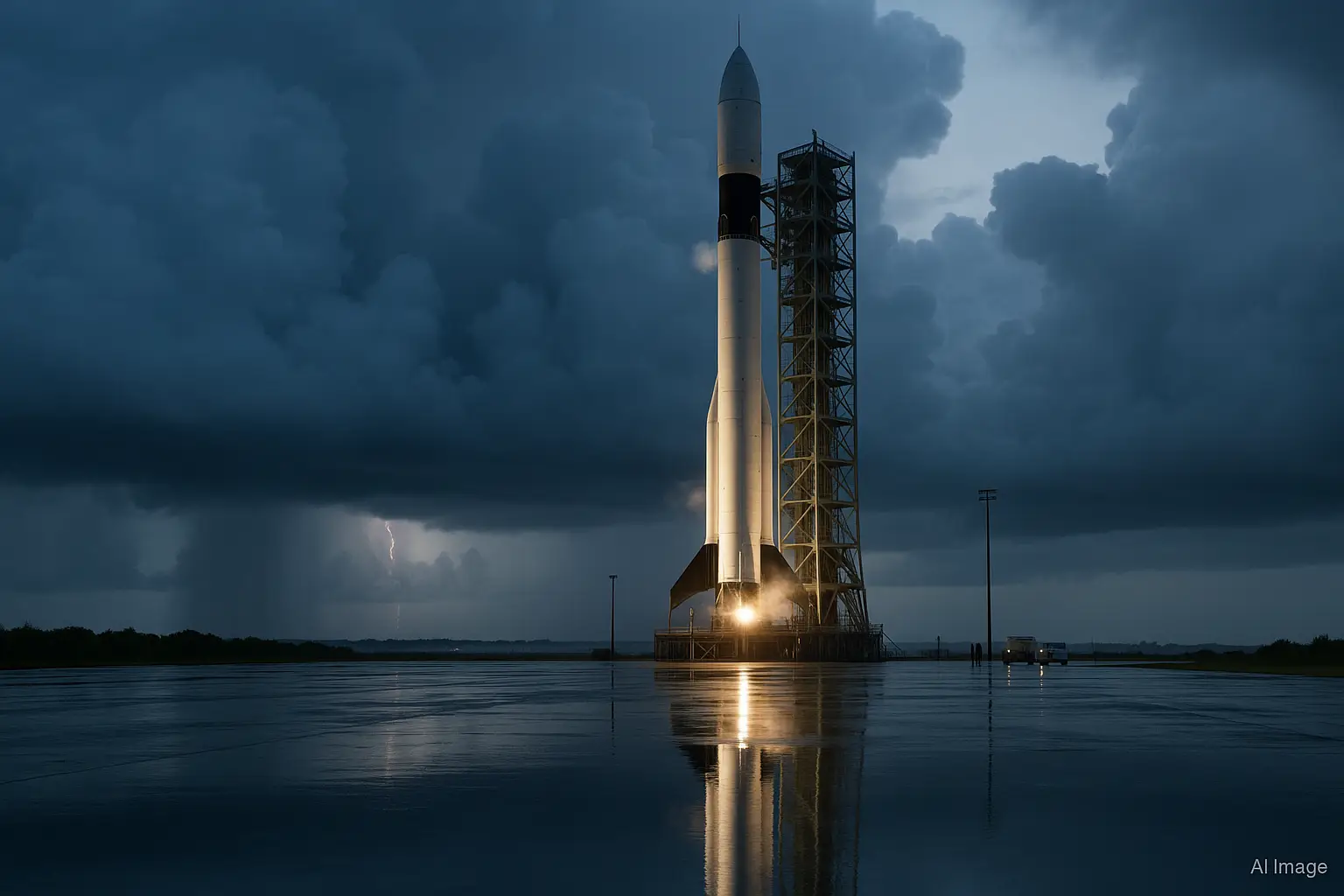
The Editorial Team of Behind The Headlines reports that Blue Origin has delayed the launch of ESCAPADE — a dual-spacecraft mission by NASA bound for Mars. The mission, to be carried by Blue Origin’s heavy-lift rocket New Glenn from Cape Canaveral, was scrubbed after weather conditions violated launch-safety rules. This postponement delays Mars-exploration science and highlights the challenges facing commercial launches.
Details and Background
The ESCAPADE mission consists of two identical small spacecraft, aptly named Blue and Gold, built by Rocket Lab for NASA and led by UC Berkeley Space Sciences Laboratory. The goal: study how Mars’ magnetosphere and atmosphere respond to solar wind and other space-weather factors.
Blue Origin’s New Glenn rocket was set to launch this mission from Launch Complex 36 at Cape Canaveral. The company had previously conducted its inaugural New Glenn flight earlier in 2025.
On the scheduled launch day, meteorologists on-site tallied a high chance of violating the “cumulus-cloud rule” — a weather guideline that prohibits flight through certain cloud formations for safety. As a result, the launch was scrubbed and rescheduled for a later date.
Analysis
This delay serves as a reminder that no matter how advanced rockets become, they remain at the mercy of Earth’s weather. For a mission as carefully timed as ESCAPADE—aimed at studying Mars over a specific trajectory—the scheduling pressure is significant.
From a commercial-space perspective, this is also a test of Blue Origin’s capability to reliably deliver high-stakes payloads. Launches of large rockets like New Glenn carry heavy expectations—both for mission success and for the rocket’s performance (including reusable features). Every delay or hiccup can affect confidence from customers and government agencies.
In terms of NASA’s science timeline, the postponement may compress follow-on scheduling or force adjustments in Mars entry windows, orbital insertion plans, and data-collection campaigns. It may not jeopardise the mission entirely but could reduce margin for error.
Reactions and Statements
Blue Origin issued a statement saying: “Today’s NG-2 launch is scrubbed due to weather, specifically the cumulus cloud rule. We’re reviewing opportunities for our next launch attempt based on forecasted weather.”
NASA’s team at UC Berkeley acknowledged the delay and emphasised that safety and mission integrity take precedence over schedule. Internal commentary highlights that while delays are regrettable, they are preferable to forcing a launch in sub-optimal conditions.
Bigger Picture and Future Impact
The ESCAPADE mission is part of NASA’s push to leverage smaller, lower-cost missions (the SIMPLEx programme) to answer key planetary science questions.
A successful launch would mark a milestone: a commercial heavy-lift rocket delivering a planetary mission to Mars. Such success would strengthen the role of private firms in deep-space exploration, potentially reducing cost and turnaround time for future Mars missions.
However, recurring delays or failures could slow down the commercialisation trend or make NASA more cautious in its contracting. For Blue Origin, demonstrating reliability is vital to compete in the heavy-lift market dominated by other players.
For Mars science, the data that ESCAPADE will gather on how Mars lost much of its atmosphere, and how its magnetic environment works, could inform future human missions and help us understand planetary habitability. The delay means that timeline is shifted, and the knock-on effects may ripple into subsequent science initiatives.
Conclusion
The Editorial Team of Behind The Headlines notes that the postponement of the ESCAPADE launch by Blue Origin underscores both natural and commercial risks in space exploration. While the mission remains on track in concept, time is now the resource under pressure. As the clock ticks toward the next launch attempt, watchers will be closely monitoring weather windows, rocket readiness, and the commercial-space ecosystem’s performance. When the twin probes eventually lift off, they will carry not just instruments for Mars—but broad expectations for private-sector capability in deep-space science.
Internal Links
- For a deeper look at how NASA is working with private companies: Behind The Headlines – “How NASA’s Commercial Partnerships Are Changing Spaceflight”
- On the topic of reusable rockets and heavy-lift: Behind The Headlines – “Reusable Rockets: Are They Living Up to the Hype?”
Related Posts



Stay Informed With the Latest & Most Important News
Previous Post
Next Post


Advertisement









Advertisement
