

Now Reading: Friendship or Fallout? US-India Ties Enter the Most Dangerous Phase Yet
-
01
Friendship or Fallout? US-India Ties Enter the Most Dangerous Phase Yet


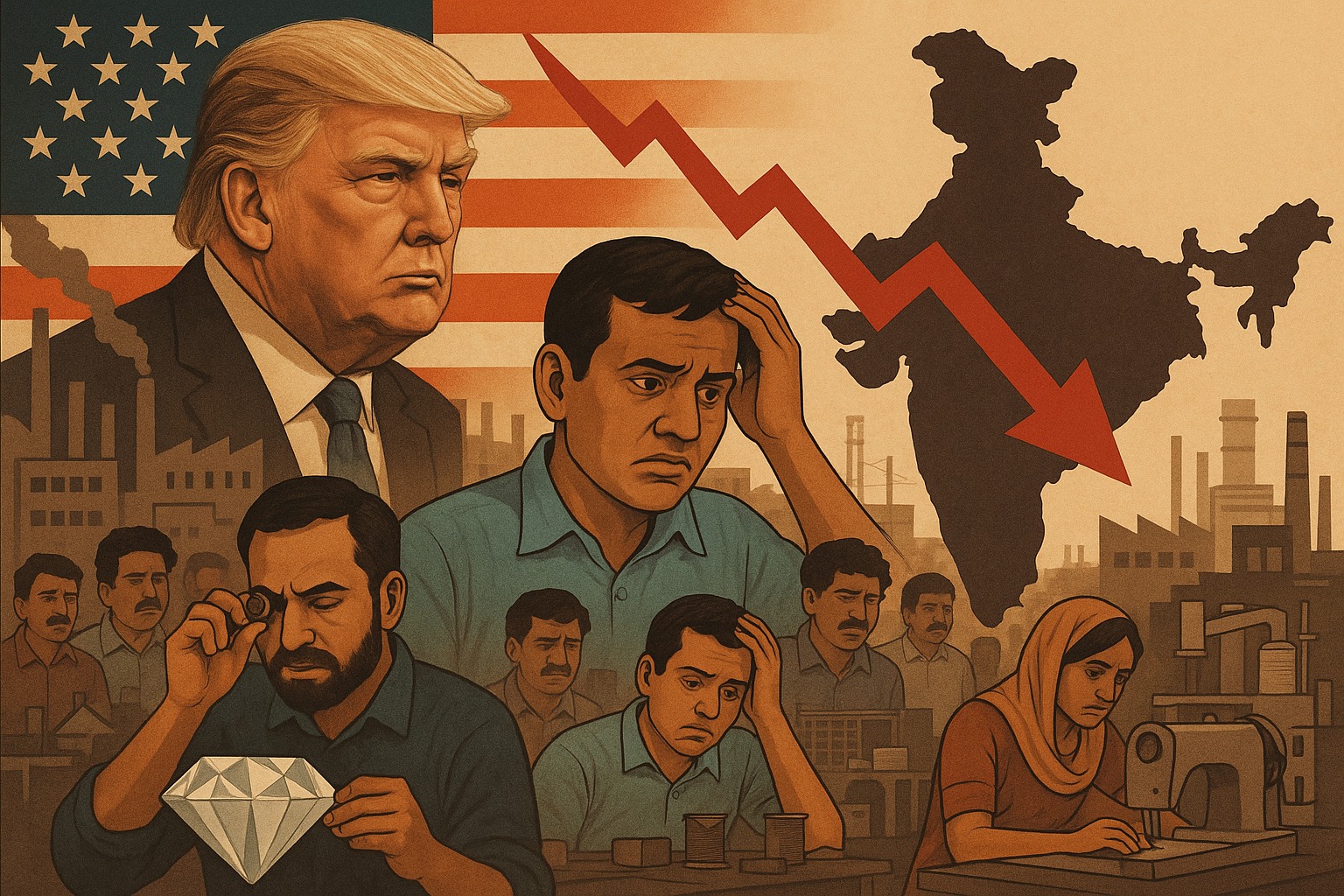
India woke up to a seismic jolt in global trade as U.S. President Donald Trump announced the doubling of tariffs on Indian exports to 50 percent, the steepest ever levied on the country. The decision, justified by Washington as a punitive step for India’s continued import of Russian oil, has left policymakers, exporters, and workers grappling with the immediate and long-term fallout.
A Blow to India’s Export Backbone
The U.S. is one of India’s largest trading partners, accounting for over $86 billion in annual exports. Trump’s sudden tariff escalation places nearly 70 percent of Indian goods to the U.S. under severe strain—including textiles, leather, shrimp, engineering goods, furniture, and especially diamonds and jewelry. Analysts predict export volumes could shrink by almost half, pushing revenues down from nearly $87 billion to below $50 billion within a year.
Surat: The First Casualty
No city illustrates the crisis more starkly than Surat, the global hub for diamond cutting and polishing. Already battling Western restrictions on Russian-origin diamonds, the city’s industry now faces crippling tariffs that make exports uncompetitive. Factories are reporting mass order cancellations, and thousands of artisans are losing jobs overnight. The ripple effect is being felt across Gujarat’s economy, where entire families depend on the diamond trade.
Political and Diplomatic Tensions
The tariffs have cast a dark shadow over the once-promising U.S.–India strategic partnership. Trade talks have stalled, and diplomatic channels are growing tense. The move also exposes a new geopolitical fault line: Washington’s attempt to enforce compliance on India’s Russia policy through economic punishment. For New Delhi, the challenge is to safeguard sovereignty without jeopardizing economic stability.
India’s Countermeasures
The government in New Delhi has launched urgent steps to cushion the blow:
- Tax relief and GST cuts to ease the burden on manufacturers.
- Credit and liquidity support from the Reserve Bank of India for affected sectors.
- Accelerated negotiations for free trade agreements with the United Kingdom, European Union, and New Zealand to diversify export markets.
- A renewed call for Atmanirbhar Bharat (self-reliant India) to reduce dependence on external markets and strengthen domestic industries.
Despite the crisis, officials highlight that India’s fundamentals remain strong. A recent sovereign rating upgrade and steady growth in IT services, fintech, and healthcare exports are bright spots that could offset part of the damage.
The Human Cost
Beyond trade statistics, the true impact is on livelihoods. From garment workers in Noida to shrimp farmers in Andhra Pradesh, and from diamond polishers in Surat to textile weavers in Tamil Nadu, millions face wage cuts, layoffs, or total loss of income. For these families, Trump’s tariff war is not a geopolitical headline—it is a matter of survival.
Editorial Perspective
The latest tariff escalation is not merely a clash of economic interests but a stress test of India’s resilience. It underscores the fragility of global supply chains, the risks of overdependence on one market, and the unpredictable nature of international politics in the Trump era. India now faces a choice: to retreat into protectionism or to reinvent its economic playbook with bold reforms, new alliances, and stronger self-reliance.
Related Posts

Stay Informed With the Latest & Most Important News
Previous Post
Next Post


Advertisement







Advertisement