

Now Reading: From Pakistan to Nepal, India’s Neighbours Are in Crisis — What It Means for Delhi
-
01
From Pakistan to Nepal, India’s Neighbours Are in Crisis — What It Means for Delhi

From Pakistan to Nepal, India’s Neighbours Are in Crisis — What It Means for Delhi

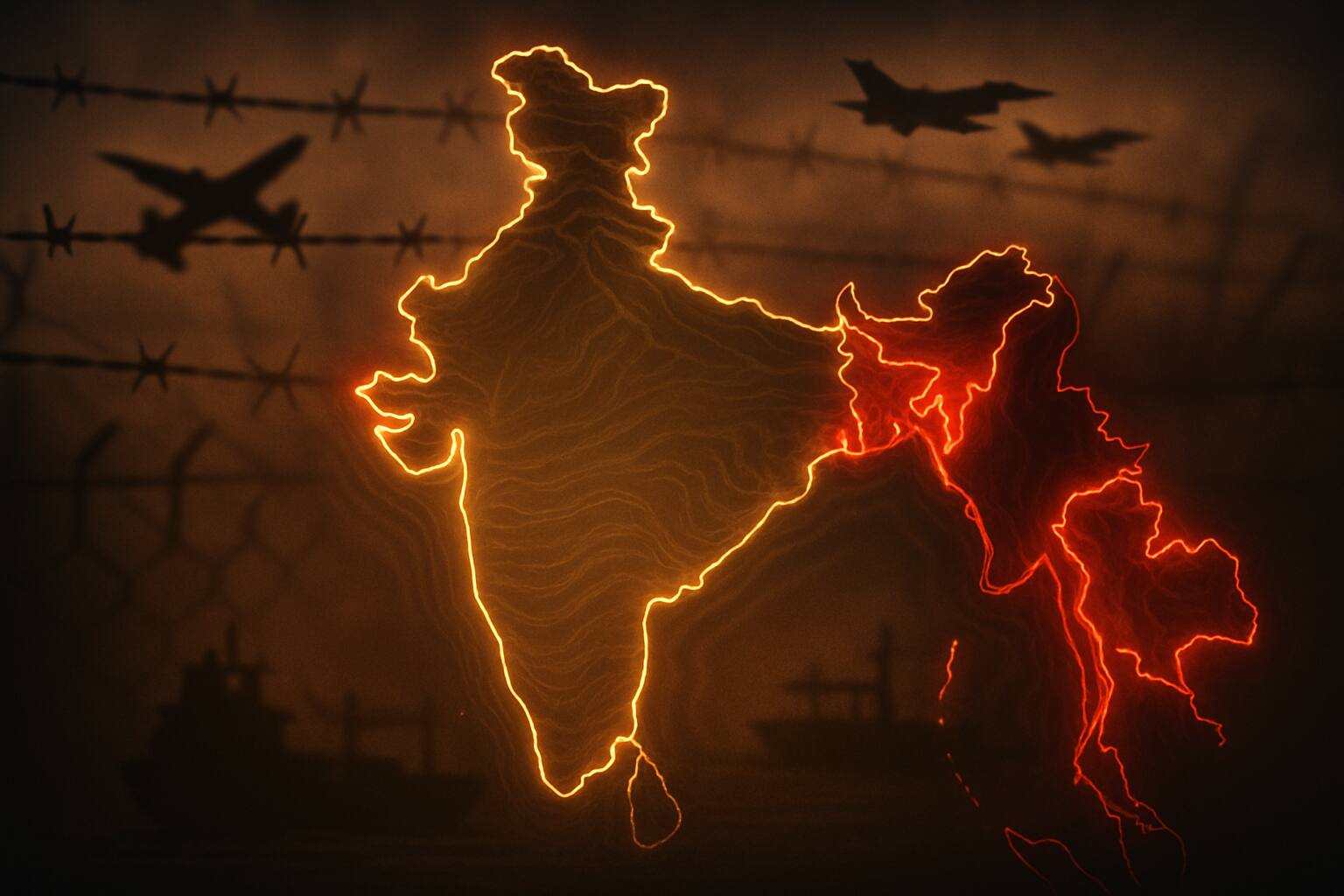
India’s geography has always been its destiny. Sharing borders with countries like Pakistan, Nepal, Bangladesh, Bhutan, Myanmar, Sri Lanka (maritime), and China, New Delhi sits at the centre of South Asia’s shifting security landscape. These borders are not just lines on a map but frontiers of trade, migration, culture, and conflict.
In recent months, the region has witnessed political upheaval, economic shocks, and rising nationalism. For India, this is more than a diplomatic test — it is a reckoning. Instability around its borders directly affects its economy, security, and global ambitions. Can India afford to remain a regional stabilizer, or is it being dragged into a crisis not of its own making?
Pakistan: A Perennial Powder Keg
No neighbour has shaped India’s security calculations as deeply as Pakistan. Its internal politics remain fragile, with frequent power struggles between the military, judiciary, and civilian leadership. Add to this an economic meltdown — high inflation, shrinking foreign reserves, and external debts — and the situation is combustible.
For India, the risks are twofold:
- Terror spillover: Even when Pakistan faces domestic crises, militant outfits find ways to regroup. Jammu and Kashmir often becomes the pressure point.
- China factor: Pakistan’s strategic closeness with Beijing under the China-Pakistan Economic Corridor (CPEC) creates additional security layers that India cannot ignore.
India’s strategy so far has been defensive engagement: keeping channels open but refusing to normalize ties until Pakistan reins in cross-border terror. Yet, given Pakistan’s instability, India must also brace for sudden escalations or refugee inflows.
Explore India’s evolving Pakistan policy
Nepal: A Friend at Risk of Drifting
Historically tied by open borders and cultural exchanges, Nepal remains deeply intertwined with India. Yet in recent years, Kathmandu has shown signs of balancing between India and China. Political instability, with governments frequently collapsing, has left Nepal vulnerable to external influence.
China’s infrastructure investments in Nepal may appear tempting, but they come with strategic strings attached. For India, the concern is that Chinese projects near the border can have military as well as economic implications.
On the ground, India continues to be Nepal’s largest trade partner and energy provider. However, growing anti-India sentiment, fuelled by nationalist politics, has complicated relations. Unless managed carefully, India risks losing traditional goodwill in Nepal.
Bangladesh: Friend Today, Uncertainty Tomorrow
Dhaka has been India’s strongest partner in South Asia in recent years. The Sheikh Hasina government worked closely with New Delhi on counterterrorism, connectivity, and trade. However, Bangladesh is also facing political turbulence.
The opposition has accused the government of authoritarianism, while rising Islamic radicalism threatens the liberal fabric of the country. India also worries about the illegal migration issue, particularly in Assam and West Bengal, where demographic shifts can trigger domestic tensions.
On the economic front, India and Bangladesh have strengthened energy and transport links. Yet, China’s aggressive courting of Dhaka — through ports, infrastructure loans, and military supplies — has the potential to tilt balances. For New Delhi, the message is clear: friendship with Bangladesh must be actively nurtured, not taken for granted.
Read more on India-Bangladesh ties
Bhutan: A Reliable Ally, But A Fragile One
Bhutan continues to be one of India’s most dependable partners. However, its own economic reliance on India, combined with rising youth aspirations, creates a subtle vulnerability. While Thimphu has not embraced China the way Nepal or Bangladesh has, Beijing has increased its diplomatic charm offensive.
India’s focus should be to ensure Bhutan’s youth do not see dependency as suffocation. Investments in education, green energy, and sustainable tourism are ways to strengthen this bond.
Myanmar: The Forgotten Neighbour on Fire
India’s eastern frontier with Myanmar is witnessing turbulence of a different kind. Since the 2021 military coup, Myanmar has been in turmoil. Rebel groups are gaining strength, and instability spills across the border into India’s Northeast.
For New Delhi, this is both a security and humanitarian challenge. Refugees are crossing into Mizoram and Manipur, while insurgent groups use the porous border to regroup. At the same time, China has deepened its influence in Myanmar, especially through infrastructure projects and military supplies.
India faces a delicate balancing act — engaging the junta to protect its strategic projects like the Kaladan corridor, while also supporting democratic aspirations.
Sri Lanka and the Maritime Dimension
Though not a land neighbour, Sri Lanka plays a crucial role in India’s maritime strategy. The 2022 economic collapse in Colombo showed how fragile South Asian economies can be. China’s port investments in Sri Lanka remain a strategic concern for India.
Maritime security, trade routes, and Indian Ocean geopolitics mean that instability in Sri Lanka directly affects India’s southern flank.
The China Shadow Over South Asia
No discussion of India’s neighbourhood is complete without mentioning China. Beijing’s Belt and Road Initiative (BRI) projects in Pakistan, Nepal, Bangladesh, and Sri Lanka aim not just at economic influence but also military reach.
From Hambantota Port in Sri Lanka to CPEC highways in Pakistan, China’s encirclement strategy — sometimes referred to as the “string of pearls” — seeks to challenge India’s traditional dominance in the region.
India must respond with a mix of diplomacy, economic integration, and regional leadership. Yet this requires resources and political will, both of which are stretched thin.
Domestic Repercussions of an Unstable Neighbourhood
India’s border challenges are not confined to foreign policy — they directly impact domestic politics.
- Refugee influxes strain resources in border states.
- Smuggling, trafficking, and cross-border crime increase security risks.
- Cultural and linguistic ties can inflame political tensions within India, especially during elections.
Thus, managing neighbourhood instability is not just a matter of diplomacy but also of safeguarding India’s internal cohesion.
Opinion: Why India Cannot Afford Complacency
From this editorial desk at Behind The Headlines, the argument is straightforward: India’s future as a global power depends on how it manages its immediate neighbourhood. Big speeches at the G20 or BRICS mean little if instability festers next door.
The border crisis is not a distant possibility — it is unfolding in real time. Refugee camps in the Northeast, terror infiltration in Kashmir, political drama in Dhaka, and Beijing’s footprints in Kathmandu all point to a regional ecosystem in flux.
India must adopt a three-pronged approach:
- Assertive Diplomacy: Clear red lines with neighbours, combined with proactive engagement.
- Economic Integration: Stronger trade, energy grids, and digital networks to bind South Asia with India at its centre.
- Security Modernization: Enhanced border infrastructure, technology-driven surveillance, and better coordination with states.
Without this, India risks being reactive rather than strategic.
The Bigger Picture: India’s Global Ambitions at Stake
India aspires to be a voice of the Global South, a counterweight to China, and a partner to the West. Yet none of this will be credible if its neighbourhood crumbles.
South Asia is India’s testing ground. If New Delhi cannot stabilize its periphery, it will always be seen as a power limited by geography. A confident, secure India begins with secure borders — not just physically, but politically and economically.
Conclusion: A Reckoning India Cannot Postpone
India’s reckoning with its dangerous neighbourhood is both urgent and unavoidable. While global headlines focus on wars in Europe or tensions in the South China Sea, South Asia simmers with crises that could redefine India’s rise.
This is not just a borderline crisis; it is a defining challenge for the world’s largest democracy. Whether India emerges as a regional stabilizer or gets entangled in endless firefighting depends on choices made today.
The message is clear: India cannot outsource its security to chance. Its neighbourhood is a mirror, and the reflection right now is troubling. But with decisive leadership, the picture can change.
Related Posts


Stay Informed With the Latest & Most Important News
Previous Post
Next Post


Advertisement




Advertisement
