

Now Reading: Keeping Four GST Slabs Was Not BJP’s Decision, Says Finance Minister Nirmala Sitharaman Amid Opposition Attack
-
01
Keeping Four GST Slabs Was Not BJP’s Decision, Says Finance Minister Nirmala Sitharaman Amid Opposition Attack

Keeping Four GST Slabs Was Not BJP’s Decision, Says Finance Minister Nirmala Sitharaman Amid Opposition Attack

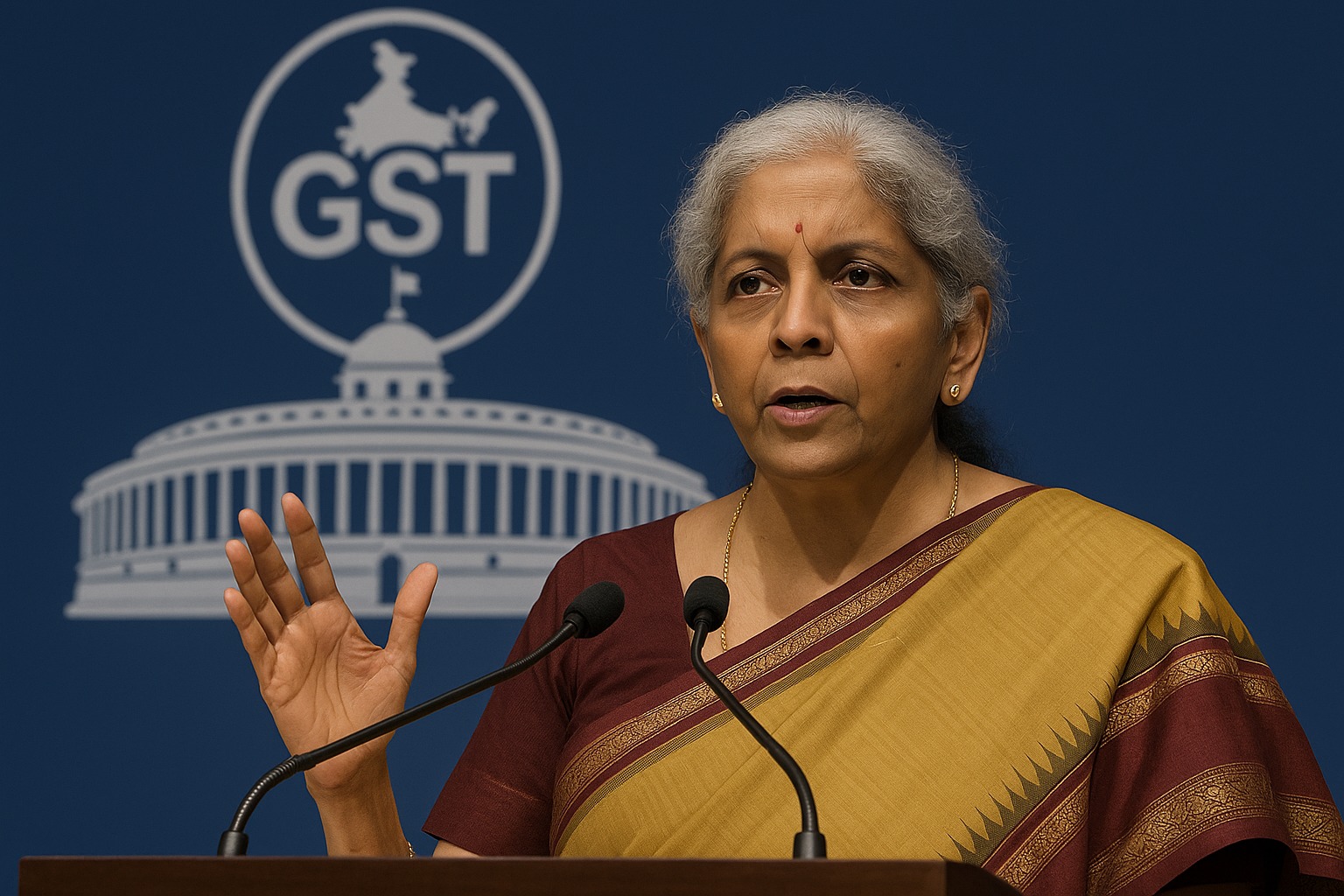
India’s Goods and Services Tax (GST) has once again become the center of a heated political battle. Finance Minister Nirmala Sitharaman, responding to criticism from the Opposition, clarified that the decision to retain four GST slabs was not taken by the Bharatiya Janata Party (BJP) alone but was a consensus-based outcome of the GST Council.
In strong remarks aimed at opposition parties, Sitharaman accused them of misleading the public by suggesting that the ruling party unilaterally imposed the slab structure. She emphasized that the GST framework was built on cooperative federalism, with all states participating in shaping the tax regime.
The Editorial Team of Behind The Headlines examines the background of the GST debate, the details of Sitharaman’s statement, and what this ongoing political tussle means for India’s tax reforms.
The GST Structure: A Quick Recap
The GST system, rolled out in July 2017, replaced multiple indirect taxes with a unified tax regime. To balance revenues and affordability, goods and services were divided into different slabs. Currently, there are four key slabs:
- 5% for essential goods and services.
- 12% for items of standard use.
- 18% for most goods and services, considered the “standard rate.”
- 28% for luxury items and sin goods.
In addition, certain goods like gold attract a 3% rate, and some items are exempt altogether.
Opposition’s Criticism
Opposition leaders have consistently argued that the four-slab structure complicates taxation and burdens consumers. Their key points include:
- Multiple slabs create confusion for businesses.
- Essential items often end up being taxed at higher-than-expected rates.
- The BJP government, they allege, has failed to simplify the system despite promises.
Some even claim that a single or two-slab system would have been more efficient and consumer-friendly.
Sitharaman’s Clarification
In response, Sitharaman strongly defended the government’s position, pointing out that the slab structure was not a unilateral BJP decision.
- Council-Based Decision: She highlighted that the GST Council, which includes representatives from all states and political parties, decided on the four-slab model.
- Consensus Framework: Every rate change, she explained, is debated and approved in the Council, making it a collective choice.
- Misleading Claims: Sitharaman accused the Opposition of deliberately spreading misinformation to score political points.
- Shared Responsibility: According to her, states governed by opposition parties were equally part of the process and had supported the slab system at the time of rollout.
Why Four Slabs Were Considered Necessary
Economists and policymakers have argued that India’s economic diversity makes a single-slab system impractical. Sitharaman reiterated similar points:
- Equity: A flat tax rate could disproportionately burden poorer sections of society.
- Revenue Balance: States depend heavily on GST collections to fund welfare schemes.
- Flexibility: Different slabs allow policymakers to adjust tax burdens across sectors.
- Consumer Protection: Essentials like food grains and life-saving drugs are either exempt or kept in the lowest slab.
The four-slab model, despite its complexity, was seen as the most pragmatic compromise during implementation.
The Political Dimension
GST has always been more than just a tax—it is a political battleground.
- The Opposition uses it to highlight alleged inefficiencies and accuse the BJP of mismanagement.
- The government, in turn, points out that the tax was designed in partnership with states and evolved from earlier proposals supported by multiple governments.
- As elections approach, debates around GST often resurface, with parties framing the issue to suit their campaign narratives.
Sitharaman’s sharp remarks underline the government’s strategy to remind voters that GST is a collective policy, not a BJP-driven imposition.
The Challenges of Reform
While GST has streamlined India’s indirect tax system, challenges persist:
- Complexity: Multiple slabs continue to confuse businesses and small traders.
- Revenue Shortfalls: Some states argue that the promised revenue compensation has not been adequately met.
- Compliance Burden: Small businesses face difficulties in filing multiple returns and managing digital systems.
- Evolving Needs: Calls for a simpler, three-slab or two-slab system are growing stronger.
Sitharaman acknowledged these challenges but emphasized that reforms are ongoing and will continue to be discussed in the Council.
Reactions from States
States ruled by both BJP and Opposition parties have historically pushed for flexibility in taxation. For example:
- Some demanded lower rates on consumer goods ahead of festivals.
- Others pressed for higher taxes on luxury items to boost state revenues.
- Agricultural states often argued for exemptions on farm-related inputs.
This patchwork of demands, according to Sitharaman, made a multi-slab system inevitable.
The Road Ahead for GST
Experts believe that while four slabs may remain for now, simplification is likely in the future. Possible changes include:
- Merging the 12% and 18% slabs into a single rate.
- Gradually reducing the 28% slab, limiting it to luxury and sin goods.
- Using technology to make compliance easier for small businesses.
- Greater transparency in Council debates to build public trust.
Sitharaman’s remarks suggest that while simplification is desirable, consensus will remain the cornerstone of GST evolution.
Conclusion
Finance Minister Nirmala Sitharaman’s clarification that the four GST slabs were not a BJP-imposed decision highlights the cooperative nature of India’s federal tax system. Her attack on the Opposition for “misleading claims” underscores the political stakes tied to GST debates.
While the system remains complex, it reflects the diversity of India’s economy and the need to balance revenue generation with affordability. The road to simplification may be gradual, but as Sitharaman emphasized, the responsibility lies with all states and political actors—not just the central government.
The Editorial Team of Behind The Headlines will continue monitoring these debates, ensuring readers receive fact-verified updates on the evolving GST landscape.
Related Posts



Stay Informed With the Latest & Most Important News
Previous Post
Next Post

Advertisement







Advertisement
