

Now Reading: Mahua Moitra Reminds PM Modi of Past Remarks: From ‘Didi O Didi’ to ‘Jersey Cow’ as Debate Over Political Abuses Escalates
-
01
Mahua Moitra Reminds PM Modi of Past Remarks: From ‘Didi O Didi’ to ‘Jersey Cow’ as Debate Over Political Abuses Escalates

Mahua Moitra Reminds PM Modi of Past Remarks: From ‘Didi O Didi’ to ‘Jersey Cow’ as Debate Over Political Abuses Escalates

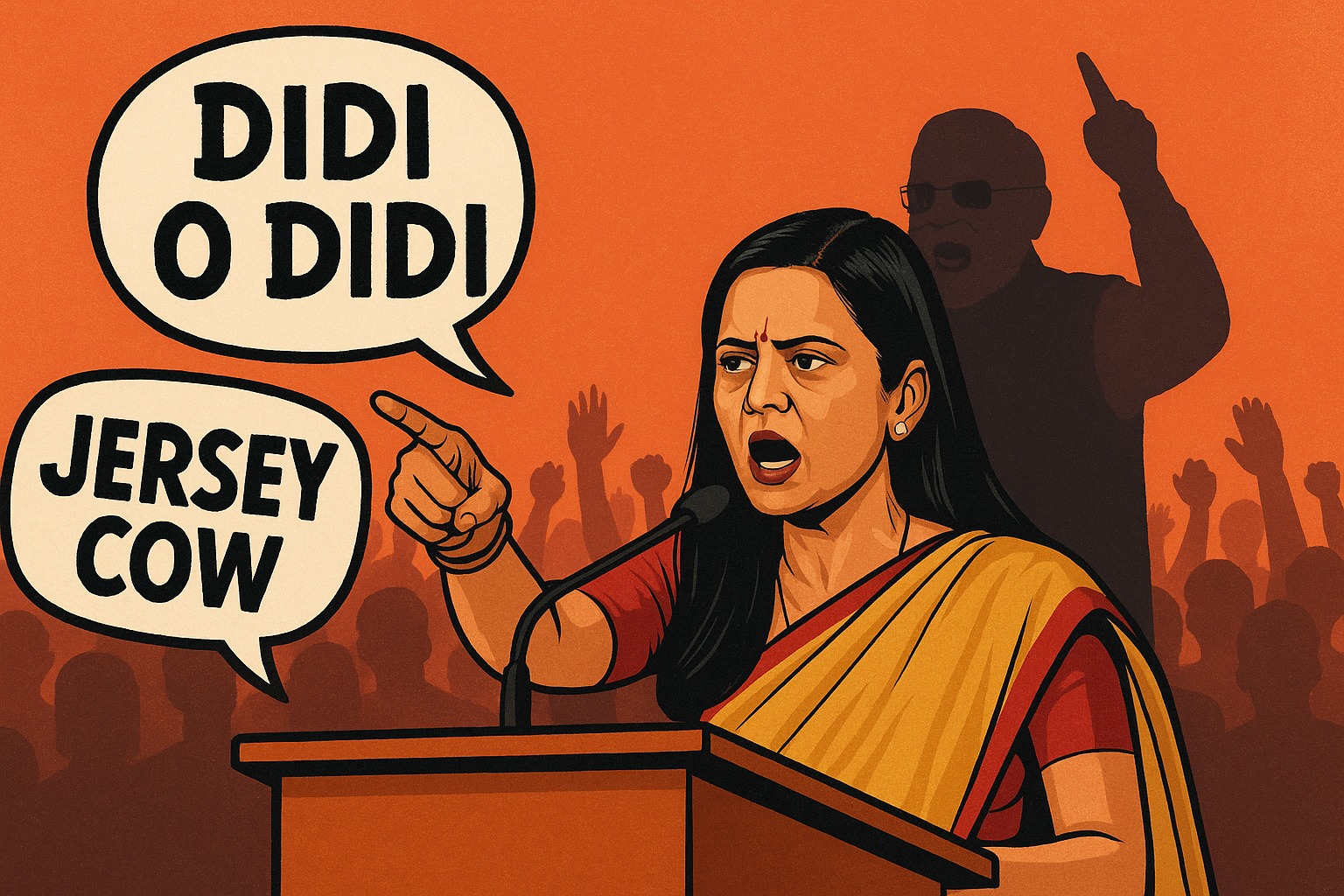
The debate over the use of abusive and derogatory language in Indian politics has flared once again, this time following Prime Minister Narendra Modi’s emotional reaction to an insult directed at his mother. While the Prime Minister condemned such remarks as crossing all limits of decency, Trinamool Congress (TMC) leader Mahua Moitra countered by listing several instances of comments made in the past by Modi himself, suggesting a double standard in political discourse.
The controversy has brought to the forefront questions about the boundaries of political criticism, the weaponization of personal attacks, and the responsibility of leaders in setting the tone for public dialogue.
PM Modi’s Reaction to Comment on His Mother
The trigger for the fresh debate came when the Prime Minister addressed an election rally and expressed deep anguish over derogatory references made about his mother by political rivals. Modi described the abuse as painful and unacceptable, arguing that political battles should remain within the realm of policies and governance rather than descending into personal attacks on family members.
His statement resonated widely with supporters, who shared his emotional appeal across social media platforms, framing it as evidence of the erosion of civility in political campaigns.
Mahua Moitra’s Counterattack
TMC firebrand Mahua Moitra quickly responded, highlighting what she described as the Prime Minister’s own history of using derogatory or mocking language against political opponents. In her remarks, she drew attention to instances where Modi’s public speeches and campaign rhetoric contained remarks that opponents viewed as disrespectful and gender-insensitive.
Among the phrases she recalled were:
- “Didi O Didi” – a jibe frequently directed at West Bengal Chief Minister Mamata Banerjee during the 2021 assembly election campaign, which many women leaders and activists criticized as mocking in tone.
- “Jersey cow” – a comment allegedly made in reference to Congress leader Sonia Gandhi, sparking outrage years ago over its derogatory connotations.
- Other instances where Modi was accused of using words that belittled opponents, particularly women, in the heat of political campaigns.
By bringing these examples forward, Moitra argued that the Prime Minister’s appeal for civility rings hollow unless he also acknowledges and reflects upon his own past remarks.
The Larger Debate: Civility vs. Political Rhetoric
Indian politics has long witnessed fiery language, but in recent years, the use of personal jibes has become increasingly normalized. Leaders from across the spectrum—be it the Bharatiya Janata Party (BJP), Congress, TMC, or regional outfits—have been guilty of deploying sharp and often offensive language to energize supporters.
However, such rhetoric often backfires by:
- Deepening polarization.
- Distracting from substantive policy discussions.
- Lowering the standards of public debate.
- Normalizing verbal aggression in civic life.
The latest clash between Modi and Moitra has revived calls for political parties to collectively establish red lines that prevent family members and personal lives from becoming tools in electoral combat.
Historical Precedents of Verbal Crossfire
Political language in India has never been free of invective. From Indira Gandhi being called names by her rivals to Atal Bihari Vajpayee facing personal criticism in Parliament, the tradition of sharp exchanges is not new. What has changed, however, is the frequency, intensity, and amplification through digital platforms.
Today, a remark made at a local rally can instantly become a nationwide controversy through Twitter, WhatsApp, and television debates. This constant spotlight magnifies offensive language and often keeps the political narrative focused on controversies rather than issues.
Mahua Moitra’s Style of Politics
Mahua Moitra is known for her combative, outspoken style, often willing to confront political giants with pointed words. In Parliament, her speeches have gone viral for their sharpness and clarity, though she has also faced criticism for being too aggressive.
By targeting Modi directly on the question of political civility, Moitra not only defended her party’s stance but also attempted to flip the narrative back on the Prime Minister, portraying him as inconsistent in his appeal for respectful discourse.
BJP’s Response
Leaders from the Bharatiya Janata Party dismissed Moitra’s remarks as politically motivated deflection. They argued that Modi’s words have often been misinterpreted or taken out of context, and that comparing them to outright abuse against his mother is unjustified. BJP spokespersons insisted that personal attacks on family members represent a “red line” that no politician should cross, regardless of party affiliation.
Public Reaction and Social Media Divide
As with most controversies in Indian politics, the public response split sharply along partisan lines:
- BJP supporters amplified Modi’s pain as evidence of opposition cruelty.
- Opposition supporters circulated Moitra’s list of past remarks as proof of hypocrisy.
- Neutral observers expressed disappointment that serious governance issues were sidelined by debates over verbal duels.
Social media hashtags trended for days, with memes, video clips, and opinion polls fueling the narrative battle.
Implications for Political Campaigning
This controversy has implications for how parties approach campaigning in the run-up to elections:
- Shift in narrative: Discussions may focus less on policy and more on who is “more civil” or “more abusive.”
- Rising sensitivity: Leaders may tread carefully, knowing that any slip in language can be weaponized by opponents.
- Opportunity for reform: Parties could seize the moment to set guidelines for respectful campaigning, though past attempts at such self-regulation have rarely succeeded.
Editorial Perspective
The Editorial Team of Behind The Headlines notes that both Modi’s anguish and Moitra’s counterattack highlight the fragility of civility in Indian politics. While it is valid for the Prime Minister to call out offensive remarks against his family, his critics are equally justified in demanding consistency in his own political language.
Ultimately, the credibility of leaders depends not just on their words in moments of pain but also on their conduct in moments of power. Indian democracy deserves better than an endless cycle of verbal duels. Citizens are best served when leaders debate policies, not personalities; governance, not grievances.
Related Posts


Stay Informed With the Latest & Most Important News
Advertisement







Advertisement
