

Now Reading: PM Modi Praises Shubhanshu Shukla, Announces India’s Own Astronaut Pool
-
01
PM Modi Praises Shubhanshu Shukla, Announces India’s Own Astronaut Pool


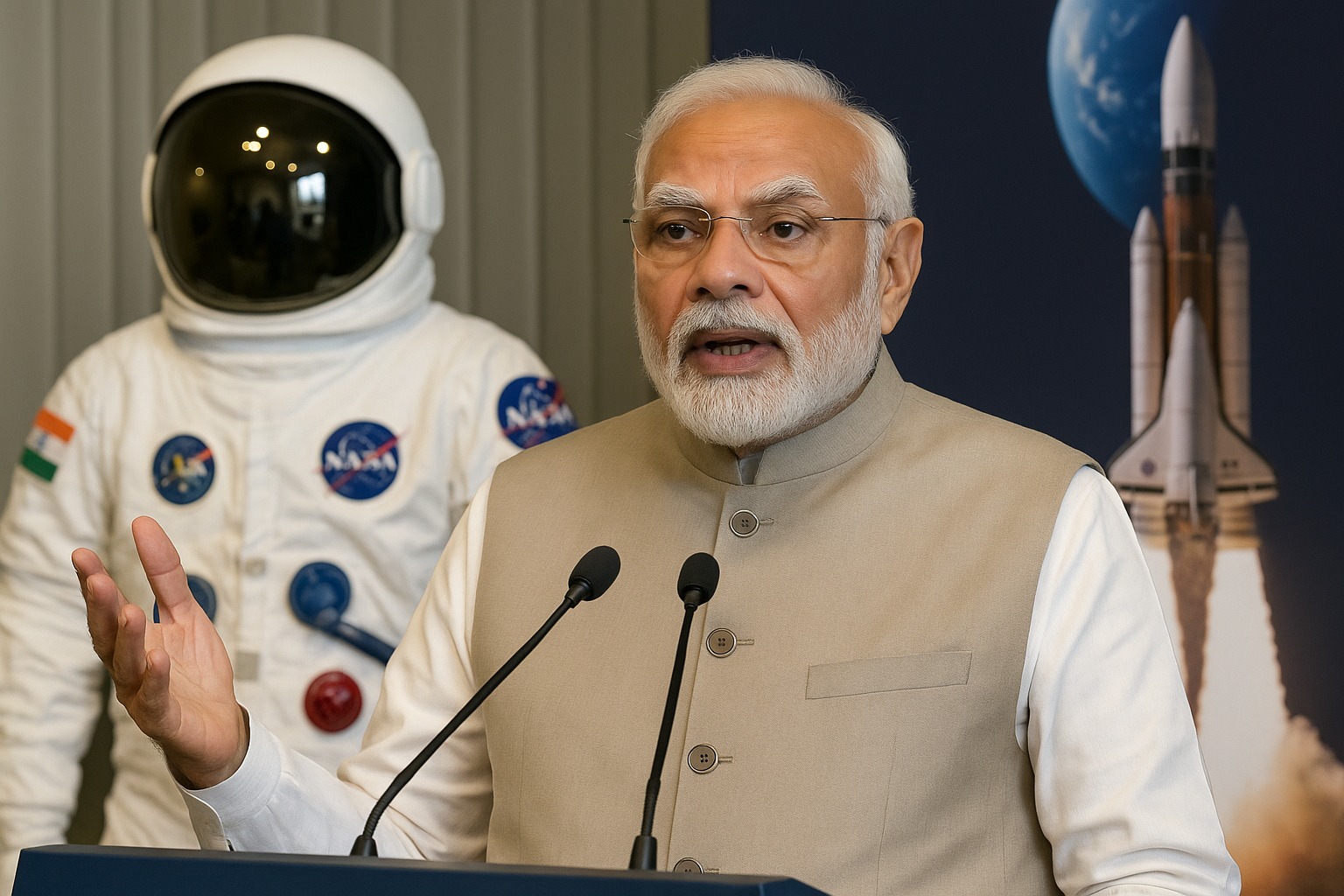
India’s space program witnessed another moment of pride as Prime Minister Narendra Modi lauded the achievement of Shubhanshu Shukla, a young scientist whose recent contribution to space research has been recognized as a breakthrough. Speaking at an event celebrating India’s expanding space ambitions, the Prime Minister not only praised Shukla’s feat but also announced plans to build a dedicated astronaut pool — a step that would mark a decisive leap forward for India’s human spaceflight capabilities.
Who is Shubhanshu Shukla?
Shubhanshu Shukla, a promising researcher associated with India’s space research community, has gained attention for his work in advancing indigenous technologies critical for crewed space missions. His efforts have been highlighted as a symbol of the new generation of Indian scientists who are pushing boundaries in aerospace engineering, propulsion systems, and space mission safety frameworks.
The Prime Minister’s recognition of Shukla’s achievements has elevated him to the forefront of India’s narrative on space exploration, particularly at a time when the country is preparing for its ambitious Gaganyaan mission, which will send Indian astronauts into space aboard an indigenous spacecraft.
PM Modi’s Vision: Building an Astronaut Pool
During his address, Prime Minister Modi emphasized that India cannot rely solely on one-off astronaut training programs. Instead, he announced the government’s intent to establish a structured astronaut pool — a cadre of highly trained individuals who would be prepared for not just Gaganyaan, but also future space missions including lunar, Mars, and deep-space explorations.
This marks a significant policy shift, bringing India closer to nations like the United States, Russia, and China, which maintain long-term astronaut programs. Such a pool would allow India to:
- Continuously train and prepare astronauts for evolving mission requirements.
- Reduce dependency on foreign space agencies for training.
- Build a sustainable ecosystem for human spaceflight within the country.
From Gaganyaan to Future Missions
The announcement comes at a crucial juncture. India’s Gaganyaan program is in advanced stages, with uncrewed test flights already in the pipeline before sending astronauts into orbit. The creation of an astronaut pool ensures that Gaganyaan is not seen as a one-time feat but as the foundation for continuous human space exploration.
Officials suggest that the proposed pool may include scientists, engineers, Air Force pilots, and specialists in medicine and space systems, ensuring a multidisciplinary team capable of handling varied missions.
National and Global Implications
- For India:
- The move strengthens India’s position as a serious contender in human space exploration.
- It inspires a new generation of students and researchers to pursue careers in space science.
- It opens pathways for collaboration with global space agencies on joint missions.
- For the World:
- India’s entry into sustained human spaceflight adds a new dimension to global space competition.
- It enhances opportunities for international scientific partnerships, especially in areas like lunar exploration and space station projects.
Symbolism of Shukla’s Feat
By specifically highlighting Shubhanshu Shukla, PM Modi sent a strong message about the importance of recognizing young Indian talent. The government’s narrative now ties individual scientific contributions to the larger national mission of technological self-reliance and space leadership.
This recognition also reflects Modi’s broader vision: India’s space program as a tool of inspiration, innovation, and international prestige.
Challenges Ahead
While the announcement is ambitious, the road ahead is demanding. India must:
- Develop advanced astronaut training facilities domestically.
- Ensure sustained funding for human spaceflight programs.
- Balance immediate missions like Gaganyaan with long-term goals of lunar and Mars exploration.
Nonetheless, experts agree that establishing an astronaut pool is a necessary step if India wants to be a permanent player in the global space race.
Related Posts



Stay Informed With the Latest & Most Important News
Previous Post
Next Post


Advertisement








Advertisement
