

Now Reading: PM unveils ₹100 coin featuring Bharat Mata at RSS event
-
01
PM unveils ₹100 coin featuring Bharat Mata at RSS event


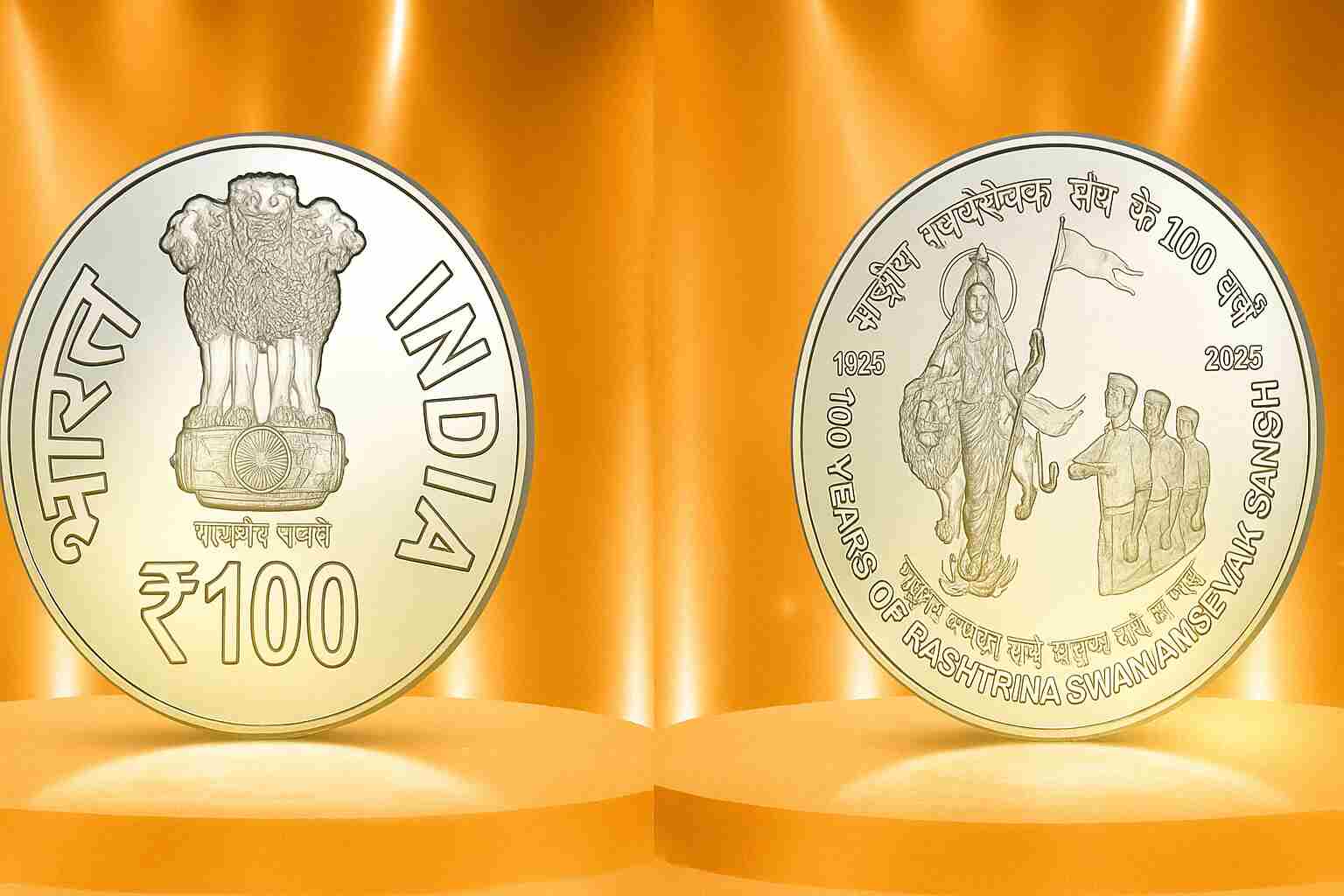
In a move rich with political symbolism and cultural resonance, Prime Minister Narendra Modi unveiled a commemorative ₹100 coin at a Rashtriya Swayamsevak Sangh (RSS) event on Wednesday. What makes this launch historic is not just the denomination, but the design: for the first time in India’s independent history, the figure of Bharat Mata features prominently on an official currency coin.
The event, held at the RSS headquarters in Nagpur, was attended by senior Sangh functionaries, government officials, and invited dignitaries. The coin, which carries the image of Bharat Mata holding the national flag, has sparked wide debate on its cultural, economic, and political implications.
This development adds a new chapter to India’s evolving relationship between currency symbolism, nationhood, and politics, raising questions about inclusivity, representation, and the state’s messaging through its financial instruments.
The design of the coin: A first of its kind
The new ₹100 coin is circular, with a silver-white finish, and bears the Ashoka Pillar emblem on one side, while the reverse showcases Bharat Mata holding the tricolour with a rising sun in the background. The depiction, government officials explained, symbolizes national pride, unity, and resurgence.
Key details include:
- Weight and material: The coin weighs 35 grams, made from a mix of metals designed for durability.
- Symbolism: The rising sun and national flag are positioned to convey progress and renewal.
- Release purpose: Issued as a commemorative piece, the coin is not for everyday circulation but for collectors and ceremonial purposes.
While commemorative coins have previously featured freedom fighters, political leaders, and cultural icons, this marks the first time Bharat Mata herself has been placed on Indian currency.
(Related: Possibility of nuclear attack part of India’s security calculus)
The timing: Why now?
Analysts say the timing of the launch is politically significant. With the Bihar Assembly elections 2025 around the corner and the 2026 general elections on the horizon, the use of Bharat Mata on currency could be seen as reinforcing themes of nationalism and cultural identity.
The choice of the RSS event as the unveiling platform also signals deeper alignment between the government and the Sangh’s ideological roots. Critics argue that the state’s endorsement of a cultural-religious figure on currency blurs the lines between governance and ideology.
For the government, however, the decision is framed as a celebration of India’s heritage and an effort to honor collective national identity.
Currency and politics: A history of symbolism
Throughout history, currencies have often carried political and cultural messages:
- Pre-independence India: Colonial-era coins bore the faces of British monarchs, symbolizing imperial authority.
- Post-independence: Coins and notes carried images of Ashoka’s lions, Mahatma Gandhi, and other secular motifs aimed at unifying a diverse nation.
- Commemorative issues: India has previously minted coins for occasions such as Mahatma Gandhi’s 150th birth anniversary, Subhas Chandra Bose’s centenary, and even cricket victories.
By featuring Bharat Mata, the government has taken a step further, embedding an explicitly cultural figure into the nation’s monetary narrative.
(Read more: Govt puts e-comm platforms on radar for GST compliance)
Reactions: Praise and criticism
The unveiling has generated mixed reactions across the political and public spectrum.
- Supporters: Many hailed the move as a proud moment for India, arguing that Bharat Mata represents the collective spirit of the nation, transcending political divisions.
- Critics: Opposition leaders and civil society groups questioned the choice, arguing that currency should remain neutral, representing all Indians without aligning with a specific ideology.
- Cultural voices: Some historians praised the artistic depiction but cautioned against politicizing a unifying symbol.
On social media, hashtags like #BharatMataCoin and #100RupeesCoin trended, with users posting images of the coin and debating its significance.
Broader implications for governance and identity
The unveiling of this coin is not just about numismatics; it reflects broader debates about how the state shapes national identity.
- Nationhood as symbolism: By featuring Bharat Mata, the government is signaling a vision of India deeply rooted in cultural heritage.
- Economic narrative: Even though the coin is commemorative, attaching Bharat Mata to a currency instrument links cultural pride with financial strength.
- Political messaging: The timing, venue, and design all suggest a strategy aimed at reinforcing themes of nationalism ahead of electoral cycles.
For ordinary citizens, the coin may become a collector’s item, but its deeper resonance lies in the symbolic message it carries about India’s future.
The bigger picture: Currency as a mirror of society
Around the world, currency has often mirrored a nation’s self-image. In the US, coins carry mottos like “In God We Trust”. In Japan, coins feature cultural motifs such as sakura blossoms. In the Eurozone, notes highlight architecture that symbolizes collective identity.
India’s new ₹100 coin fits into this global trend of using money as a medium of cultural storytelling. The question, however, is whether such symbolism will unify or polarize.
Future outlook: More cultural imprints ahead?
If this move sets a precedent, India could see more commemorative issues featuring cultural and civilizational symbols. Potential future motifs might include depictions of historical dynasties, regional heroes, or religious figures.
For now, the Bharat Mata coin remains a powerful example of how governments use symbolic acts to shape public imagination.
Conclusion: Between pride and politics
The unveiling of the ₹100 coin featuring Bharat Mata is both a milestone and a mirror. It reflects India’s ongoing negotiation between heritage and governance, between pride and political signaling.
For collectors, it is a rare addition. For citizens, it is a conversation starter about what symbols should represent them on currency. And for policymakers, it is a reminder that while symbolism is powerful, inclusivity is essential.
As India moves towards another crucial electoral season, this coin will not just be remembered for its silver sheen, but for the debates it sparked about identity, nationalism, and the role of the state in shaping them.
Related Posts



Stay Informed With the Latest & Most Important News
Previous Post
Next Post


Advertisement







Advertisement
