

Now Reading: Tech Giants Lose $770 Billion as Trump’s China Tariff Sparks Historic Market Crash
-
01
Tech Giants Lose $770 Billion as Trump’s China Tariff Sparks Historic Market Crash

Tech Giants Lose $770 Billion as Trump’s China Tariff Sparks Historic Market Crash

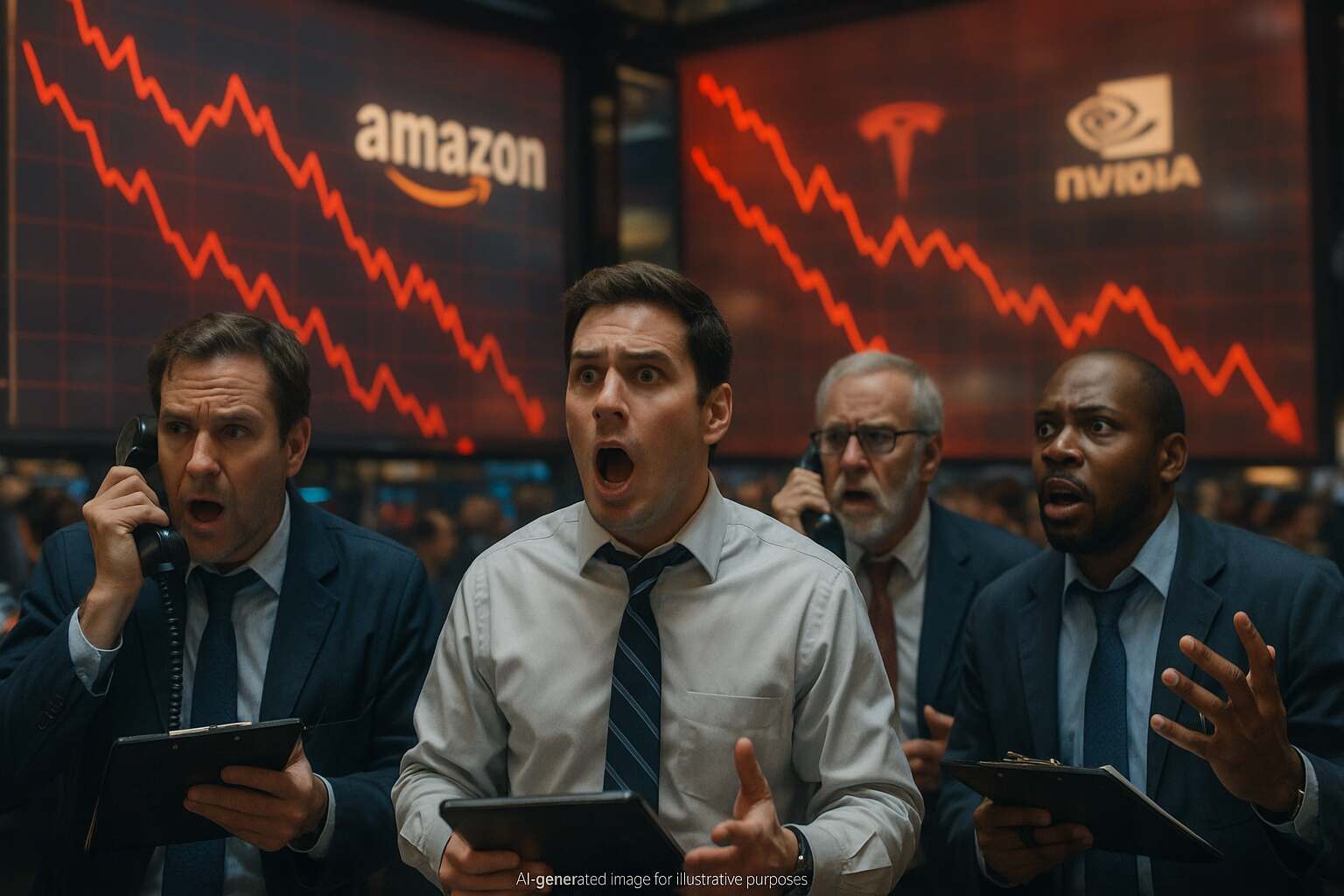
$770 billion from the world’s largest tech companies.
The sell-off hit Wall Street’s biggest names — Amazon, Nvidia, Apple, and Tesla — marking their steepest single-day decline since April. Investors reacted sharply to fears that a renewed US–China trade war could squeeze profits, raise production costs, and trigger a wider global slowdown.
The move also reignited debate over America’s economic strategy and the growing uncertainty surrounding Trump’s tough trade policies as he seeks a second term in office.
Details: How Trump’s tariff triggered the meltdown
In his latest statement, Trump announced a 100% import tariff on Chinese technology products, citing the need to “protect American industries from unfair trade practices.” The announcement instantly rattled markets already struggling with inflation and high interest rates.
The Nasdaq fell more than 3%, led by a massive slide in high-valuation tech firms. Nvidia, which has been one of the best-performing stocks this year, plunged nearly 7%. Tesla dropped 6%, while Amazon and Apple fell around 5% each.
Market data showed that over $770 billion in combined market capitalization was erased from the top ten US tech companies within hours.
(Read more: Trump’s 100% Tariff on China: The Trade War Reignites)
Analysis: Why the fall was so steep
The global tech sector has deep ties to China — from supply chains to manufacturing components. Trump’s new tariff threatens to break those links, which could mean higher costs for hardware companies and uncertainty for software and AI players dependent on Chinese hardware.
Nvidia, for example, earns billions from selling high-end chips to China. The new tariffs could severely limit its exports, affecting global AI growth. Tesla faces similar trouble since a major part of its battery supply chain still runs through China.
Amazon and Apple, which rely heavily on Chinese factories for assembly, may see immediate cost pressure if tariffs remain in place. Investors fear this could push companies to hike prices, potentially dampening demand.
Economists say the reaction was amplified by “panic selling,” with many traders offloading tech stocks as a precaution before more policy details emerge.
(Read next: How the 2025 Market Is Reacting to Trade Tensions)
Reactions: Market jitters and political noise
The White House released no immediate follow-up statement, leaving analysts to speculate whether Trump’s tariff is a symbolic move or a policy meant for immediate implementation.
Market strategist Lisa Thompson told Behind The Headlines, “This was a shockwave. No one expected such a steep tariff number. The tech sector, being the most exposed to global supply chains, felt the impact first.”
Social media was flooded with reactions — some praising Trump’s move as “a defense of American manufacturing,” others calling it “an economic grenade” that could hurt US companies more than China.
China’s Commerce Ministry, in a brief response, said it would “safeguard its economic interests,” hinting at potential retaliatory measures.
Meanwhile, Elon Musk tried to calm Tesla investors, tweeting that the company would “adapt quickly” to new trade conditions. Nvidia CEO Jensen Huang also addressed concerns, assuring shareholders that the company’s global operations remain “resilient and flexible.”
Bigger Picture: The new phase of the US–China tech war
Trump’s latest move reopens one of the most contentious chapters in global trade history. The earlier trade war during his presidency had already disrupted manufacturing networks and slowed international investment.
Now, the stakes are higher. The technology sector is the backbone of both economies, and any prolonged tariff battle could affect everything from smartphones and electric vehicles to AI chips and robotics.
For India and other emerging economies, this shift could present an unexpected opportunity. Several analysts believe companies might accelerate plans to diversify manufacturing away from China, turning to India and Southeast Asia for stable production bases.
(Read more: India’s Semiconductor Race: Can Tata’s Chip Ambition Fill the Global Gap?)
However, experts warn that the ripple effects could still harm global growth. If both nations impose tariffs on each other’s goods, global inflation could rise again, affecting developing markets the most.
Impact on investors and what’s next
Financial markets are now watching closely for a response from the US Federal Reserve and the Chinese government. Traders say that if the situation escalates, it could cause another round of global stock market volatility.
Analysts at Morgan Stanley estimate that continued uncertainty could wipe out an additional $300 billion from tech stocks in the next quarter if tariffs stay in place.
For investors, the coming weeks will test whether the sell-off was a short-term overreaction or the start of a longer correction. Much will depend on whether diplomatic talks resume or tensions rise further.
As of now, the world’s largest technology firms are bracing for impact — balancing between profit warnings and strategic repositioning.
Conclusion
The $770-billion tech wipeout is more than a bad trading day — it’s a reflection of how fragile the global economy remains in an age of political shocks and interdependence.
Trump’s tariff move has reignited fears of a full-scale trade war, reminding markets that politics and economics can collide faster than algorithms can trade.
As global investors count their losses, the world watches closely to see whether Washington and Beijing can restore calm — or if this is only the beginning of another cycle of economic confrontation.
Related Posts



Stay Informed With the Latest & Most Important News
Previous Post
Next Post


Advertisement








Advertisement
