

Now Reading: After U.S. Tariffs, Modi Finds a Lifeline in Japan—Strategic Economic Pact Unveiled
-
01
After U.S. Tariffs, Modi Finds a Lifeline in Japan—Strategic Economic Pact Unveiled

After U.S. Tariffs, Modi Finds a Lifeline in Japan—Strategic Economic Pact Unveiled

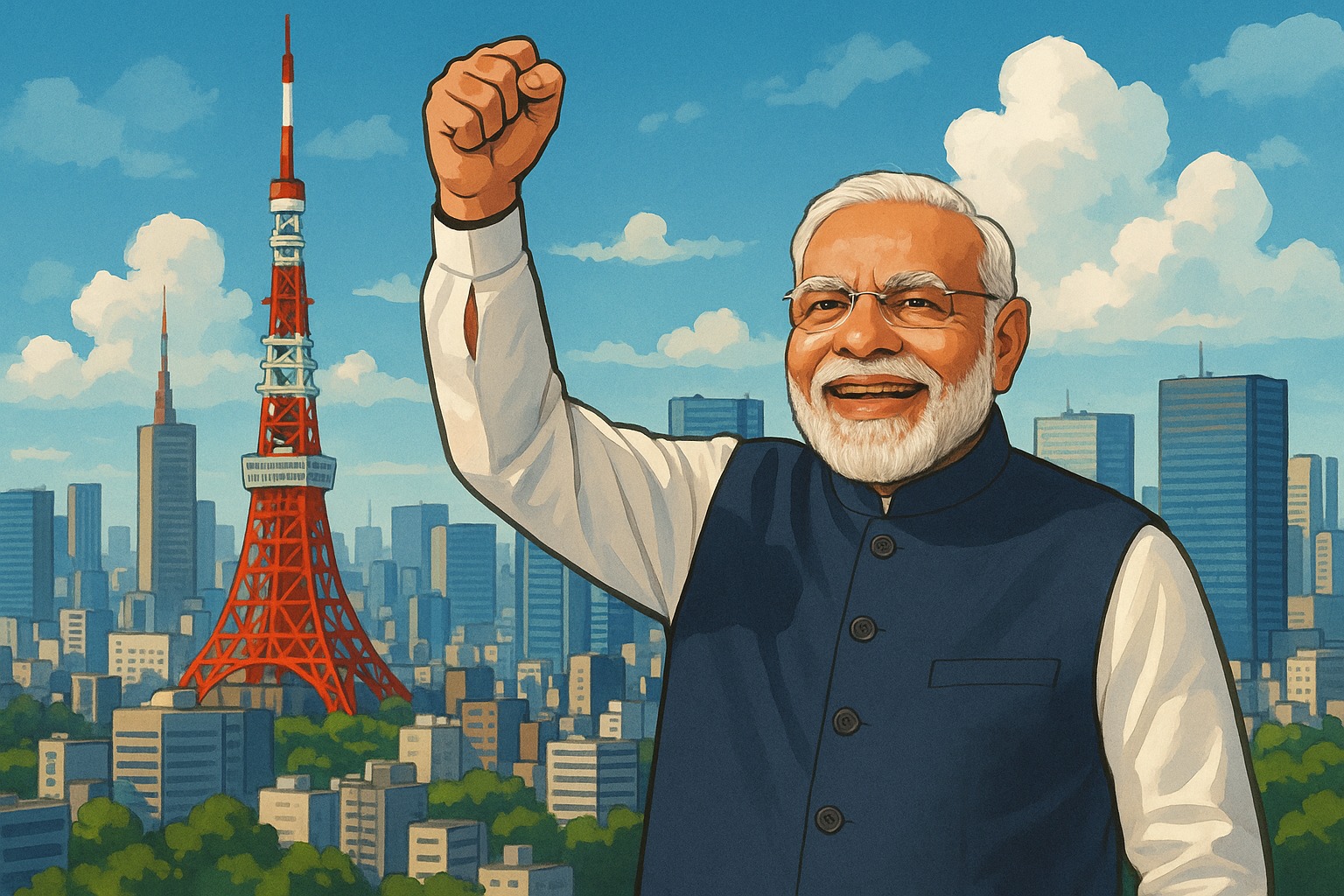
Tokyo Summit Marks a Strategic Reboot. Prime Minister Narendra Modi’s two-day visit to Tokyo for the 15th India–Japan Annual Summit with PM Shigeru Ishiba unfolded as much more than protocol diplomacy. It has emerged as a strategic reset, aligning India and Japan along both economic and geopolitical lines.
Fuelled by surging U.S. tariffs and regional instability, this trip catapulted their relationship into a broader blueprint:
- A record-setting investment pledge from Japan—¥10 trillion over 10 years—signals confidence in India’s growth trajectory.
- A sweeping Economic Security Initiative, with five crucial sectors taking center stage.
- Key agreements in AI, defense, semiconductors, and people-to-people exchanges underscore ambitions for deep integration.
Five Pillars of Episodic Collaboration
At the heart of the agreements lies the Economic Security Initiative. Conceived to assure supply chain resilience and future-ready collaboration, it outlines five sectors as the backbone of partnership:
- Semiconductor Manufacturing & Critical Minerals
Both nations recognized the geoeconomic vulnerability of reliance on singular regions. India gains not just technical guidance but also access to critical minerals, while Japan secures a trusted partner in diverse supply chains. - Pharmaceuticals & Healthcare
The pandemic’s legacy reshaped priorities. India and Japan will now jointly enhance drug R&D, manufacture therapeutic ingredients, and fortify healthcare supply chains—creating a buffer against global disruptions. - Information & Communications Technology (ICT)
From 5G to AI governance, this sector promotes data resilience with secure ICT infrastructure, homegrown protocols, and language-model collaboration. - Clean Energy Technologies
A green future needs vision and capital. From green hydrogen to modular solar, India’s renewable dreams are schemed with Japanese technological precision. - Defense and Strategic Industry
The initiative extends into security cooperation, joint development, and maintenance—solidifying Indo-Pacific defense readiness amid shared geopolitical anxieties.
A Pledge of Confidence: The Investment Cascade
China’s evolving positioning and U.S. tariffs created ripples of uncertainty across global markets. In this climate, Japan’s commitment of approximately $68 billion in private-sector investment becomes more than symbolic—it’s a vote of confidence and a catalyst for manufacturing resilience, innovation corridors, and long-term value creation.
Mobility and Soft Power: People Do the Diplomacy
Technology and capital aside, India and Japan unveiled ambitious ambitions for cross-cultural exchange: half a million students, professionals, and workersmoving freely between the countries over the next five years. These exchanges go beyond talent mobilization—they’re soft power levers, building trust, shared know-how, and institutional familiarity.
Indo-Pacific Vision: Democracy Beyond Borders
Beyond commerce and strategy, the summit reaffirmed a shared commitment to a free, open, and rules-based Indo-Pacific. Japan and India declared unity on maritime security, counterterrorism, cybersecurity, and democratic governance—each statement directly responding to rising regional uncertainty, particularly in light of China’s territorial assertions.
Geopolitical Diversification in Practice
Modi left for Japan amid heightened tensions with the United States: punitive tariffs had just been imposed, threatening India’s export-driven sectors. Simultaneously, he’s scheduled to go to China immediately thereafter. Together, this signals a balancing act: India, while upholding its strategic ties with the U.S., is deepening economic and defense linkages across Asia—India’s diplomacy rethought for a multipolar moment.
The Long View: Secure, Open, Future-proofed
- Economic Resilience: By diversifying supply chains in semiconductors, energy, health, and tech, India makes a long-term economic leap—anchored in self-reliance and global trust.
- Strategic Sovereignty: Shared defense projects and open innovation jointly empower India’s stance in a reshaped regional security architecture.
- Human Power Infrastructure: Investing in exchange programs helps India build both capacity and soft clout.
• 4. Global Signaling: This visit signals India’s intent to lead—both in economic diplomacy and in shaping Asia’s strategic future.
Related Posts



Stay Informed With the Latest & Most Important News
Previous Post
Next Post


Advertisement








Advertisement
