Now Reading: Blue Origin Lands Booster Rocket on a Barge at Sea
-
01
Blue Origin Lands Booster Rocket on a Barge at Sea


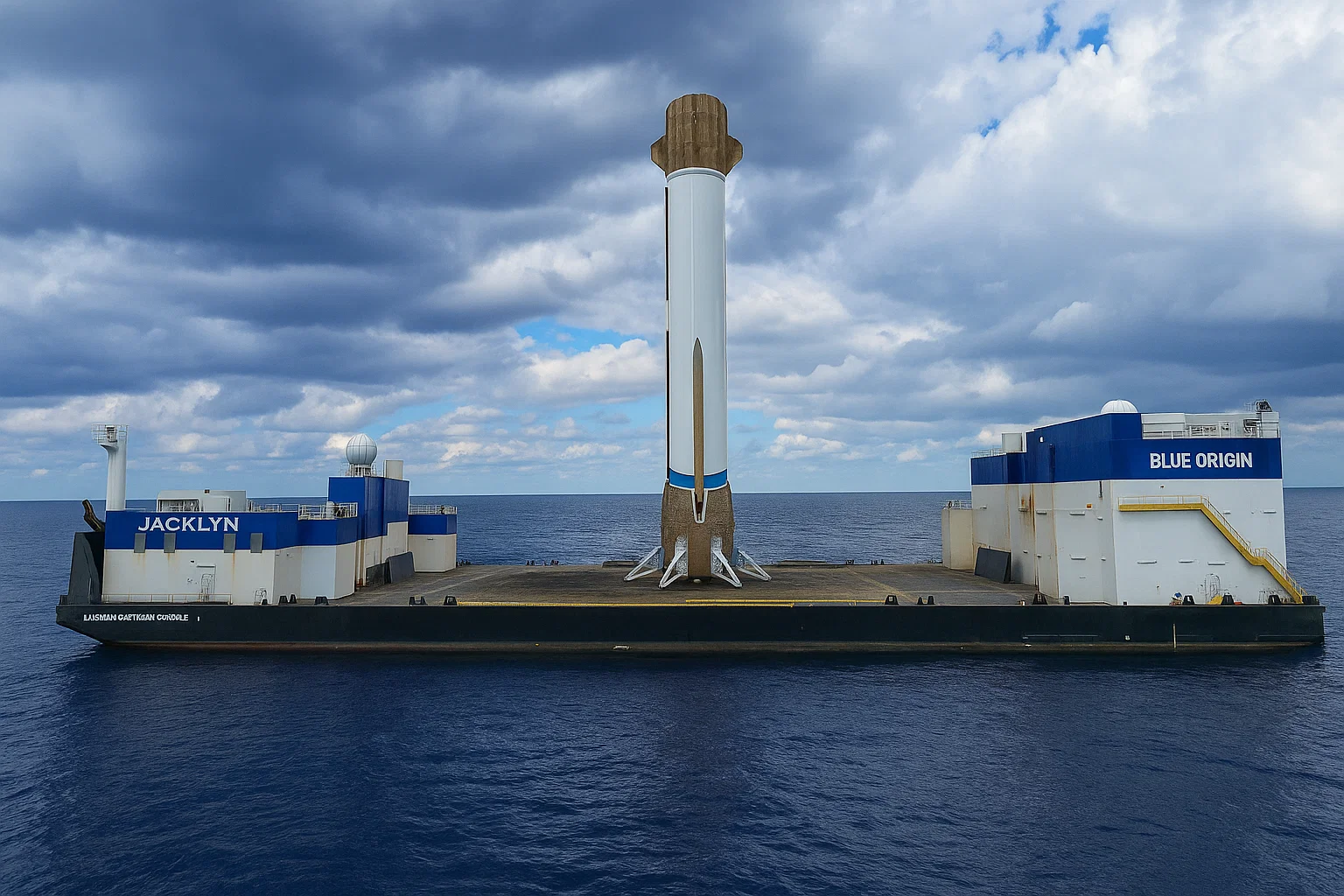
The Editorial Team of Behind The Headlines reports that Blue Origin has achieved a major breakthrough by successfully landing its booster rocket on a barge stationed at sea. This marks the company’s most significant step yet toward fully reusable spaceflight systems. The booster, part of Blue Origin’s New Glenn program, completed its mission, returned from the edge of space, and executed a controlled landing on the barge with precision. The achievement places Blue Origin in direct competition with global commercial space leaders and strengthens the company’s vision for cost-effective and sustainable access to orbit.
Details / Background
Blue Origin’s successful landing is the result of years of testing, development and iterative engineering. The booster used in this mission forms a key part of the New Glenn heavy-lift rocket, designed to carry satellites and cargo into orbit. After completing its ascent phase and separating from the upper stage, the booster performed a series of engine burns to reduce speed and align itself with the target landing site. Strong winds and sea movement added difficulty, but the booster stabilized itself using onboard sensors and thrusters before touching down on the ocean-going landing barge.
This capability mirrors long-term industry trends where private space companies attempt to reduce mission costs through recoverable launch systems. Blue Origin had previously completed land-based booster recoveries with its New Shepard program, but landing at sea required a different set of precision techniques.
Analysis
The landing demonstrates Blue Origin’s growing technological maturity in reusable launch systems. Sea landings are crucial because many heavy-lift rockets do not have enough fuel to return to land after completing ascent; landing at sea allows recovery without compromising mission payload capacity. The achievement helps Blue Origin compete more directly with other companies working on reusable upper-stage boosters and barge landings.
Additionally, the success could reduce overall mission costs and make commercial launches more accessible. It also serves as a proof-of-concept for future missions where large boosters must be recovered safely after flying high-energy trajectories.
Reactions / Statements
Industry analysts have praised the accomplishment, noting that it positions Blue Origin as a stronger player in a growing commercial space race. Company engineers stated that the landing validated major improvements made in stability control, engine restart reliability and onboard navigation systems. Space policy experts commented that reusable technology reduces barriers for countries and companies wishing to launch scientific payloads, communication satellites and exploration missions. Supporters of commercial space innovation called this “a defining achievement” in Blue Origin’s timeline.
Meanwhile, space enthusiasts on social media celebrated the landing, pointing out that safe rocket recovery is essential for lowering launch costs and increasing mission frequency.
Bigger Picture / Future Impact
Blue Origin’s latest achievement is more than a technical milestone—it represents a shift in how the global space industry approaches exploration. Reusable boosters cut costs dramatically and enable more frequent flights, which is vital for missions such as satellite deployment, lunar surface logistics and future Mars expeditions.
The success also strengthens the company’s New Glenn roadmap, paving the way for expanded commercial contracts. With satellite-internet providers, research agencies and defence customers seeking reliable launch services, Blue Origin’s new capability could reshape future competition and accelerate advancements in space travel technologies.
For the broader space economy, this development supports innovations that make space more accessible for scientific and commercial use, aligning with global ambitions for deeper space exploration.
Conclusion
The successful landing of Blue Origin’s booster rocket on a barge at sea is a defining moment for the company and for commercial spaceflight as a whole. It demonstrates growing confidence in reusable launch systems, reduces overall mission costs and strengthens Blue Origin’s position in the race for sustainable space transportation. The Editorial Team of Behind The Headlines will continue to monitor developments as Blue Origin prepares for future missions and moves closer to regular use of reusable boosters.
Related Posts



Stay Informed With the Latest & Most Important News
Previous Post
Next Post


Advertisement