

Now Reading: India’s New Trade Strategy: How US and EU Deals Could Reshape the Economy
-
01
India’s New Trade Strategy: How US and EU Deals Could Reshape the Economy

India’s New Trade Strategy: How US and EU Deals Could Reshape the Economy

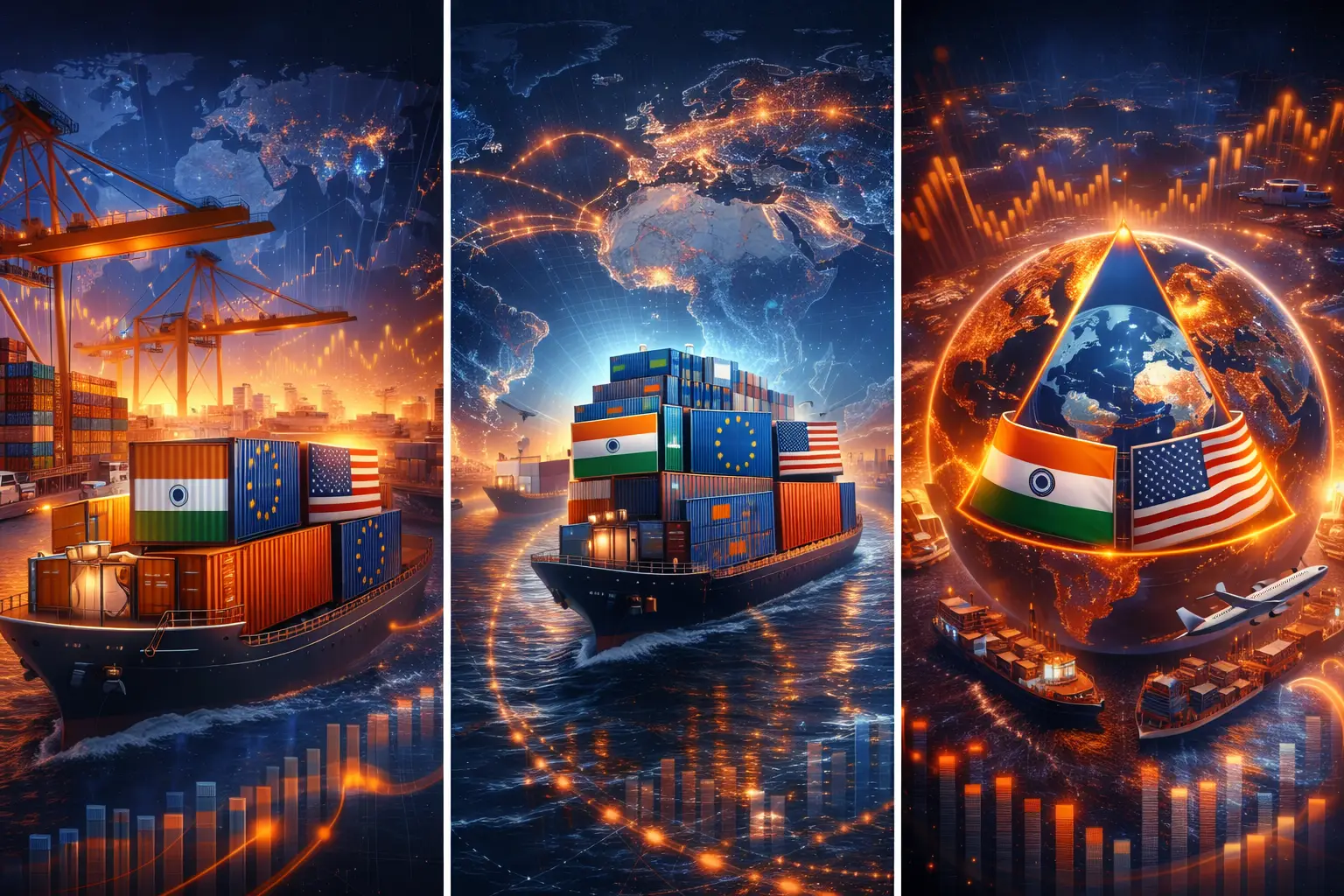
India is entering a new phase in global trade as negotiations and agreements with the United States and the European Union reshape the country’s economic landscape.
Over the past two years, India has pursued an aggressive strategy of signing trade agreements with major global economies. These deals are designed to expand exports, attract investment, and position the country as a key manufacturing and supply-chain hub. However, economists and industry groups warn that these agreements could also expose domestic industries—especially small and medium enterprises—to intense global competition. The debate over whether India’s entrepreneurs can withstand the impact of these agreements has become a major topic in economic policy circles.
A Shift in India’s Trade Policy
For decades, India followed a relatively protectionist trade policy, maintaining high tariffs and strict regulations to protect domestic industries. However, the rapid evolution of global supply chains, geopolitical tensions, and the need to boost exports have pushed policymakers toward a more open trade regime.
The government has signed or negotiated multiple trade agreements in recent years, including deals with the United Kingdom, the European Free Trade Association (EFTA), and the European Union. These agreements aim to reduce tariffs, improve market access, and integrate India more deeply into global trade networks.
A key example is the India–European Union Free Trade Agreement, which has been described as one of the largest trade deals in modern history. The agreement covers a market of nearly two billion people and represents about a quarter of global GDP. It will reduce or eliminate tariffs on more than 90 percent of traded goods between the two economies.
Supporters argue that such agreements could transform India’s economic prospects by expanding exports, improving supply chains, and attracting foreign investment.
The India–EU Trade Deal: Opportunities and Risks
The India–EU trade pact is often described as the “mother of all deals” because of its scale and potential impact on global commerce.
Under the agreement, India will reduce tariffs on several European products, including automobiles, machinery, chemicals, and food items. In return, the European Union will ease access for Indian exports such as textiles, leather products, engineering goods, and chemicals.
European companies are expected to save billions of euros annually in duties once the deal is implemented, while Indian exporters could gain improved access to one of the world’s largest consumer markets. Analysts believe the agreement could significantly boost sectors such as textiles, gems and jewellery, footwear, and pharmaceuticals.
At the same time, critics warn that opening India’s market to European products could put pressure on domestic industries that rely on tariff protection.
For example:
- European automobiles could become cheaper in India as tariffs fall over time.
- Imported wines, processed foods, and luxury goods may gain greater market share.
- Domestic manufacturers could face increased competition from European firms with advanced technology and higher productivity.
This raises concerns about whether Indian small businesses and manufacturers will be able to compete effectively.
US–India Trade Tensions and Negotiations
While India has been strengthening trade relations with Europe, its economic relationship with the United States has become more complex.
In 2025, the United States imposed steep tariffs on Indian exports, citing trade imbalances and geopolitical concerns. These tariffs, which reached as high as 50 percent in some cases, triggered a major diplomatic and economic dispute between the two countries.
The dispute highlighted the vulnerability of Indian exporters to global trade conflicts. Many industries—including textiles, steel, and pharmaceuticals—depend heavily on access to the US market.
Recent negotiations between the two countries have attempted to resolve these tensions by reducing tariffs and expanding trade cooperation. Some agreements have improved market sentiment and strengthened the Indian rupee, demonstrating the powerful economic impact of trade diplomacy.
However, critics say that certain conditions attached to these deals—such as pressure on India’s energy imports—could affect the country’s economic autonomy.
Trade Balance Concerns
One of the key concerns raised by economists involves the potential trade imbalance that could emerge from these agreements.
According to some analysts, India may significantly increase imports from the United States without receiving equivalent market access in return. Estimates suggest that imports from the US could rise dramatically, potentially creating a large trade deficit.
A trade deficit occurs when a country imports more goods than it exports. While such deficits are not necessarily harmful in the short term, persistent imbalances can create pressure on domestic industries and currency stability.
In the case of India, a sharp rise in imports—especially in sectors like technology, defence equipment, and high-value consumer goods—could increase the country’s reliance on foreign products.
Impact on Indian Entrepreneurs and Small Businesses
Perhaps the most significant concern surrounding new trade agreements is their impact on small and medium-sized enterprises (SMEs).
India’s economy relies heavily on SMEs, which employ millions of people and form the backbone of manufacturing and services sectors. However, these businesses often operate with limited resources, outdated technology, and lower productivity compared with global competitors.
As trade barriers fall, SMEs may face competition from multinational corporations with stronger supply chains, better access to finance, and advanced technology.
Economists warn that some industries could struggle to survive in this new environment. Conservative estimates suggest that hundreds of thousands of jobs could be affected if domestic businesses fail to adapt to increased competition.
For example:
- Small textile manufacturers may face competition from large global brands.
- Local electronics firms could struggle against imported products.
- Traditional manufacturing clusters may experience declining demand.
However, supporters of trade liberalisation argue that competition could also drive innovation and efficiency in the long run.
Opportunities for Export Growth
Despite these risks, trade agreements also present enormous opportunities for Indian exporters.
The European Union is already one of India’s largest trading partners, with bilateral trade in goods valued at more than $130 billion annually. When services and investment are included, the total economic relationship exceeds $190 billion.
With tariffs reduced, Indian exporters could significantly expand their presence in European markets.
Sectors expected to benefit include:
- Textiles and garments
- Leather and footwear
- Gems and jewellery
- Pharmaceuticals
- Engineering goods
For instance, the gems and jewellery industry expects exports to Europe to increase substantially as trade barriers are removed. Industry leaders believe the sector could double its trade with Europe over the next few years.
Such growth could generate employment, increase foreign exchange earnings, and strengthen India’s manufacturing sector.
Strategic Importance of Trade Diversification
Another major objective behind India’s trade strategy is diversification.
Global trade patterns are undergoing significant changes due to geopolitical tensions, supply chain disruptions, and shifting alliances. Many countries are seeking to reduce dependence on a single trading partner and build stronger relationships with multiple economies.
For India, this means expanding trade ties with Europe, Southeast Asia, and other regions while maintaining strategic partnerships with the United States and other global powers.
The EU agreement is seen as part of this broader strategy. By strengthening economic ties with Europe, India can reduce the impact of potential trade disputes with the United States or other partners.
Diversification also helps Indian companies access new markets and reduce risks associated with global economic shocks.
Impact on Key Sectors
Manufacturing
Manufacturing is expected to be one of the most affected sectors.
Lower tariffs on imported machinery and technology could help Indian companies modernise their operations. At the same time, increased competition from foreign firms may challenge domestic manufacturers.
Agriculture
Agriculture remains a politically sensitive sector in trade negotiations. Many agreements exclude certain agricultural products to protect farmers from foreign competition.
Even so, agricultural exports such as spices, marine products, and processed foods could benefit from improved market access.
Technology and Services
India’s services sector—including IT, consulting, and financial services—stands to gain significantly from trade agreements.
Many deals include provisions that make it easier for professionals to work across borders and for companies to provide services internationally.
Investment and Economic Growth
Trade agreements often lead to increased foreign investment.
When tariffs fall and market access improves, multinational companies are more likely to establish manufacturing facilities and supply chains in partner countries.
For India, this could accelerate economic growth by:
- Creating new jobs
- Expanding manufacturing capacity
- Boosting technology transfer
- Strengthening infrastructure development
The India–EFTA trade pact, for example, includes commitments for significant long-term investment into the Indian economy.
Such investments could support India’s ambition to become a global manufacturing hub.
Political and Geopolitical Implications
Trade agreements are not only economic arrangements; they also carry geopolitical significance.
The India–EU deal, for example, reflects a broader effort by both sides to strengthen economic cooperation amid global political tensions.
With rising protectionism in some parts of the world, partnerships between large economies are increasingly viewed as strategic alliances that support a stable global trade system.
For India, these agreements reinforce its role as a major economic power and an important partner in global supply chains.
The Road Ahead
While trade agreements offer significant opportunities, their success will depend on how effectively India adapts to a more open economic environment.
Key challenges include:
- Improving infrastructure and logistics
- Supporting small businesses in adapting to global competition
- Enhancing workforce skills and productivity
- Ensuring fair trade practices
The government may also need to introduce policies that help vulnerable industries transition to a more competitive global market.
Conclusion
India’s new trade agreements with the United States and the European Union mark a major turning point in the country’s economic strategy. By reducing tariffs and expanding market access, these deals could unlock new opportunities for exporters, attract foreign investment, and strengthen India’s position in global supply chains.
At the same time, the agreements could expose domestic industries to unprecedented competition, raising concerns about job losses and the survival of smaller businesses.
Whether these trade deals become a catalyst for economic transformation or a challenge for local entrepreneurs will depend largely on how effectively India balances global integration with domestic economic resilience.
In the coming years, policymakers, businesses, and entrepreneurs will all play a crucial role in determining whether India can turn these historic agreements into long-term economic success.
Related Posts


Stay Informed With the Latest & Most Important News
Previous Post
Next Post
Advertisement







Advertisement
