Now Reading: 'Will humanity shape AI or let it shape us?' UN chief asks existential question
-
01
'Will humanity shape AI or let it shape us?' UN chief asks existential question


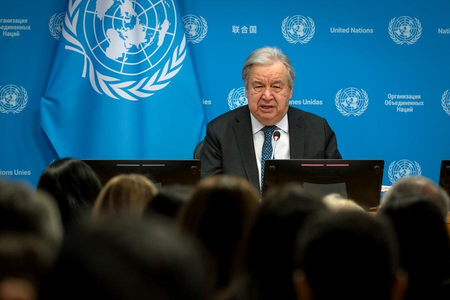
United Nations, July 6 (IANS) As artificial intelligence races at “runaway speed”, the UN launched on Monday a global meeting to ponder the existential question posed by Secretary-General Antonio Guterres: Will humanity “shape this transformation together — or let it shape us”?
“Today, that question has an answer — right here, at this Global Dialogue on AI Governance,” he said. “For the first time, every country has a seat at the table, and we have a shared base of evidence.”
“Some lines, once crossed, cannot be uncrossed,” he warned of the urgency for international cooperation on AI governance.
The meeting in Geneva brings together governments, technology enterprises, and thought leaders in this effort to put humanity in control.
The Independent International Scientific Panel on AI (IISPAI), which released its preliminary report last week, helps set the agenda for the meeting.
Guterres said the panel’s first warning is about speed: “The internet took fifteen years to reach a billion people. AI got there in two.”
AI systems are “no longer tools awaiting instruction; they are writing code, acting online, and making choices with less and less human oversight”.
Human institutions are “not ready for machines that decide” for them.
The second warning is about power, he said.
“The computing power, the data and the talent behind the most advanced systems are concentrated in a handful of companies, in a handful of countries”, and most nations “have had no say in decisions that will shape their futures”. he said.
“When power imbalances are hard-wired into technology, inequality becomes part of the code,” he said.
The third warning is about truth, Guterres said.
“A machine-enabled lie can now persuade as effectively as the truth — and authentic evidence can be dismissed as fake”, and this further erodes “the integrity of our information ecosystem”.
“The choice before us is not between faith in AI and fear of it,” he declared. “It is between governing by design — and drifting by default”.
For AI’s power to be governed, for it to be made accountable and safe, governments will have “to act with urgency. Companies to accept responsibility equal to their power. Scientists to keep bringing evidence into the light”.
Amandeep Singh Gill, the Under-Secretary-General and Special Envoy for Digital and Emerging Technologies, in remarks earlier, called the meeting’s inauguration “a turning point — not just for AI governance, but for how the international community responds to transformative technology”.
The Global Digital Compact adopted by the General Assembly in 2024 and the work of the IISPAI “gave the multilateral system two things it never had before: an independent scientific panel to assess AI’s impacts and opportunities, and a global dialogue where every government has a seat at the table,” Gill said. “Today, for the first time, both come together.”
The UN said the meeting will discuss how to bridge the AI divide; international cooperation on AI governance; and strengthen human oversight of AI systems to ensure safety and security.
General Assembly President Annalena Baerbock said, “This Global Dialogue is not merely about regulating a technology. It is about defining a shared vision in which technological progress goes hand in hand with human dignity, equity, and sustainable development.”
(Arul Louis can be contacted at arul.l@ians.in)
–IANS
al/sd/
Related Posts


Stay Informed With the Latest & Most Important News
Previous Post
Next Post


Advertisement