Now Reading: Anant Singh Arrest Shakes Bihar Politics Ahead of Election
-
01
Anant Singh Arrest Shakes Bihar Politics Ahead of Election


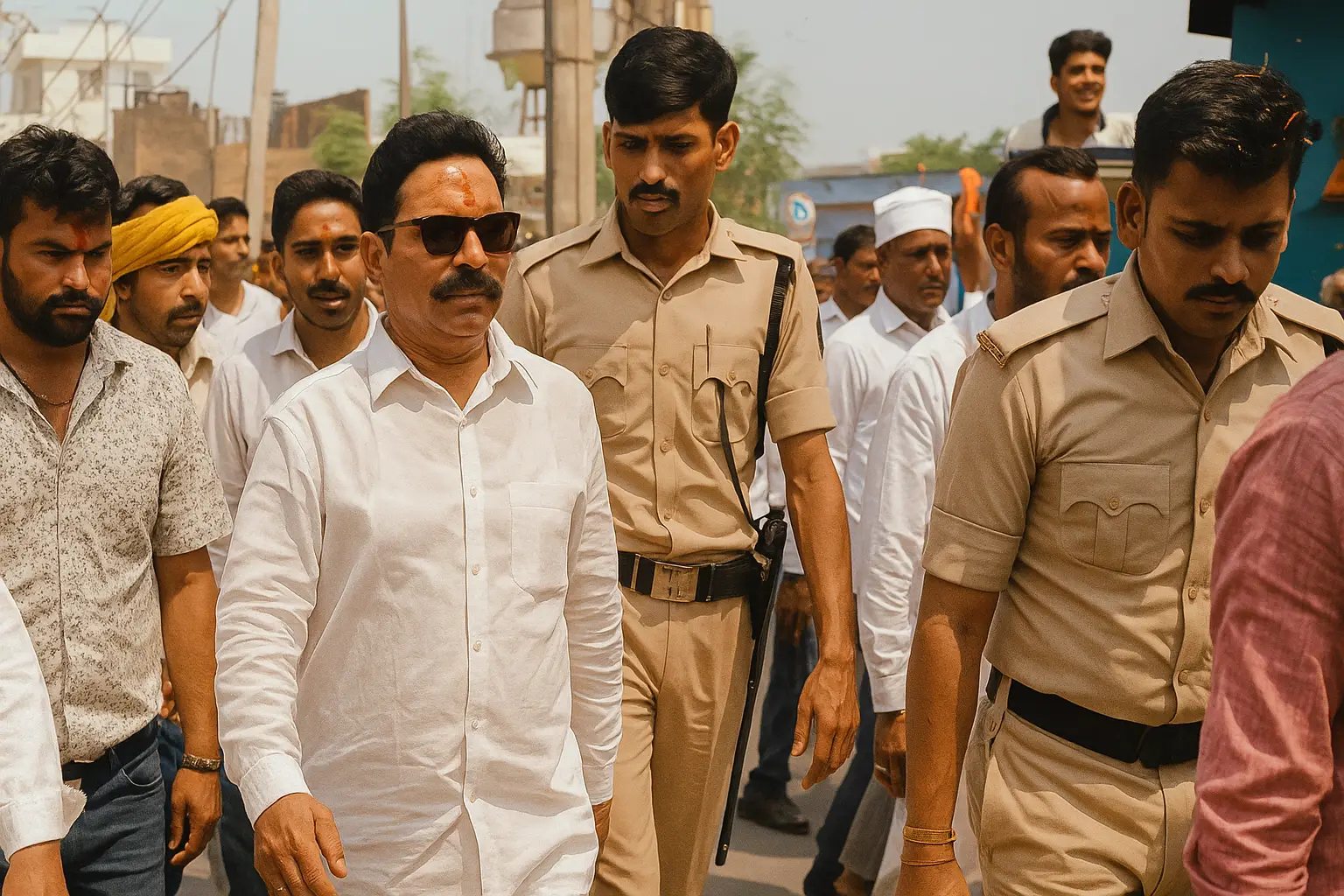
The Editorial Team of Behind The Headlines reports that the arrest of former MLA Anant Singh has set off a storm in Bihar’s political landscape. Singh, a well-known figure in state politics and the current Janata Dal (United) candidate from Mokama, was taken into custody along with two associates in connection with the death of Jan Suraaj Party worker Dular Chand Yadav. The development, coming just days before the assembly elections, has added fresh intensity to an already heated contest in the region. Political observers believe that this arrest could influence voter sentiment and alter campaign strategies across multiple constituencies.
Details / Background
Anant Singh’s arrest is linked to the violent death of Dular Chand Yadav, who was campaigning for the Jan Suraaj Party in the Mokama area. According to police reports, a clash broke out between rival supporters on October 30 during door-to-door campaigning. The confrontation allegedly turned violent, leading to injuries that proved fatal for Yadav.
Singh, once considered an influential “bahubali” (strongman) of the area, has had a long and controversial political career. He was earlier associated with the Rashtriya Janata Dal (RJD) before moving to the Janata Dal (United). His image as a tough leader with deep local roots made him both feared and respected in Mokama, a constituency often marked by personality-driven politics.
Police officials confirmed that Singh, along with Manikant Thakur and Ranjeet Ram, was arrested after preliminary investigations suggested direct involvement in the incident. The trio was taken into custody from Singh’s residence in Barh under tight security. Authorities have also transferred key police officers in Patna district, citing lapses in election-time law and order enforcement.
A post-mortem report on Yadav’s death mentioned internal injuries consistent with blunt-force trauma. The findings led investigators to treat the incident as a case of culpable homicide. The Election Commission of India has meanwhile sought a detailed report from the district administration regarding violations of the model code of conduct and steps taken to ensure fair polling in Mokama.
Political Profile of Anant Singh
Anant Singh’s arrest carries significance that extends far beyond one criminal case. Often referred to as “Chhote Sarkar” by supporters, Singh has represented Mokama multiple times and is known for his local influence and populist style. Despite several criminal cases in the past, he has maintained a loyal voter base, often projecting himself as a man of the people and a protector of the poor.
His shifting political alliances over the years—from RJD to Independent to JD(U)—mirror the flexible, personality-driven nature of Bihar politics. For Nitish Kumar’s JD(U), his candidacy was seen as a strategic move to secure the volatile Mokama seat, which has been a traditional hotspot of electoral competition. The arrest, therefore, not only dents Singh’s campaign but also puts the JD(U) in a defensive position just days before voting.
Analysis
The timing of Anant Singh’s arrest, so close to the Bihar Assembly elections, has raised many eyebrows. Election-time arrests of candidates are not new in Bihar’s political history, but this case stands out because of Singh’s stature and the gravity of the allegations. Analysts suggest that the move might serve as both a law enforcement action and a message from the administration that criminality in politics will not be tolerated.
However, the optics are complex. Supporters of Singh argue that the arrest is politically motivated and aimed at weakening his influence in Mokama. They claim that rival parties are using the police machinery to sideline powerful candidates who can swing local results. On the other hand, civil society groups have welcomed the arrest, saying it reflects growing accountability in a state long marred by “muscle power politics.”
Beyond Mokama, the case resonates across Bihar, where more than 40% of candidates in previous elections have declared criminal cases in their affidavits. The Anant Singh episode revives the larger debate over criminalization of politics—how leaders accused of serious offences continue to contest elections and wield local power.
Reactions and Statements
After the arrest, Anant Singh maintained that he was innocent and was not present at the site when the incident occurred. Speaking through his legal team, he claimed the entire case was fabricated by rivals to damage his reputation before polling day.
Political reactions have been swift. JD(U) leaders have said that the party respects the law and that the investigation should take its natural course. The Jan Suraaj Party, whose worker died, demanded a fair and transparent probe. The Rashtriya Janata Dal (RJD) and the Congress have used the incident to attack the JD(U)-BJP alliance, calling it proof that law and order in Bihar has deteriorated under Nitish Kumar’s leadership.
Among voters in Mokama, reactions are mixed. Some see the arrest as a long-overdue step toward justice, while others view it as political targeting. For many residents, Anant Singh remains a local hero—a man who, despite controversies, has brought attention and development projects to the region.
Election Impact and Future Scenarios
The immediate effect of the arrest is uncertainty within the JD(U) camp. Party strategists are reportedly considering backup plans in case Singh’s campaign faces restrictions. With polling just days away, replacing a candidate is not feasible, leaving the party to rely on local workers to salvage voter confidence.
If convicted, Singh could face disqualification under election laws, further complicating his political future. However, in the short term, his arrest could also evoke sympathy among loyal supporters who perceive him as a victim of political vendetta.
For Nitish Kumar, who has repeatedly emphasized governance and clean politics, this episode is a setback. It allows opposition parties to question the credibility of JD(U)’s candidate selection and to portray the party as inconsistent in its commitment to ethical politics.
Beyond Mokama, the case may influence voters in other constituencies where “strongman leaders” still hold sway. If the case leads to a conviction, it could strengthen the argument for electoral reforms that bar candidates with serious criminal charges from contesting elections. If not, it may reinforce the perception that political influence continues to shield the powerful from consequences.
Bigger Picture
The “Anant Singh arrest” story is not just about one man—it is about the state of democracy in Bihar. It highlights how politics, crime, and community loyalty often intersect in rural constituencies. Bihar has a long history of criminal-politician figures who command respect through fear and familiarity. Singh’s arrest exposes how deeply this culture is embedded, even as new generations of voters demand transparency and law-based governance.
The timing of the incident—during an election—makes it a defining moment for both the administration and the electorate. The outcome will show whether Bihar has truly moved beyond its reputation for “bahubali politics” or whether old habits still shape the democratic process.
For the Election Commission and law enforcement, this case is also a test of credibility. Swift and impartial action can reinforce trust, but selective enforcement risks fuelling further political polarization. The people of Bihar, however, appear more aware than ever—social media discussions and local debates show growing fatigue with leaders who rely on intimidation rather than ideas.
Conclusion
The arrest of Anant Singh marks a turning point in Bihar’s election narrative. It intertwines law, politics, and public sentiment in ways that reflect the complexities of Indian democracy at the grassroots. Whether Singh’s arrest leads to justice or political realignment remains to be seen. But one thing is certain—the case has already reshaped the tone of the Bihar election, forcing both parties and voters to confront uncomfortable truths about power and accountability.
The Editorial Team of Behind The Headlines will continue to monitor the case closely, focusing on its legal outcomes, political consequences, and what it reveals about the future of governance in Bihar.
nternal Links (to related Behind The Headlines stories)
Read More: Bihar’s Strongman Politics and the Voter Dilemma
Read More: Nitish Kumar’s Coalition Under Pressure Before Polls
Read More: Bihar Election 2025 — Criminal Charges and Candidacy Debate
Related Posts



Stay Informed With the Latest & Most Important News
Previous Post
Next Post

Advertisement