

Now Reading: India vs China: Why the Growth Gap Keeps Widening
-
01
India vs China: Why the Growth Gap Keeps Widening


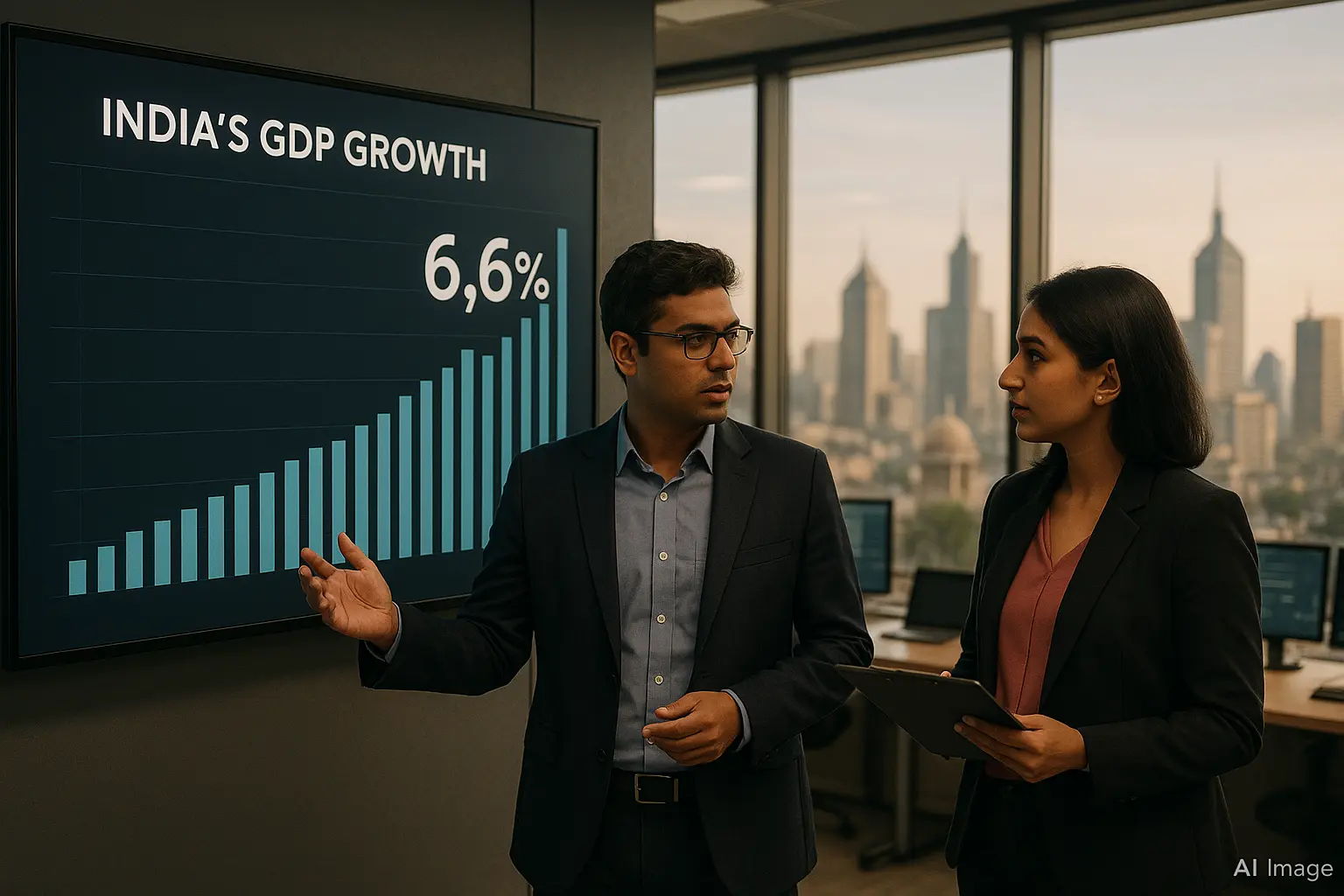
For decades, China’s economic rise was the benchmark for the world. But that story is shifting — and India is taking the lead. The latest IMF forecast puts India’s growth at 6.6%, while China’s is expected to remain around 4.8%.
This widening gap is not a coincidence. It reflects a fundamental change in how both economies are structured, how they respond to global pressures, and how their internal engines are performing. The once-unquestioned Chinese dominance in manufacturing and exports is slowing, while India’s diverse, consumption-driven model continues to accelerate.
As the world’s two most populous nations follow divergent paths, the India–China growth gap is becoming one of the defining economic shifts of the 21st century.
The Numbers Tell the Story
The IMF’s recent revision marks a turning point: India’s GDP growth now exceeds China’s by nearly two percentage points. This is the third consecutive year India’s economy has outperformed its northern neighbour.
In 2020, both economies faced the pandemic’s blow. China rebounded briefly, but structural weaknesses soon appeared — a slowing property sector, shrinking exports, and weak domestic demand. India, meanwhile, used the crisis to push digital payments, infrastructure reforms, and supply-chain diversification.
By 2025-26, India’s growth is projected to hold above 6%, while China’s may remain below 5%. In a decade, this compounding difference could make India the third-largest economy globally, narrowing the gap with the U.S. and leaving China’s growth story behind.
How India Gained Momentum
Domestic demand as the foundation
India’s growth rests on strong domestic consumption, which makes up nearly 60% of its GDP. This contrasts sharply with China’s export-driven model, which depends heavily on global demand.
Even amid global tariff tensions and slowing trade, India’s internal market — fuelled by a young population, expanding middle class, and digital access — keeps the economy moving.
Infrastructure push and reforms
Massive investment in roads, railways, logistics, and renewable energy is transforming India’s growth base. Public capital expenditure has more than doubled in five years, triggering private-sector confidence and job creation.
Reforms in taxation, production-linked incentives, and simplified business norms have encouraged both domestic entrepreneurs and foreign investors.
(Read: “India’s Growth Hits 6.6%: IMF Says Tariffs Can’t Slow It”)
Digital revolution and inclusion
India’s digital public infrastructure — UPI, Aadhaar, and e-governance — has connected millions of citizens and small businesses, creating a unique model of inclusive capitalism. This tech-driven inclusion strengthens demand, expands the tax base, and supports small-scale industries.
Why China’s Growth Is Slowing
Property and debt crisis
China’s real-estate sector, once contributing a quarter of its GDP, is now a major drag. Property prices have fallen, developers are in distress, and household wealth is eroding. The debt overhang is limiting Beijing’s ability to stimulate growth.
Declining global demand
Exports, long the engine of Chinese prosperity, are losing steam as the world diversifies supply chains. Western economies are prioritising resilience and de-risking — a polite term for reducing dependence on China.
Demographic and social pressures
China’s shrinking working-age population adds another layer of strain. The workforce decline reduces productivity and innovation, while social welfare costs are rising. India, in contrast, still enjoys a demographic dividend.
Reduced investor confidence
Policy unpredictability and regulatory crackdowns on sectors like tech have dented foreign investor sentiment. India’s relatively stable democratic structure has become an advantage in attracting long-term capital.
(Read: “China’s Economic Slowdown: How India Is Emerging as Asia’s Bright Spot”)
Comparing Economic Models
| Factor | India | China |
| Growth Forecast (IMF, 2025-26) | 6.6% | 4.8% |
| Main Driver | Domestic demand, services | Exports, manufacturing |
| Workforce Trend | Expanding youth population | Shrinking working age |
| Government Focus | Infrastructure, tech, inclusion | Stability, real-estate recovery |
| Investor Confidence | Rising | Declining |
| Currency Outlook | Stable rupee | Weak yuan pressures |
| Geopolitical Posture | Global partnerships | Controlled isolation |
This comparison shows that India’s model is currently more adaptive to global changes. Its mix of democracy, digitalisation, and domestic strength has created flexibility — while China’s centralised system is struggling to adjust to global fragmentation.
Reactions from Markets and Policymakers
Global investors are taking note. Major funds have increased allocations to Indian equities, viewing the country as a long-term growth story.
Economists say the shift is not cyclical but structural — India’s reforms are finally converging with global timing. Meanwhile, Chinese markets remain under pressure as investor confidence wanes.
Government officials in both nations have responded cautiously. India’s finance ministry described the IMF forecast as “a reflection of hard-earned policy stability,” while China’s state media insisted its slowdown is “a managed transition toward high-quality growth.”
(Read: “India 2030: Can Reforms Keep the 6% Growth Story Alive?”)
Global Impact of the India–China Divide
The growing divergence between the two Asian giants has implications far beyond Asia.
- Shift in investment flows: Multinationals are redirecting manufacturing investments from China to India, Vietnam, and Indonesia.
- Strategic partnerships: India’s economic rise strengthens its voice in the G20 and BRICS, reshaping the balance of influence.
- Trade reconfiguration: As supply chains diversify, India’s exports of electronics, pharmaceuticals, and auto components gain global traction.
- Geopolitical leverage: Stronger growth gives India greater confidence in diplomatic and trade negotiations.
In short, India’s economic ascent is not just a statistic — it’s a strategic transformation reshaping the world order.
The Bigger Picture: Sustaining the Advantage
India’s challenge is now to sustain its lead responsibly. Experts suggest focusing on:
- Job creation: Turning growth into employment for the youth bulge.
- Sustainable growth: Expanding renewable energy and reducing carbon intensity.
- Education and health: Strengthening social infrastructure to support innovation.
- Governance and stability: Maintaining policy consistency across political cycles.
If these pillars hold, India could sustain 6%+ growth for the next decade — keeping the gap with China wide and stable.
Conclusion
The India–China economic race is no longer about catching up; it’s about consolidation. China’s slowdown is structural, while India’s growth is structural too — but in the opposite direction.
The IMF’s numbers are just the surface. Beneath them lies a deeper story: one of a maturing democracy leveraging digital inclusion, infrastructure, and reform-driven capitalism to build a resilient future.
As global growth slows, the world will look increasingly toward India — not as an emerging alternative, but as a central force shaping the next phase of the world economy.
Related Posts


Stay Informed With the Latest & Most Important News
Previous Post
Next Post
Advertisement








Advertisement
