

Now Reading: Indias Education Reforms: A Leap Towards Global Standards
-
01
Indias Education Reforms: A Leap Towards Global Standards


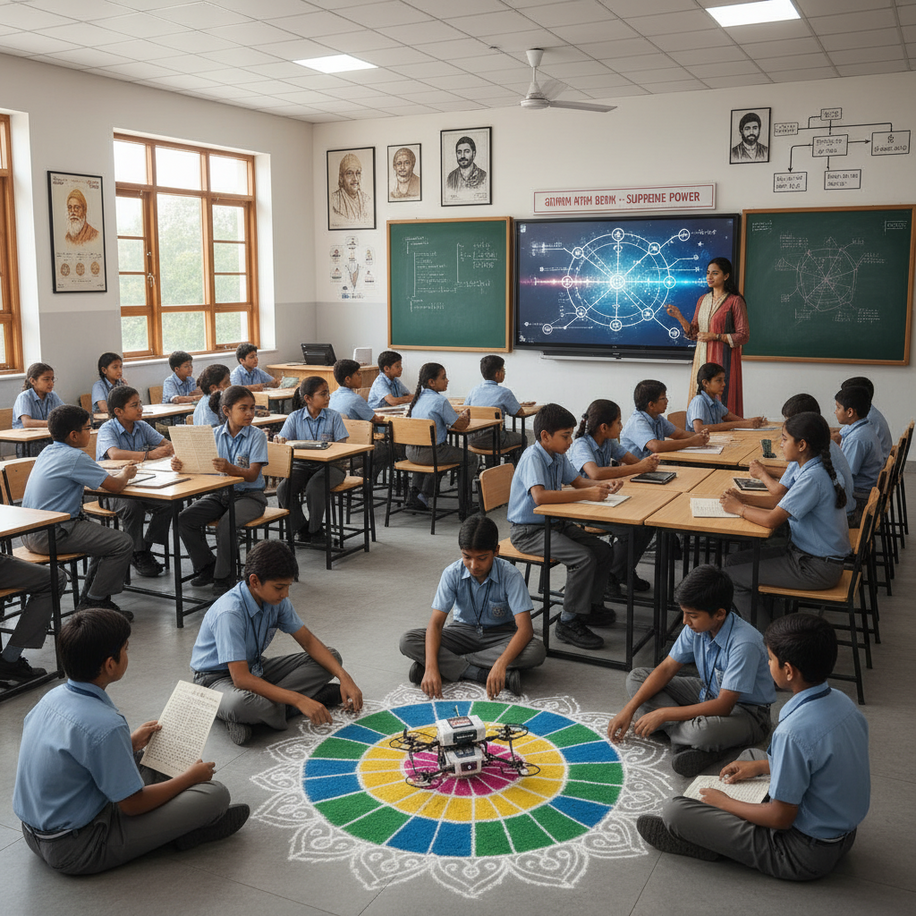
India’s sprawling and diverse education system is currently undergoing a profound transformation, spearheaded by the ambitious National Education Policy (NEP) 2020 and further bolstered by the recently introduced Viksit Bharat Shiksha Adhishthan Bill, 2025. These landmark reforms signal a strategic shift, aiming to recalibrate the educational landscape with a new 5+3+3+4 structural framework, a robust integration of Artificial Intelligence (AI) across curricula, and an unwavering focus on achieving excellence in higher education. The intent is clear: to position India as a global leader in education, fostering innovation and producing a skilled workforce ready for the 21st century. While the term “ISA education” does not refer to a specific entity in recent news, it can be interpreted as a broad reference to international or global educational benchmarks against which India’s progress is often measured.
The Viksit Bharat Shiksha Adhishthan Bill, 2025, which received Union Cabinet approval on December 12 and was subsequently introduced in the Lok Sabha on December 15 by Education Minister Dharmendra Pradhan, is a cornerstone of this reform agenda. This pivotal legislation is designed to empower Higher Educational Institutions (HEIs) by streamlining coordination, establishing rigorous standards, and facilitating the adoption of global best practices, all meticulously adapted to the unique Indian context. It aligns seamlessly with the overarching goals of NEP 2020, striving to create an education system that is not only equitable and flexible but also fundamentally driven by innovation. This framework seeks to ensure that Indian graduates are globally competitive and equipped with the necessary skills to thrive in an increasingly complex world.
A significant stride in India’s educational evolution is the emphasis on AI integration. On December 19, Minister Pradhan chaired a crucial meeting addressing the strategic incorporation of AI into education. The discussions covered a wide spectrum, from fostering AI literacy at the foundational school stages through project-based learning to leveraging advanced digital platforms such as DIKSHA 2.0 and Vidya Samiksha Kendra for highly personalized learning experiences. In the realm of higher education, the focus is squarely on developing AI-enabled curricula, stimulating cutting-edge research, and enhancing graduate employability, thereby aiming to cultivate a talent pool that can rival the best globally. This forward-looking approach positions India to harness the power of AI for educational advancement.
The implementation of NEP 2020 itself represents a monumental overhaul, replacing the conventional 10+2 structure with an innovative 5+3+3+4 framework that caters to students from ages 3 to 18. This policy also marks the end of the long-standing no-detention policy for classes 5 and 8, reintroducing a measure of accountability. Furthermore, it champions the establishment of multidisciplinary universities, promotes multiple entry and exit options in higher education, and introduces the Academic Bank of Credits, providing students with unprecedented flexibility. A key target of NEP 2020 is to achieve a remarkable 50% Gross Enrolment Ratio (GER) in higher education by 2035, a significant leap from the current 28-30%. In parallel, there are recent pledges to deeply integrate Indian Knowledge Systems (IKS) into school curricula nationwide, utilizing frameworks like the IKS Charter to enrich cultural understanding and heritage.
Despite these ambitious reforms, India’s education system faces considerable challenges when benchmarked against global standards. While the reforms aim for 21st-century alignment, particularly in vocational training and technology skills, the ground realities often lag. A prominent issue is the escalating dependence on private schools; statistics show that 28.5% of national enrollment is in private unaided schools, surging to 44.3% in urban areas. Conversely, urban government school enrollment stands at a mere 54.1%. This shift exacerbates the rising costs of education, turning it into a “market-driven commodity” despite Article 21A of the Indian Constitution guaranteeing free and compulsory education for ages 6-14 (now expanded by NEP to 3-18). Infrastructure gaps also remain a significant hurdle, with only 24.4% of schools possessing smart classrooms, thereby limiting digital literacy and hindering the realization of NEP’s technological goals, especially in underserved rural areas. Other pressing concerns include a recent UGC alert against fake universities, a burgeoning mental health crisis among students due to academic pressure, and an over-reliance on coaching institutions. While India is undoubtedly moving towards global competitiveness, a concerted effort to strengthen and ensure equitable access to quality public schooling remains absolutely critical to bridging these persistent gaps. This holistic approach will pave the way for a truly inclusive and advanced educational ecosystem.
Related Posts

Stay Informed With the Latest & Most Important News
Previous Post
Next Post

Advertisement








Advertisement
