

Now Reading: BJP mocks Mahagathbandhan’s ‘joint press meet’ poster showing only Tejashwi Yadav
-
01
BJP mocks Mahagathbandhan’s ‘joint press meet’ poster showing only Tejashwi Yadav

BJP mocks Mahagathbandhan’s ‘joint press meet’ poster showing only Tejashwi Yadav

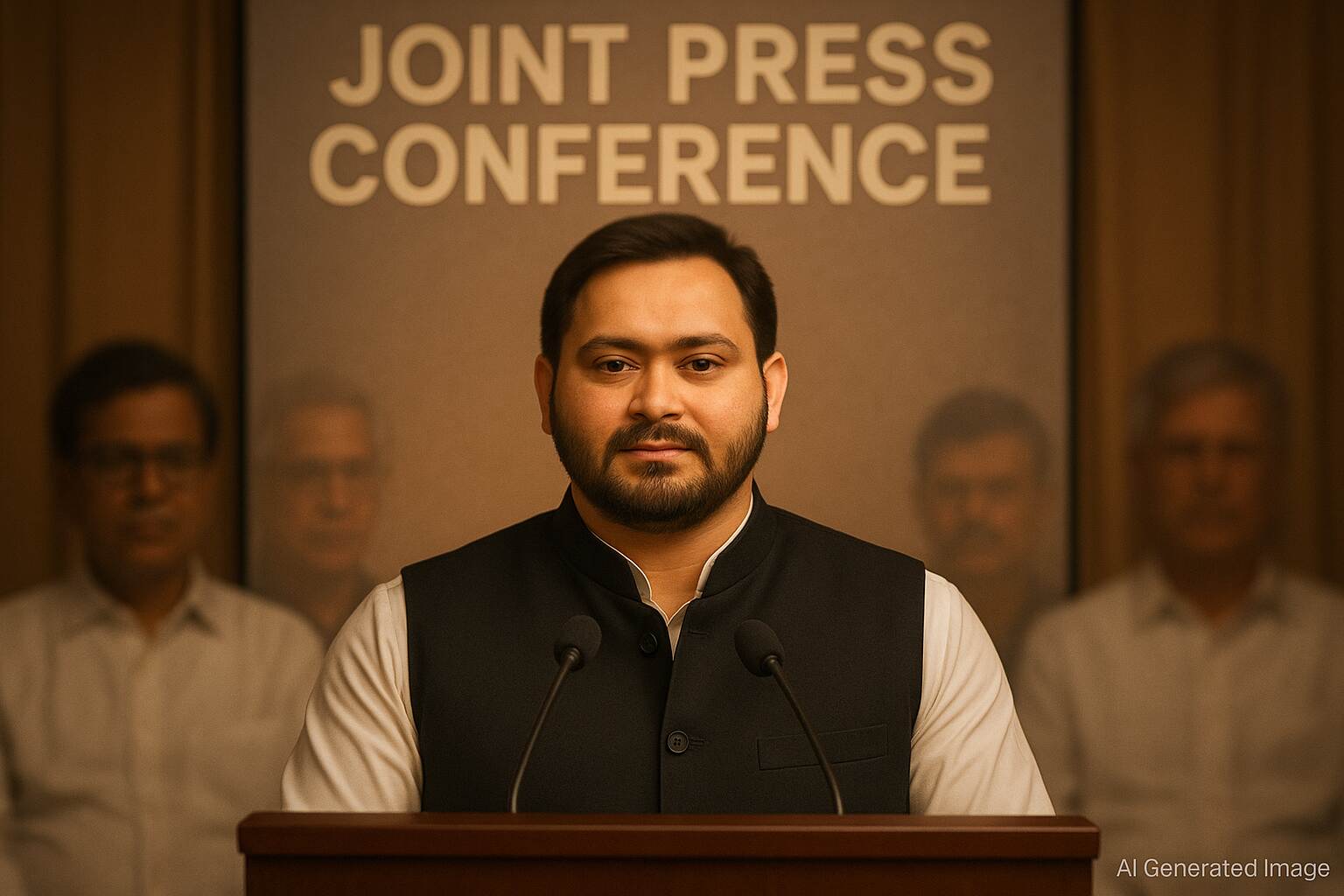
The political war of words in Bihar turned sharper when the Bharatiya Janata Party (BJP) mocked the Mahagathbandhan alliance over a press conference poster that displayed only one face — Rashtriya Janata Dal (RJD) leader Tejashwi Yadav.
The opposition alliance had called for a joint press conference to showcase unity before the coming Bihar elections. However, the promotional poster for the event carried only Tejashwi’s picture, leaving out other alliance leaders, including those from the Congress and Left parties.
Within hours, BJP leaders turned this into a campaign issue, joking that the so-called “joint press meet” was joint only in name. The remark quickly spread across social media, giving fresh fuel to the BJP’s narrative that the opposition alliance lacked coordination and mutual trust.
The poster that triggered the controversy
The image used to promote the press meet became the center of debate. It carried the title “Joint Press Conference of the INDIA Bloc” but featured only Tejashwi Yadav in a confident pose. No other leader — from Congress, CPI(ML), CPI, or other partner parties — was visible.
For the BJP, this was the perfect opportunity to question the balance within the Mahagathbandhan. They argued that the absence of other leaders on the poster exposed the reality of internal power struggles. What was supposed to be a joint show of strength ended up highlighting one leader over all others.
Several BJP leaders shared the poster on their social media handles with sarcastic captions, calling it proof that the alliance was “joint only on paper.” Some even quipped that Congress had been reduced to a background role while Tejashwi Yadav had become the sole face of the alliance in Bihar.
Inside the opposition camp
The Mahagathbandhan, also part of the larger INDIA Bloc, is made up of the RJD, Congress, and Left parties. The alliance was formed to challenge the ruling National Democratic Alliance (NDA) in Bihar. However, its campaign strategy and leadership structure have been under constant debate.
The recent controversy once again brought those internal discussions into public view. Many observers believe the poster was not a mistake but a clear indication that Tejashwi Yadav will be projected as the chief ministerial face for the alliance.
Congress leaders, however, maintained that the issue was being blown out of proportion. They said that the focus on Tejashwi was natural since the press meet was being held in Patna and the RJD was leading the coordination at the state level. But the explanation did little to calm the chatter around visible cracks within the alliance.
BJP’s sharp reaction
The BJP immediately seized the opportunity to corner the opposition. The party’s spokespersons and digital media cells circulated the poster widely, adding witty captions and pointed remarks.
According to BJP’s narrative, the image perfectly symbolized the INDIA Bloc’s confusion and leadership struggle. The ruling party described the alliance as a group of ambitious leaders who could not agree even on whose face should appear on a simple poster.
By highlighting this issue, the BJP managed to turn a single poster into a talking point that questioned the credibility of the entire opposition. Political analysts believe this was a clever move that kept the focus away from governance questions and redirected public attention toward the opposition’s disunity.
Why visuals matter in politics
In today’s era of digital campaigning, images often speak louder than speeches. Political parties know that a single photograph can define a message more strongly than pages of text.
The Mahagathbandhan’s “one-picture” poster became a visual narrative that many voters could instantly interpret. It suggested that the opposition was not truly united, no matter how strongly it claimed otherwise.
In contrast, the BJP has consistently presented a single leadership model, with clear messaging and uniform branding. By comparing the two, the ruling party managed to strengthen its perception of discipline and coordination.
The timing and election context
The controversy comes just weeks before Bihar goes to polls in two phases, with voting scheduled on November 6 and 11, and counting on November 14.
For the opposition, this was meant to be a critical moment to demonstrate unity and purpose. A well-planned press conference could have helped them outline a joint roadmap for the state. Instead, the debate around the poster diverted attention from their key messages on unemployment, education, and corruption.
Tejashwi Yadav, who has emerged as the central figure of the alliance, has been trying to build a youth-driven, anti-incumbency campaign. But visuals like this one, critics say, make it harder for other parties in the bloc to feel equally represented.
Opposition’s explanation and attempts to calm the storm
Soon after the controversy gained traction, leaders from the Congress and RJD tried to play down the row. Tejashwi Yadav told reporters that the opposition is united and the poster controversy was being exaggerated. He said the alliance is focused on issues of governance and people’s welfare, not on photo placements.
Congress functionaries also assured that the seat-sharing and campaign structure were being finalized with full consultation from all sides. They dismissed BJP’s criticism as a “diversion tactic” meant to deflect from core issues like inflation and unemployment.
Still, political circles believe that the episode has made the opposition cautious about its messaging. Party workers have been advised to double-check campaign materials and maintain visual balance to avoid unnecessary controversies in the future.
Public reactions and online chatter
On social media, the poster quickly became a trending topic. Supporters of the BJP used the opportunity to poke fun at the opposition, while alliance supporters defended the design choice. Memes, short videos, and edited images flooded platforms like X, Facebook, and Instagram.
Many neutral commentators noted that such incidents, even if minor, can influence voter perceptions. In an age where people consume more visuals than long speeches, a single image can shape an entire political narrative.
The deeper political meaning
The incident may look like a simple design error, but in a state like Bihar, where coalition politics has always been complex, such signals matter. The Mahagathbandhan has often faced challenges balancing regional and national ambitions.
Tejashwi Yadav, being the most popular opposition face in the state, naturally dominates headlines. However, keeping partners like Congress satisfied is equally crucial for maintaining alliance morale and ensuring ground-level coordination.
Analysts point out that unless the INDIA Bloc maintains internal discipline, such symbolic mistakes could become real weaknesses in the final stretch of the campaign.
How BJP turned a picture into a strategy
For the BJP, the controversy fit perfectly into its larger communication playbook. The ruling party has long worked on highlighting contradictions within opposition alliances — from differences over leadership to seat distribution.
By amplifying this poster issue, the BJP not only mocked the opposition but also subtly reminded voters of its own unity under a single leadership structure. The party’s messaging team ensured that the phrase “joint PC, but one picture” reached both digital and television audiences across Bihar.
The incident shows how modern campaign strategy is as much about timing and social media as it is about ground rallies and speeches.
The bigger picture
Beyond the humour and the headlines, the poster controversy touches on a bigger question — who truly leads the opposition in Bihar. The Congress, once a dominant force, now plays a secondary role, while Tejashwi Yadav’s RJD drives the campaign engine.
If the INDIA Bloc wants to present a serious alternative to the NDA, it must manage these perceptions carefully. Unity must not only exist in meetings but also be seen in public representation. Every banner, every image, and every slogan must reflect equality among partners.
Lessons for both sides
For the Mahagathbandhan, this episode is a reminder that optics cannot be ignored in modern politics. Even small design decisions can carry big messages. Balancing representation in communication materials is as important as negotiating seat numbers.
For the BJP, it reinforces the effectiveness of its digital strategy — spotting small missteps and turning them into talking points. This approach allows the ruling party to maintain narrative control even when major issues are being debated.
Conclusion
The “one-picture” poster episode has added another chapter to Bihar’s colourful political storytelling. While it may seem like a trivial issue, it has opened wider conversations about leadership, unity, and the power of political imagery.
As Bihar moves closer to the elections, the Mahagathbandhan faces the dual challenge of maintaining its internal balance and projecting confidence before voters. For the BJP, the controversy is a reminder of how even a single photograph can become a campaign weapon.
The joint press conference will likely go ahead, but the memory of that lone image of Tejashwi Yadav will linger — a visual that, for many, said more about the state of the opposition than any speech could.
Related Posts


Stay Informed With the Latest & Most Important News
Previous Post
Next Post

Advertisement



Advertisement
