Now Reading: Putin Tells Ukraine: End War Through Talks or Face Force
-
01
Putin Tells Ukraine: End War Through Talks or Face Force


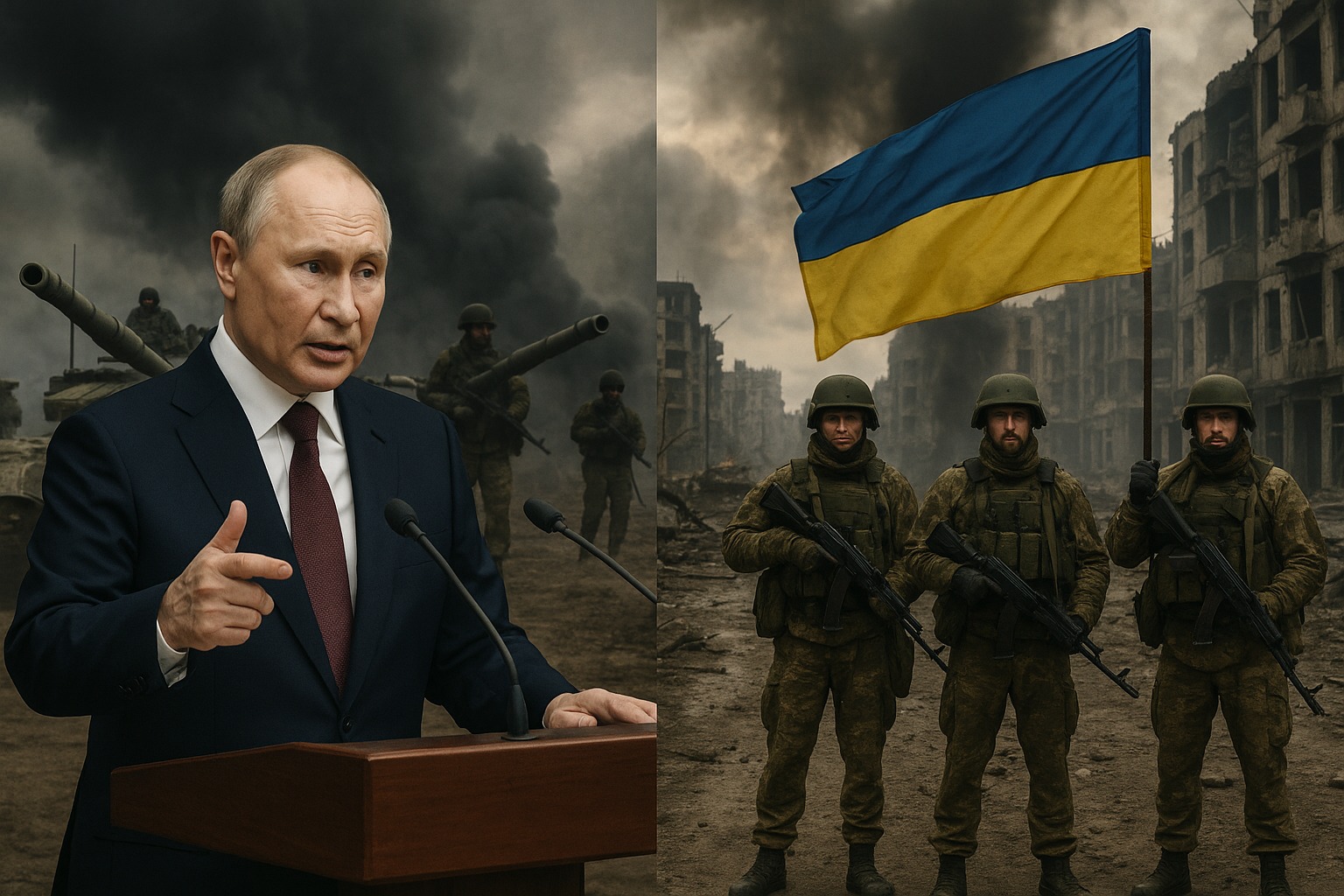
Russian President Vladimir Putin has issued one of his starkest warnings yet to Ukraine, declaring that Kyiv must choose between negotiating peace or facing a forceful resolution imposed by Moscow. His remarks, delivered during a meeting with senior officials in Moscow, underline Russia’s hardened position as the war enters a prolonged and devastating phase.
The statement immediately sparked global reactions, with Western governments reaffirming support for Ukraine while analysts weighed the possibility of fresh escalations. The Editorial Team of Behind The Headlines examines the context of Putin’s warning, the history of stalled talks, and the consequences this ultimatum may carry for Ukraine, Russia, and the international community.
Putin’s Message: Talks or Force
During his address, Putin stated that Russia remains open to peace negotiations but accused Ukraine of refusing to engage seriously in dialogue. He framed the choice starkly: either Kyiv comes to the table or Moscow will resort to decisive military action to end the conflict.
His words suggest that Russia believes it has both the military capacity and political will to push for battlefield gains if diplomacy continues to stall. This reflects not only Moscow’s confidence in its current position but also its frustration with what it sees as Western-backed resistance by Ukraine.
The History of Failed Peace Efforts
Peace negotiations between Russia and Ukraine have been attempted multiple times since the outbreak of war in 2022. Early talks in Belarus and Turkey collapsed without progress.
Later attempts, including mediation by third parties, also failed as both sides held firm to their conditions.
- Ukraine has consistently demanded the restoration of its territorial integrity, including Crimea and the eastern regions.
- Russia has insisted on recognizing its annexations and guaranteeing that Ukraine does not join NATO.
This fundamental gap has prevented any meaningful agreement. Putin’s latest statement underscores Moscow’s belief that negotiations are only possible if Ukraine shifts its red lines.
Military Context of the Warning
Putin’s ultimatum comes at a time when fighting remains intense along the frontlines. Russian forces have recently made incremental advances in eastern Ukraine, particularly in the Donetsk and Luhansk regions. Ukraine, meanwhile, continues to receive Western military aid, including advanced weaponry, but faces growing challenges in manpower and resources.
Analysts suggest that Putin’s message is designed not only for Kyiv but also for Western capitals. By presenting negotiations as the only alternative to intensified warfare, Russia is attempting to increase pressure on Ukraine’s allies to push for talks.
Global Reactions
The international response to Putin’s remarks was swift.
- The United States and European Union reaffirmed their support for Ukraine, stating that no country has the right to impose peace terms through threats of force.
- NATO officials reiterated that military aid to Ukraine would continue as long as necessary.
- Ukraine’s leadership rejected the ultimatum, emphasizing that peace can only come through sovereignty and security guarantees.
China, which has positioned itself as a potential mediator, called for restraint and encouraged both sides to pursue dialogue without preconditions.
Implications for Ukraine
For Ukraine, Putin’s words represent both a threat and a political challenge. Accepting talks under Russian conditions could be seen as a betrayal of national sovereignty, but rejecting them risks further military escalation.
Ukraine’s government has repeatedly made clear that it will not concede territory. Public sentiment within Ukraine remains strongly opposed to compromises that would legitimize Russian control over annexed areas. This leaves Kyiv in a difficult position where continuing the fight seems inevitable, despite the heavy costs.
Implications for Russia
For Russia, the ultimatum serves several purposes.
- Domestically, it reinforces Putin’s image as a strong leader unwilling to back down.
- Internationally, it signals to the West that Russia will not relent until its demands are met.
- Militarily, it prepares the ground for possible escalations if diplomacy fails.
However, the risk for Moscow lies in overestimating its leverage. If Western support for Ukraine remains strong, further escalation could deepen Russia’s isolation and prolong the war.
Economic and Humanitarian Dimensions
The continuation of the war, whether through force or failed negotiations, will have severe consequences for ordinary people.
- Ukraine faces ongoing destruction of infrastructure, displacement of millions, and economic contraction.
- Russia grapples with sanctions, trade restrictions, and a heavy financial burden from sustaining military operations.
- Globally, the war disrupts food and energy supplies, adding to inflationary pressures in multiple regions.
Putin’s ultimatum, rather than offering a path to peace, risks worsening the humanitarian crisis.
Expert Analysis
Experts on international relations see Putin’s statement as both a negotiating tactic and a real threat. By framing the choice as binary—talks or force—Russia seeks to put Ukraine and its allies on the defensive.
Some analysts argue that Russia may be preparing for a new military offensive to back up its words. Others believe the statement is primarily aimed at breaking Western unity by raising fears of prolonged conflict.
Either way, the ultimatum underscores the limited room for compromise in the current geopolitical environment.
The Role of Western Support
Western nations hold significant influence over how this ultimatum plays out. Continued financial and military aid to Ukraine strengthens Kyiv’s ability to resist both on the battlefield and in negotiations.
If support weakens, Russia may believe it can impose its terms by force. On the other hand, if aid continues robustly, Moscow may eventually face pressures of its own to reconsider its approach. This dynamic makes Western unity a critical factor in the months ahead.
The Road Ahead
The path forward remains uncertain. Putin’s ultimatum makes it clear that Russia is unwilling to settle for a frozen conflict and wants decisive outcomes. Ukraine, however, insists on sovereignty and territorial integrity.
The possibilities include:
- Renewed military escalation if talks remain off the table.
- Third-party mediation attempts, though past efforts have failed.
- A protracted stalemate, where neither side achieves decisive victory but both continue to endure heavy losses.
What is clear is that the war remains far from resolution, and Putin’s latest words only highlight the gulf between the two sides.
Conclusion
Russian President Vladimir Putin’s warning to Ukraine—negotiate peace or face force—marks a critical moment in the ongoing conflict. While framed as an invitation to talks, the ultimatum reflects Moscow’s uncompromising stance and raises fears of intensified warfare. For Ukraine, Russia, and the wider world, the stakes remain as high as ever, with peace appearing distant.
The Editorial Team of Behind The Headlines will continue to track developments closely, providing fact-verified updates on how this ultimatum shapes the next phase of the war.
Related Posts

Stay Informed With the Latest & Most Important News

Advertisement