

Now Reading: Quantum vs AI: Which Technology Will Define the Next Decade?
-
01
Quantum vs AI: Which Technology Will Define the Next Decade?


Two of the most powerful technologies of our time — Artificial Intelligence (AI) and Quantum Computing — are heading toward a point where their paths may soon converge. Both are transforming industries, rewriting economies, and redefining what machines can do.
Within the first 100 words: While AI has already taken center stage in today’s digital economy, quantum computing is preparing for its big breakthrough moment. The question now is — which of these two technologies will ultimately define the next decade? Will it be the rapid intelligence of AI or the unimaginable processing power of quantum systems? Or will the future belong to the combination of both?
Artificial Intelligence: The Power That’s Already Here
AI is the most visible force of innovation today. From smartphones and self-driving cars to personalized healthcare, artificial intelligence touches almost every aspect of modern life.
At its core, AI uses algorithms to mimic human reasoning and learning. With machine learning and deep learning models, AI can recognize speech, predict outcomes, and even generate human-like writing or images.
Over the last few years, AI has become the engine behind automation, business analytics, and creative tools. It powers everything from social media recommendations to fraud detection in financial systems.
However, the rise of AI has also raised concerns — from data privacy and job displacement to ethical questions about bias and autonomy.
(You may also like: “AI Chip Revolution: How India Is Catching Up”.)
Quantum Computing: The Power That’s Coming
While AI is already mainstream, quantum computing is the technology of the near future — one that could make today’s computers look primitive.
Quantum systems rely on qubits, which can exist in multiple states at once. This allows them to process enormous amounts of data simultaneously, performing calculations that even the most powerful supercomputers would take years to complete.
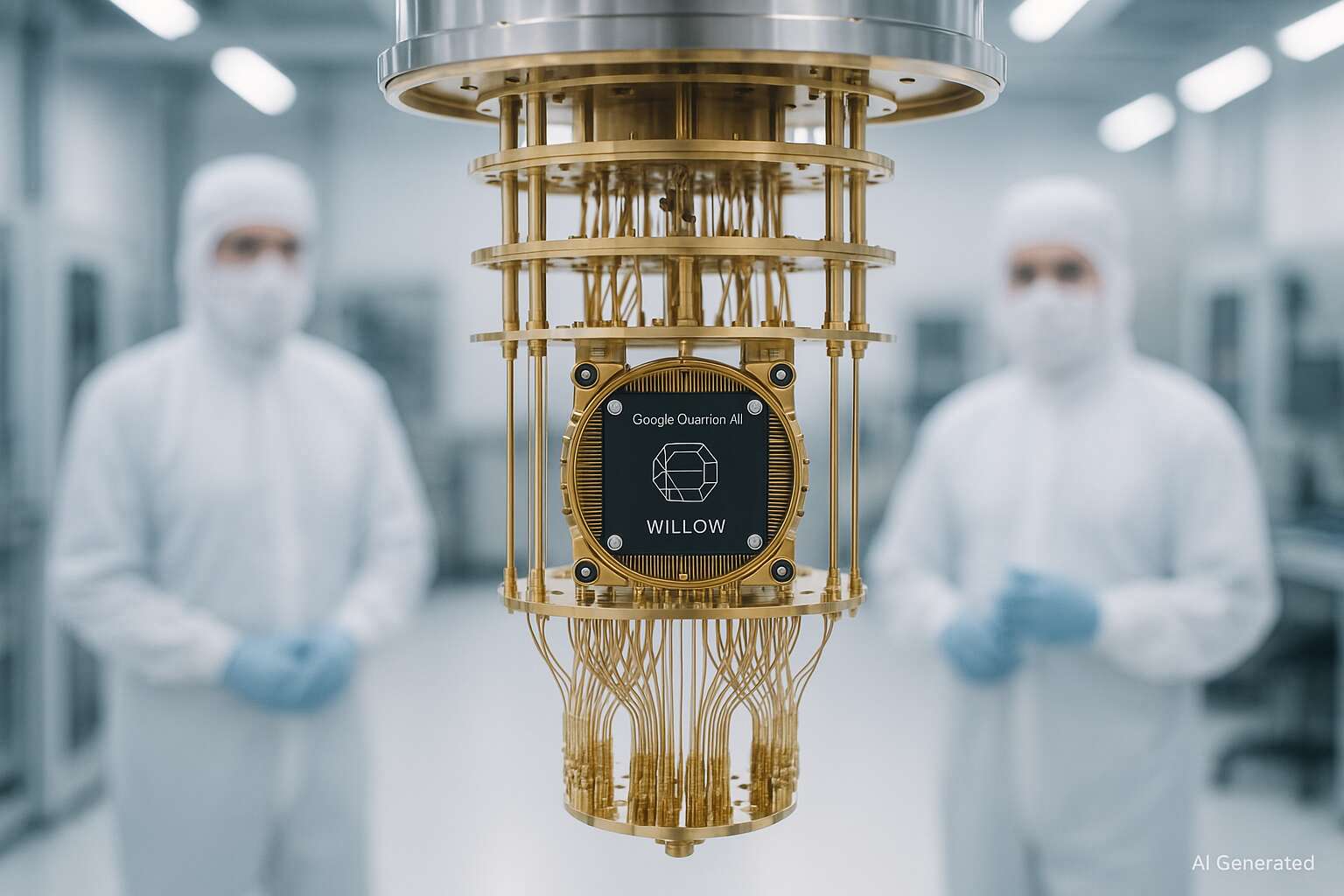
The recent development of Google’s Willow chip, which achieved a breakthrough in stability and error reduction, has pushed the boundaries of what’s possible in quantum research. The chip’s performance shows that practical quantum applications are no longer distant dreams but achievable milestones.
Quantum computing holds the potential to transform industries like cryptography, medicine, logistics, and finance — areas where complex problems need extraordinary computing power.
(Also read: “Google’s Willow Chip Quantum Breakthrough: What It Means”.)
The Core Difference Between AI and Quantum
AI and quantum computing may seem similar in ambition, but they solve problems in fundamentally different ways.
- AI focuses on learning and prediction. It studies data, identifies patterns, and predicts outcomes based on probability.
- Quantum computing focuses on optimization and computation. It can analyze all possible outcomes of a problem simultaneously, finding the most efficient solution faster.
In simpler terms, if AI is the brain that learns from experience, quantum computing is the calculator that can solve impossibly large puzzles at lightning speed.
These technologies address different challenges but can complement each other when combined — leading to what experts call Quantum AI.
The Rise of Quantum AI
Quantum Artificial Intelligence is the convergence of the two — where AI algorithms run on quantum hardware instead of traditional processors.
This integration could speed up machine learning exponentially. Training an AI model that currently takes weeks might one day be done in seconds. Quantum AI could also allow systems to handle complex, real-time data analysis far beyond today’s capabilities.
Imagine an AI doctor that diagnoses millions of patients in seconds, or an AI climate model that calculates global weather predictions with perfect accuracy. That’s the scale of possibility Quantum AI could unlock.
Several research institutions and companies, including Google, IBM, and India’s National Quantum Mission, are exploring this space aggressively. It is believed that the first successful combination of these technologies could change the entire digital landscape.
(Also read: “India’s Quantum Mission 2030: How Prepared Are We for the Coming Tech Revolution”.)
AI’s Dominance Today
Right now, AI dominates because it’s accessible and profitable. Businesses can easily integrate AI models into their existing systems.
AI has already transformed marketing, customer service, manufacturing, and healthcare. Tools like ChatGPT, Copilot, and Gemini have made generative AI a global phenomenon.
In India, AI is being used in governance, agriculture, fintech, and education. From crop prediction tools to digital tutors, AI is reshaping everyday lives.
However, AI’s growth is increasingly limited by computing power. Large language models require massive energy, high-end GPUs, and storage infrastructure. That’s where quantum technology could step in — as the next logical leap in computing capability.
Quantum’s Promise Tomorrow
Quantum computers aren’t yet replacing laptops or cloud servers, but their impact could be revolutionary once scalability improves.
They can model molecules for drug discovery, simulate new materials for renewable energy, and even break conventional encryption methods.
For countries like India, investing in quantum research means ensuring technological sovereignty — the ability to protect national data and develop indigenous capabilities.
Quantum computing could also help reduce the cost and energy needed for global computing tasks, making large-scale AI models more sustainable and environmentally friendly.
The Battle or the Partnership?
While some view AI and quantum computing as competing technologies, the truth is — they are complementary.
AI needs faster and more powerful systems to analyze complex datasets. Quantum computers can provide that boost. In return, AI can help design better quantum algorithms and optimize qubit behavior.
Together, they could create a self-reinforcing cycle: quantum hardware accelerating AI learning, and AI improving quantum design.
Experts believe that the next decade will not belong to either AI or quantum individually — but to their partnership.
India’s Role in the Quantum–AI Race
India is positioning itself at the intersection of these two revolutions. Through the National Quantum Mission 2030, the country aims to build homegrown quantum hardware, while also scaling up AI research under its Digital India and Make in India frameworks.
Startups such as BosonQ Psi are working on quantum-driven simulations, while major IT firms like TCS, Infosys, and Wipro are integrating AI into their cloud and automation platforms.
This dual focus gives India a unique opportunity — to become one of the few countries combining AI innovation with quantum capability.
(You may also like: “Inside Quantum Race: Why Big Tech Is Betting on Qubits.”)
Challenges Ahead
Despite the promise, both AI and quantum computing face real hurdles:
- For AI: Data privacy, algorithmic bias, and the need for massive computing resources.
- For Quantum: Technical instability, high costs, and the need for specialized infrastructure.
Moreover, building expertise in both areas simultaneously will require global partnerships, investment in education, and strong ethical frameworks to guide progress.
The Bigger Picture
The coming decade could be defined by how well humanity combines intelligence with power. AI gives machines the ability to learn, while quantum computing gives them the speed to think.
Together, they can accelerate problem-solving, predict complex outcomes, and create innovations that once existed only in imagination.
The next industrial revolution may not come from factories or code, but from the marriage of quantum precision and artificial intelligence.
For India and the world, this convergence could mark the beginning of a new era — one where knowledge itself becomes the most powerful resource.
Conclusion
The battle between Quantum and AI isn’t about which one will win — it’s about how they’ll evolve together.
Artificial Intelligence is the mind of modern technology; Quantum Computing is its muscle. When they unite, humanity gains a tool powerful enough to reshape industries, economies, and even the future of discovery.
The next decade will belong to those who can bridge the gap between intelligence and computation — and build the tools that make imagination possible.
Related Posts


Stay Informed With the Latest & Most Important News
Previous Post
Next Post

Advertisement









Advertisement
