

Now Reading: Red Alert in the Maximum City: 10 Big Updates on Mumbai’s Flood Fury
-
01
Red Alert in the Maximum City: 10 Big Updates on Mumbai’s Flood Fury


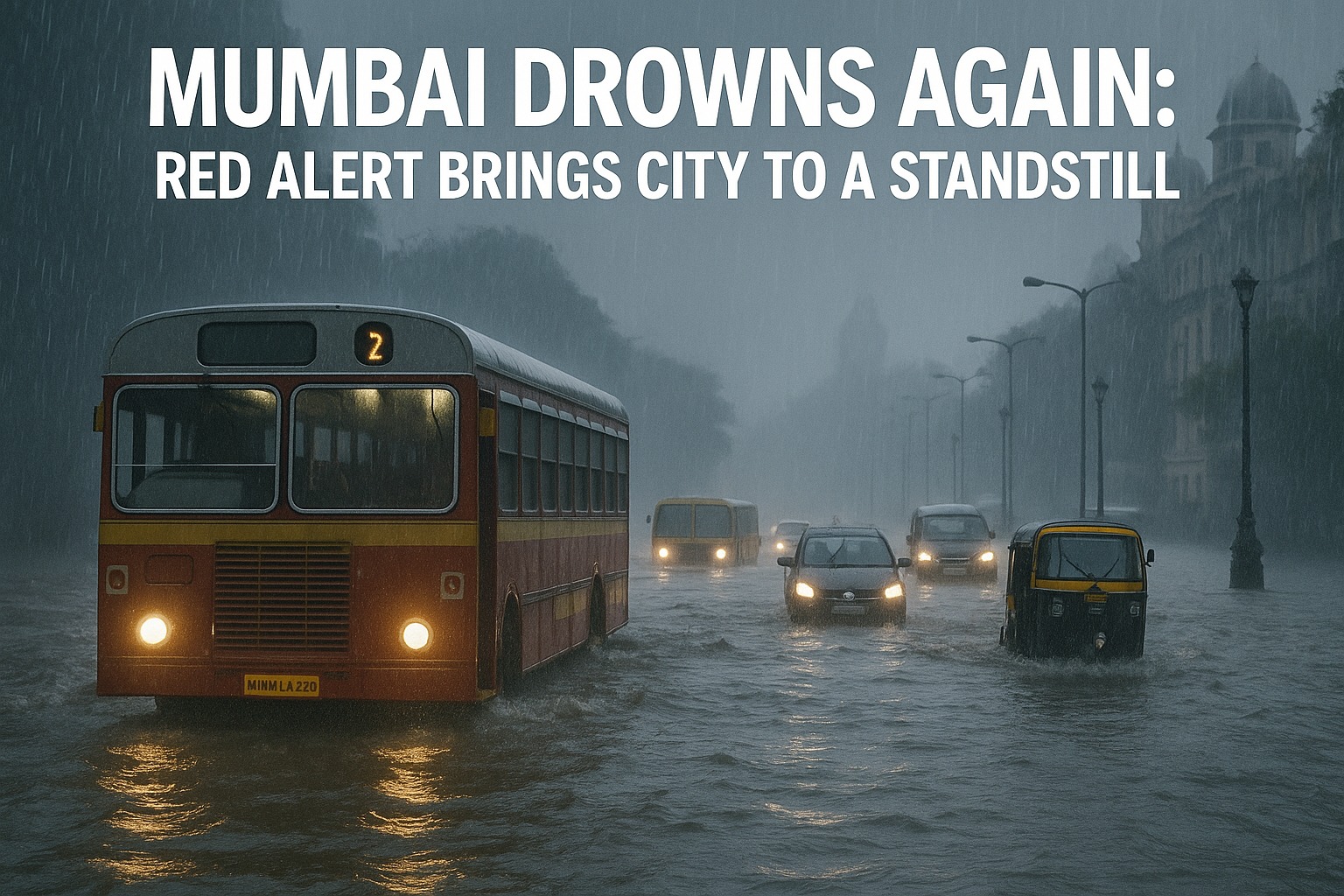
Mumbai, India’s financial capital, once again found itself struggling against nature’s fury as the India Meteorological Department (IMD) issued a red alert warning of extremely heavy rainfall. The downpour not only inundated streets and low-lying areas but also crippled local transport and forced Mumbai University to postpone its scheduled examinations.
Our editorial team has cross-verified all developments and brings you the 10 biggest updates from Mumbai’s rain-hit Monday, painting a complete picture of how the city of dreams turned into a city under siege.
1. IMD Issues Red Alert
The IMD sounded a red alert for Mumbai and adjoining districts, warning of rainfall exceeding 200 mm in 24 hours. The advisory urged citizens to avoid non-essential travel, especially in coastal and low-lying areas, where flooding was expected to worsen.
2. Local Trains Disrupted
Mumbai’s lifeline – its suburban local trains – was hit hard. Services on Central and Western Railway routes were delayed by hours, while some trains were cancelled altogether. Passengers were stranded at stations, and the crowding added to the chaos.
3. Road Traffic in Chaos
Heavy waterlogging brought traffic to a crawl across arterial roads like the Eastern Express Highway, Western Express Highway, and SV Road. Long queues of vehicles were reported, with some areas seeing cars and buses stuck in knee-deep water.
4. Mumbai University Exam Postponed
In a major decision impacting thousands of students, Mumbai University postponed its scheduled examinations, citing safety concerns. Students welcomed the move, though many complained about the uncertainty caused by last-minute changes.
5. Schools and Colleges Shut
The state government directed that all schools and colleges in affected areas remain closed until further notice, prioritizing student safety amid the worsening rain situation.
6. Flooding in Low-Lying Areas
Neighborhoods like Sion, Kurla, Dadar, Andheri, and Chembur faced severe flooding. Residents reported water entering homes, shops, and housing societies, reviving memories of past monsoon disasters in Mumbai.
7. Power Outages Reported
In some parts of the city, particularly in suburban belts, power cuts were imposed as a precautionary measure. Electricity supply companies said this was necessary to avoid accidents due to waterlogging.
8. Flight Operations Hit
Operations at Chhatrapati Shivaji Maharaj International Airport were disrupted. Several flights were delayed, and a few were diverted to nearby airports. Passengers faced long waiting hours inside terminals.
9. Rescue and Relief Work Intensified
The BMC (Brihanmumbai Municipal Corporation) deployed extra pumps and relief teams to clear waterlogging. Disaster response teams were kept on standby, and helplines were activated for residents in distress.
10. Citizens Brace for More Rains
Despite the challenges, Mumbaikars showed resilience. However, with IMD warning of continued heavy rains for the next 48 hours, the city remains on high alert, preparing for another potential wave of disruption.
Conclusion
The unfolding monsoon chaos in Mumbai highlights the recurring struggle between extreme weather and inadequate urban infrastructure. While the red alert has made citizens cautious, the combination of crippled transport, postponed exams, and flooded streets has once again exposed the city’s fragile coping mechanisms.
Mumbai, a city known for its spirit of endurance, continues to move forward even in the face of adversity. But as climate change intensifies monsoon patterns, the question remains — will Mumbai adapt fast enough to survive the storms of the future?
Related Posts



Stay Informed With the Latest & Most Important News
Previous Post
Next Post


Advertisement






Advertisement
