

Now Reading: Big Political Twist! Modi Refused to Exempt Himself From Removal Clause
-
01
Big Political Twist! Modi Refused to Exempt Himself From Removal Clause


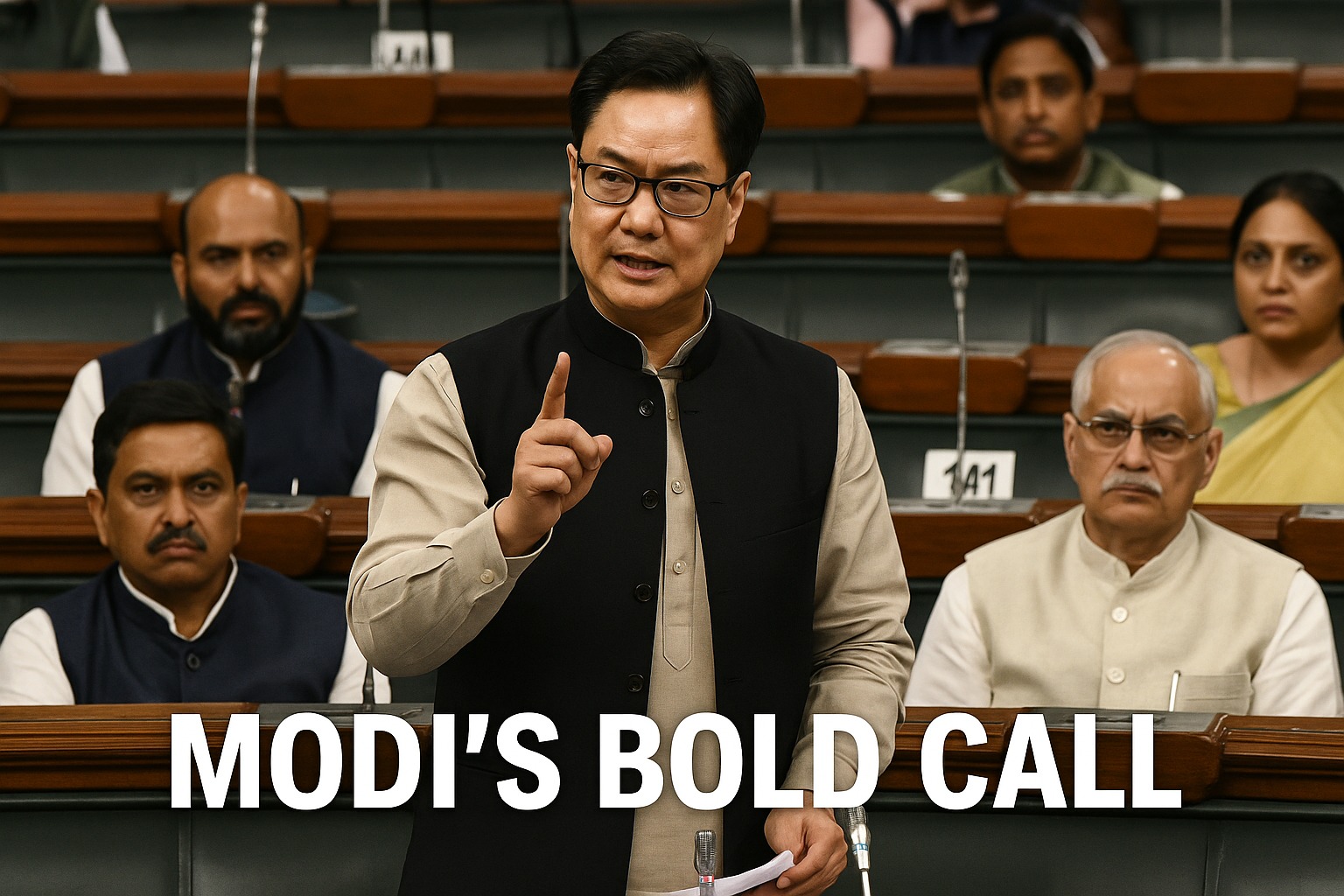
Union Parliamentary Affairs Minister Kiren Rijiju has stirred a major political debate with his revelation that Prime Minister Narendra Modi personally declined any special exemption for the office of the Prime Minister in the newly introduced bills that define the process for removal of ministers. Rijiju’s comments, made during a recent parliamentary discussion, are being viewed as both a strong message of equality before the law and a significant political statement in the context of governance reforms.
What Are These Bills?
The bills under debate deal with the accountability and removal of ministers in cases where allegations of misconduct, corruption, or breach of constitutional duty arise. They lay down the legal framework for how a minister — whether at the Union or state level — can be stripped of office if found guilty of serious violations.
In the past, such matters were largely left to the political and moral judgment of the Prime Minister or Chief Minister. The new bills aim to institutionalize the process, giving it legal clarity and transparency, ensuring ministers cannot cling to office in cases of proven misconduct.
Rijiju’s Revelation: No Special Privileges for the PM
During the heated session, Rijiju disclosed that some voices within the political and legal establishment had informally suggested that the office of the Prime Minister be given an exception — a carve-out where the PM could be immune from removal under such laws.
However, according to Rijiju, PM Modi outright rejected the proposal, insisting that the Prime Minister should be treated like any other minister. Modi reportedly emphasized that “in a democracy, no individual is above the law, not even the head of government.”
This refusal, Rijiju said, reflects Modi’s vision of accountability and equal responsibility across all levels of governance.
Why This Matters
The decision not to exempt the Prime Minister carries far-reaching political and constitutional implications:
- Strengthening Accountability: It signals a move towards tightening checks on political power and ensuring that even the highest office in the land is subject to scrutiny.
- Political Messaging: It projects Modi as a leader who does not want to be seen as above the system, but as part of it.
- Opposition Reactions: While some critics dismissed it as political posturing, others acknowledged that the principle of uniform accountability strengthens democratic institutions.
Debates and Criticism
The bills themselves have sparked vigorous debate:
- Supporters argue they will enhance public trust by formalizing procedures to act against erring ministers.
- Critics worry that the laws could be misused politically, with rival parties weaponizing them to destabilize governments.
Opposition leaders also questioned whether the refusal to exempt the Prime Minister was symbolic, pointing out that in practice, it is extremely difficult to remove a PM who enjoys a parliamentary majority.
A Larger Narrative on Modi’s Leadership
Rijiju’s revelation fits into the larger narrative often projected by the government — that Modi is committed to discipline, accountability, and transparency within public life. For his supporters, this is evidence of Modi’s willingness to be judged by the same standards as his ministers. For his critics, it raises the question of whether the principle will hold in practice during moments of real political crisis.
The Road Ahead
The bills on ministerial accountability are still under parliamentary scrutiny, with further discussions and possible amendments expected. What remains clear is that the refusal to exempt the Prime Minister has set the stage for intense political confrontation, especially with the Opposition likely to test the ruling party on whether these principles will truly be applied without bias.
Related Posts


Stay Informed With the Latest & Most Important News
Previous Post
Next Post

Advertisement




Advertisement
