

Now Reading: Bombay High Court Rebukes Maratha Quota Protesters for Bringing Mumbai to a Standstill
-
01
Bombay High Court Rebukes Maratha Quota Protesters for Bringing Mumbai to a Standstill

Bombay High Court Rebukes Maratha Quota Protesters for Bringing Mumbai to a Standstill

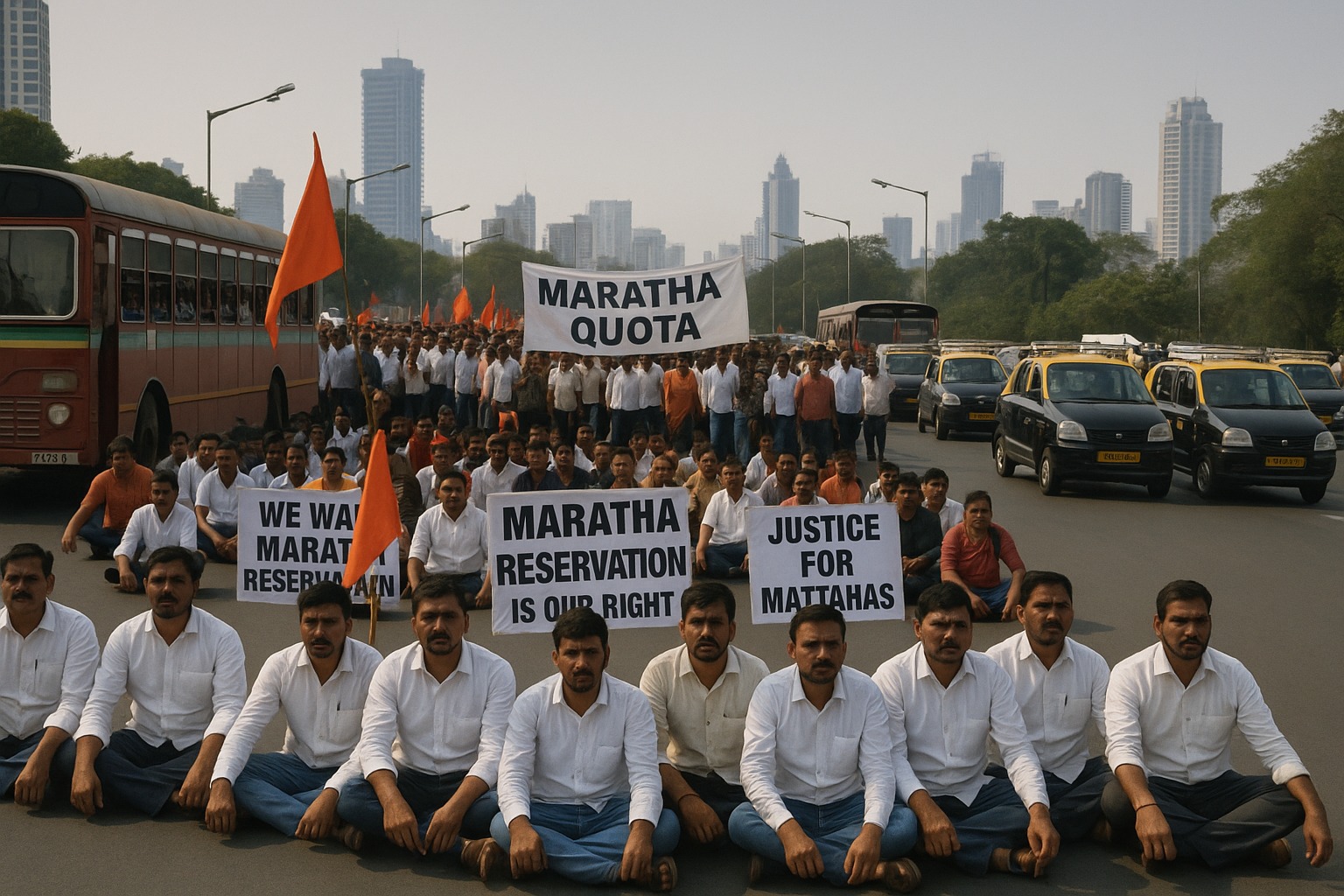
The simmering debate over Maratha reservation once again escalated into courtroom drama as the Bombay High Court pulled up Maratha quota protesters for disrupting daily life in Mumbai, questioning the methods of agitation that left the city’s transport, businesses, and schools in disarray. While acknowledging the community’s long-standing demand for reservation, the court made it clear that public inconvenience and disruption of law and order cannot be justified under the banner of protest.
This incident has reignited discussions on the balance between democratic rights and civic responsibility, with the High Court setting strong boundaries for the State government and agitators alike.
Background: The Maratha Quota Issue
The demand for Maratha reservation in education and government jobs has been one of Maharashtra’s most sensitive political flashpoints for over two decades. The community, which constitutes nearly one-third of the state’s population, has been demanding a share in the Other Backward Classes (OBC) quota.
In 2018, the Maharashtra government passed the SEBC (Socially and Educationally Backward Classes) Act, granting Marathas 16% reservation. However, the Supreme Court struck it down in 2021, ruling that the law breached the 50% cap on quotas set by earlier judgments.
Since then, various organizations, under the leadership of activist Manoj Jarange-Patil, have continued their fight for inclusion, staging hunger strikes, statewide bandhs, and large-scale marches.
The Recent Mumbai Protests
In August 2025, thousands of Maratha protesters marched into Mumbai, demanding immediate implementation of quota policies and threatening to escalate their agitation unless the government complied.
The demonstrations brought Mumbai to a near standstill:
- Traffic congestion paralyzed arterial roads.
- Public transport services were hit, with buses and trains delayed.
- Businesses and schools either shut down or saw major disruptions.
- Hospitals reported difficulty in staff movement, with ambulances struggling to navigate blockaded roads.
The sheer scale of disruption prompted the Bombay High Court to intervene, responding to multiple petitions highlighting the inconvenience faced by ordinary citizens.
High Court’s Stern Observations
The division bench, while hearing urgent matters, criticized both the protesters and the state government.
- On Public Disruption:
The Court remarked that while every citizen has the right to protest, no group has the right to hold an entire metropolis hostage. “Mumbai cannot be brought to a standstill each time a community raises its demand,” the bench observed. - On State’s Laxity:
The judges also questioned why the government allowed such large numbers of protesters to gather in Mumbai without adequate arrangements. They asked the police and civic authorities to ensure that the city’s law and order, transport, and essential services were not compromised. - On Preventive Measures:
The Court directed the State to stop further inflow of protesters into Mumbai to prevent escalation, stressing that containment and dialogue should be prioritized.
Political Undercurrents
The agitation has placed the ruling coalition under pressure. Parties across the spectrum have tried to appease the Maratha community without alienating OBC groups that fear dilution of their quota benefits.
- The Shinde-Fadnavis government faces the immediate challenge of negotiating with protest leaders while preventing violence.
- The Opposition, meanwhile, is using the protests to question the government’s administrative preparedness and commitment to social justice.
- OBC leaders have expressed concerns that accommodating Marathas within their category will erode existing reservation benefits.
Thus, the political stakes are high, with the agitation touching not just legal and administrative domains but also electoral calculations.
Social and Economic Impact on Mumbai
The High Court’s intervention comes against the backdrop of the enormous social and economic cost of such agitations:
- Mumbai, the financial capital of India, loses millions in productivity each day of shutdown.
- Daily wage workers, hawkers, and small business owners are among the worst hit.
- Students preparing for competitive exams faced cancellations and delays.
- Healthcare services faced severe disruption, putting patients at risk.
The episode has sparked renewed debate on whether large-scale protests should be allowed inside metropolitan hubs or diverted to designated grounds away from sensitive zones.
Protesters’ Perspective
Leaders of the agitation defended their actions, arguing that years of broken promises forced them onto the streets. They stressed that repeated assurances from governments had yielded little change, and only disruptive protests secured attention.
Manoj Jarange-Patil, the face of the movement, reiterated that Marathas had been historically marginalized in education and jobs and deserved immediate inclusion in reservation policies. He also urged the State to show urgency in resolving the issue rather than curbing dissent.
Courtroom as Arbiter of Democratic Limits
The High Court’s observations underline a larger principle: constitutional rights to protest must coexist with civic responsibilities. While dissent is a hallmark of democracy, protests cannot infringe on the fundamental rights of others to move freely, work, and access healthcare.
By directing the State to restrict further inflow of protesters and demanding better governance, the Court positioned itself as a guardian of balance—ensuring that citizens’ grievances are heard but not at the cost of collective inconvenience.
Editorial Perspective
The Maratha quota agitation reflects the deep challenges of affirmative action in India. Balancing historical injustices, contemporary aspirations, and constitutional caps is a delicate task. The High Court’s rebuke serves as a reminder that while communities have every right to seek justice, the methods of protest must not paralyze civic life.
The State must strengthen dialogue channels, offer time-bound solutions, and develop structured mechanisms for grievance redressal. Simultaneously, protesters must ensure that their fight for recognition does not undermine the very society they seek inclusion in.
Related Posts


Stay Informed With the Latest & Most Important News
Previous Post
Next Post

Advertisement




Advertisement
