Now Reading: Congress Even Taxed Children’s Toffees: PM Modi Slams Opposition Over GST Debate
-
01
Congress Even Taxed Children’s Toffees: PM Modi Slams Opposition Over GST Debate

Congress Even Taxed Children’s Toffees: PM Modi Slams Opposition Over GST Debate

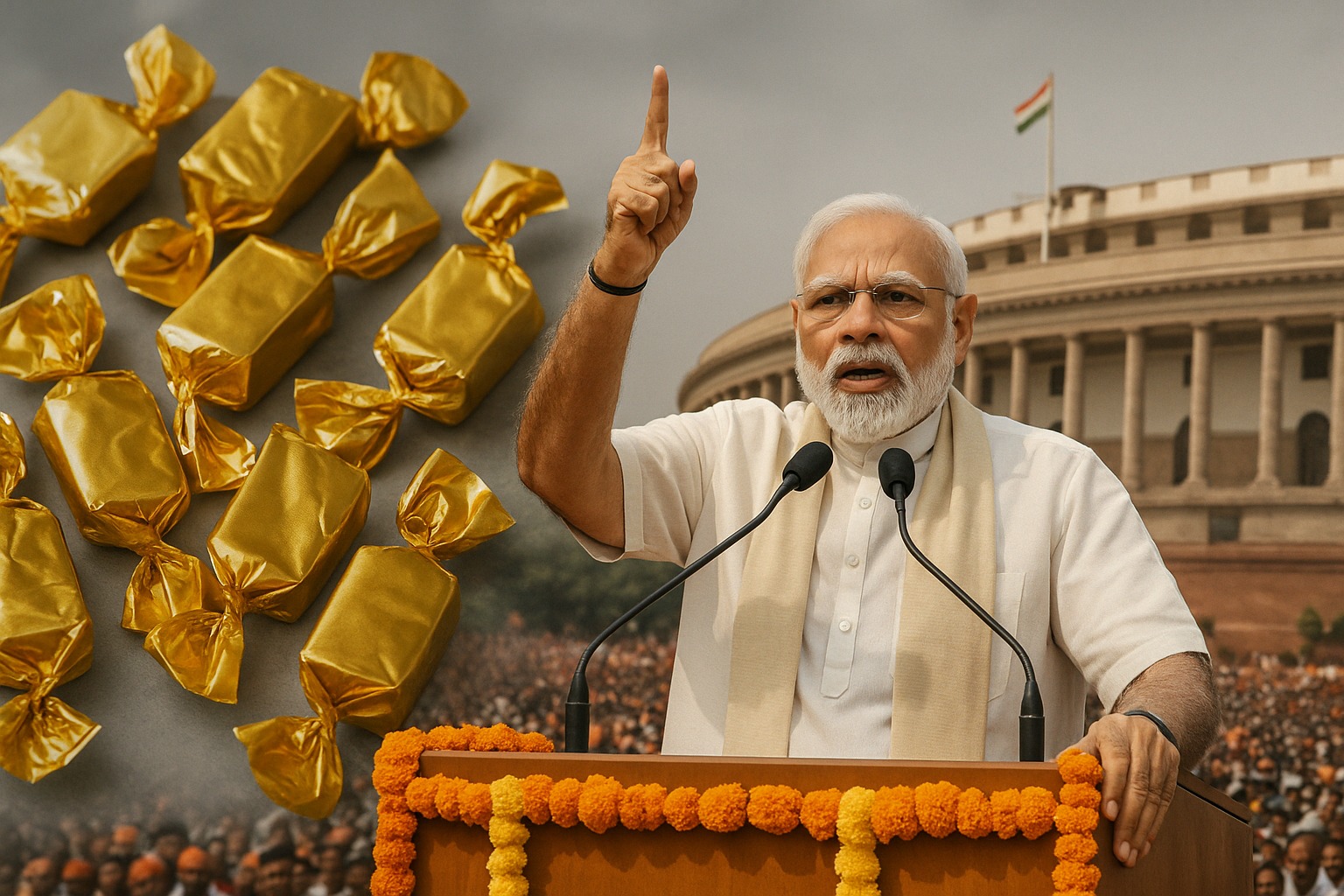
Prime Minister Narendra Modi sharpened his attack on the Congress party, accusing it of pushing ordinary citizens into financial hardship through unreasonable taxation practices during its years in power. In a scathing remark, Modi said that Congress governments went so far as to tax children’s toffees, turning even the smallest joys of life into a burden for families. His comments came during a public address where he positioned the Goods and Services Tax (GST) reforms under his government as a corrective measure to decades of mismanagement.
The Editorial Team of Behind The Headlines reviews Modi’s remarks, the historical background of GST, how taxation has shaped India’s economy, and what this political sparring means in the context of upcoming elections.
Modi’s Sharp Criticism of Congress
In his speech, Prime Minister Modi directly accused the Congress of exploiting the tax system for decades. He said that before GST streamlined indirect taxation, Congress governments had imposed a web of levies on everyday products. According to him, these included not just essentials and household items but even goods like children’s toffees, highlighting how taxation had seeped into the lives of ordinary citizens.
By framing his critique in such stark terms, Modi sought to drive home the message that Congress was disconnected from the struggles of common families. The imagery of a child’s toffee being taxed was designed to emotionally connect with voters, reminding them of how taxation under Congress had affected daily life.
GST as a Reform Measure
Modi contrasted this with the current system of GST, introduced in 2017 under his leadership. The GST replaced a complicated structure of excise duty, service tax, VAT, octroi, and other levies that varied across states.
Key features of GST include:
- One unified tax system across the country.
- Input tax credit for businesses, reducing cascading effects.
- Transparent rates that are easier for consumers to understand.
- Rationalisation of tax slabs to keep essentials affordable.
Modi emphasised that GST was designed to reduce inefficiency and prevent the exploitation of consumers through overlapping and hidden taxes.
Why Toffees Became a Talking Point
The reference to children’s toffees was not just rhetorical. Under earlier tax systems, many states levied VAT and excise duties even on inexpensive packaged items. While individually small, these taxes added up, raising prices and reducing affordability for poorer families.
By pointing to something as basic as toffees, Modi illustrated how deeply Congress-era taxes were felt by households. It was a way of translating complex tax debates into a simple, relatable example for the public.
Opposition Response
The Congress and other opposition parties have often criticised GST as well. They argue that the rollout was rushed and created confusion for small traders. Some leaders say the current GST structure still places a burden on micro and small businesses that lack resources to comply with digital systems.
However, Modi’s attack flipped the narrative, positioning Congress as historically responsible for exploitative taxation while portraying GST as a corrective measure.
Political Timing of Modi’s Statement
Modi’s statement comes at a politically charged moment, with assembly elections approaching in several states and national elections looming. Taxation, inflation, and economic management are key concerns for voters. By framing Congress as a party that taxed even children’s toffees, Modi is attempting to remind voters of what he calls Congress’s legacy of insensitivity towards ordinary people.
This line of attack also aligns with his larger narrative of pro-poor governance and middle-class relief, positioning his government as one that simplifies systems and reduces burdens rather than increasing them.
The Broader Debate on GST
While Modi defended GST as a necessary reform, the debate over its efficiency continues. Economists point out both benefits and challenges:
- Benefits:
- Unified market across India.
- Increased tax compliance.
- Formalisation of economy.
- Challenges:
- Compliance costs for small traders.
- Frequent rate changes causing uncertainty.
- Revenue pressures on states.
The debate underscores how taxation remains one of the most contested political and economic issues in India.
Impact on FMCG and Daily Essentials
The mention of toffees also connects to a larger story about FMCG products. Under earlier systems, goods like confectionery, chocolates, biscuits, soaps, and shampoos were often subject to multiple taxes. GST brought these under clearer slabs, often lowering the effective burden.
This is particularly relevant for India’s vast rural and lower-income populations, where small changes in pricing can significantly influence consumption habits.
Public Perception and Emotional Politics
By highlighting something as symbolic as children’s toffees, Modi turned a technical economic discussion into a political soundbite that resonates emotionally. For parents, this remark brings back memories of how even small purchases once felt expensive under a complex tax regime.
This tactic of framing taxation through everyday products helps simplify political messaging and makes economic reforms more relatable to voters who may not follow policy debates closely.
Expert Views
Tax experts note that while Modi’s claim has a rhetorical edge, it is true that India’s pre-GST tax structure often placed levies on low-value items. For instance, packaged sweets and toffees carried VAT in many states.
Economists also agree that while GST has flaws, it represents a more transparent and standardised system compared to what existed before. However, they caution that GST needs further simplification and more rationalisation of slabs to fully meet its objectives.
Conclusion
Prime Minister Modi’s remark that Congress “even taxed children’s toffees” is more than a political jibe. It highlights the long-standing debate over how taxation affects everyday life and positions GST as a corrective step taken under his leadership.
As elections approach, taxation narratives are likely to become sharper. While opposition parties will continue to criticise GST’s implementation, Modi is betting that the public will recall the complexity and burden of earlier systems and view his reforms as a relief.
The Editorial Team of Behind The Headlines will continue to monitor the unfolding political debate around GST, analysing both its economic impact and its use as a political tool in shaping voter perceptions.
Related Posts


Stay Informed With the Latest & Most Important News






Advertisement