Now Reading: Massachusetts Plane Crash: What Caused the Tragedy That Shut Down I-195
-
01
Massachusetts Plane Crash: What Caused the Tragedy That Shut Down I-195


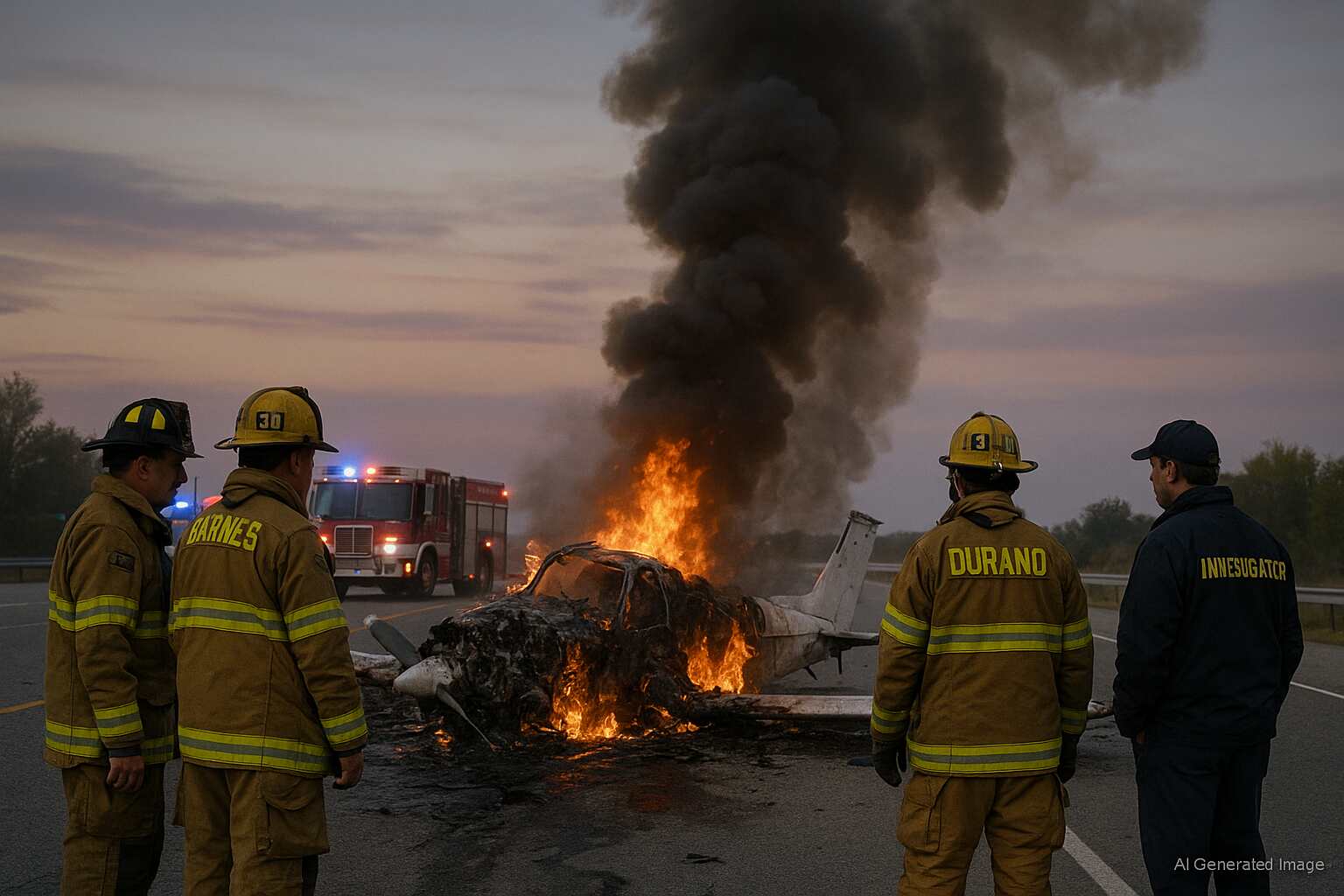
A routine flight that ended in tragedy
A quiet Sunday afternoon in Massachusetts turned tragic when a small private plane crashed on Interstate 195 near Dartmouth, causing chaos, fire, and an immediate shutdown of one of the state’s busiest highways. The incident, which took place around 3:00 PM local time, left multiple fatalities and raised serious questions about air safety and emergency response systems in the United States.
The crash has drawn nationwide attention — not only for the loss of life but also for the frightening scene it created: burning debris scattered across the highway, black smoke rising into the sky, and vehicles halted for miles. What exactly went wrong? And could this tragedy have been prevented?
The crash: What happened on I-195
According to preliminary reports, the plane — a small twin-engine aircraft — was en route to New Bedford Regional Airport when it suddenly lost altitude. Witnesses described seeing the aircraft wobble before hitting a section of the highway near the Faunce Corner Road exit.
Within seconds, the plane burst into flames upon impact. Several nearby vehicles narrowly escaped the explosion, while first responders from Dartmouth and neighboring towns rushed to the scene. Firefighters worked for hours to control the blaze and clear the wreckage.
Authorities immediately closed both eastbound and westbound lanes of I-195, redirecting traffic through alternate routes. The closure lasted well into the night as investigators from the National Transportation Safety Board (NTSB) and the Federal Aviation Administration (FAA) began examining the crash site.
(Read more: Inside the NTSB’s role in US aviation safety investigations and Why small aircraft accidents are on the rise).
Who was on board
Local authorities confirmed that the plane was carrying two people — a pilot and one passenger — at the time of the crash. Both were pronounced dead at the scene. Their identities have not yet been released publicly, pending family notification.
Officials stated that the aircraft was privately owned and had taken off from a small airfield in Rhode Island. It was expected to land at New Bedford, roughly 30 miles away, suggesting that the crash occurred during a short domestic flight.
No motorists on the ground were seriously injured, a fact authorities are calling “a miracle,” given the potential scale of disaster on a busy interstate.
Eyewitness accounts: “It just fell from the sky”
Several eyewitnesses who were driving on I-195 described the horrifying moment when the plane came down.
“It was flying low, almost scraping the trees, and then it just dropped,” said one motorist who was about 200 feet away from the crash site. “There was a huge explosion — the flames were unbelievable.”
Another driver told reporters that traffic immediately stopped as people jumped out of their cars to help. “A few of us ran toward it, but the heat was too strong. We couldn’t get close,” he said.
These eyewitness accounts are now part of the evidence being reviewed by investigators, as they piece together the aircraft’s final moments.
The investigation: What experts are saying
The NTSB has launched a full investigation to determine what caused the crash. Early indications point to a mechanical failure or possible engine malfunction, though weather conditions and pilot error are also being examined.
The weather in the region at the time was clear and mild, ruling out storm turbulence as a factor. Aviation analysts suggest that technical issues or fuel-related problems are more likely.
An FAA spokesperson confirmed that maintenance records, flight path data, and air traffic control communications are being reviewed. Investigators will also look into whether the aircraft was properly inspected and if the pilot was certified for the specific type of plane.
Why small plane crashes are becoming more common
While major commercial airline accidents have declined sharply over the past decade, smaller private aircraft crashes have continued to occur at a worrying rate.
According to FAA data, the United States sees over 1,200 general aviation accidents every year, many of them involving private pilots or charter operators. Unlike large airlines, smaller planes often have fewer layers of mechanical checks, limited automation, and pilots with lower flight hours.
Experts believe that tighter maintenance oversight, advanced safety equipment, and stricter pilot training are urgently needed.
The Dartmouth tragedy is now part of a troubling pattern — and a wake-up call for the aviation community.
The emergency response
Emergency services in Massachusetts were quick to act, but the incident tested the limits of coordination between air and ground agencies. Within minutes, firefighters from Dartmouth, New Bedford, and Fall River reached the scene. Police shut down the highway and created safety perimeters, while ambulances and hazmat teams managed fire control and fuel spill containment.
Governor Maura Healey praised first responders for their “swift and courageous actions” and promised full state cooperation with federal investigators.
Drone footage released later showed the full scale of the destruction — twisted metal, charred asphalt, and melted signage. For hours, the site resembled a war zone, with investigators wearing protective suits combing through wreckage.
Broader implications: Air safety and infrastructure risks
The crash has reopened an old debate: Should small aircraft be allowed to fly over densely populated or highway-adjacent areas?
Aviation safety experts argue that while such flights are legal, the risk increases when older planes or inexperienced pilots are involved. “Every minute a private plane flies over a city or interstate, it carries potential danger,” one aviation engineer noted.
The Massachusetts crash underscores the need for better air traffic zoning, emergency coordination, and infrastructure planning. Highways like I-195 are vital routes, and any disruption — especially from air disasters — affects not only safety but also logistics and economy.
The human cost behind the headlines
Behind the statistics and investigations are families grieving sudden loss. Residents near the crash site described the emotional toll of witnessing such devastation.
A local shop owner said, “I could feel the ground shake when it happened. My first thought was — not again.”
For nearby communities, this tragedy echoes previous small-aircraft crashes in New England, where private planes have gone down in residential areas or near highways.
Such incidents remind us that while aviation is statistically safe, its rare failures are profoundly human — instant, irreversible, and deeply affecting everyone nearby.
What happens next
The NTSB is expected to release a preliminary report within a week, outlining possible causes and technical findings. A full investigation may take several months.
Authorities will also examine whether similar aircraft have shown recurring mechanical issues, potentially prompting new safety advisories.
Meanwhile, the Massachusetts Department of Transportation has completed repairs to the affected stretch of I-195, which reopened after 24 hours of closure.
This tragedy, though isolated, has already reignited national discussion on small-plane regulations and the growing need for improved general aviation oversight in the US.
(Also read: How AI is reshaping aviation safety protocols).
Bigger picture: Balancing freedom and safety in the skies
Private aviation has always symbolized freedom — the thrill of flying without the red tape of commercial schedules. But as this crash shows, freedom in the skies comes with responsibility on the ground.
It’s time for a serious re-evaluation of how America treats small aircraft. Every new crash chips away at public trust and highlights the gap between ambition and accountability.
Technology exists today to prevent many such accidents — from real-time engine diagnostics to automated distress alerts — but adoption remains slow due to cost and regulation.
The Massachusetts tragedy is not just about one plane; it’s a mirror reflecting the state of small-scale aviation in America — ambitious, but often underprotected.
Conclusion: Lessons from loss
Every air crash leaves two stories — one written in data, and another written in emotion. The first is technical; the second is human.
This disaster on I-195 was not just a failure of machinery but a reminder of how fragile the balance between technology and safety can be. As the investigation unfolds, one hope remains constant — that lessons from this tragedy prevent another one from ever taking flight.
Behind The Headlines believes that accountability and empathy must go hand in hand. Aviation may be mechanical, but safety is deeply human.
Related Posts



Stay Informed With the Latest & Most Important News
Previous Post
Next Post


Advertisement