Now Reading: Trump to Oversee Cambodia–Thailand Peace Deal at ASEAN Summit
-
01
Trump to Oversee Cambodia–Thailand Peace Deal at ASEAN Summit


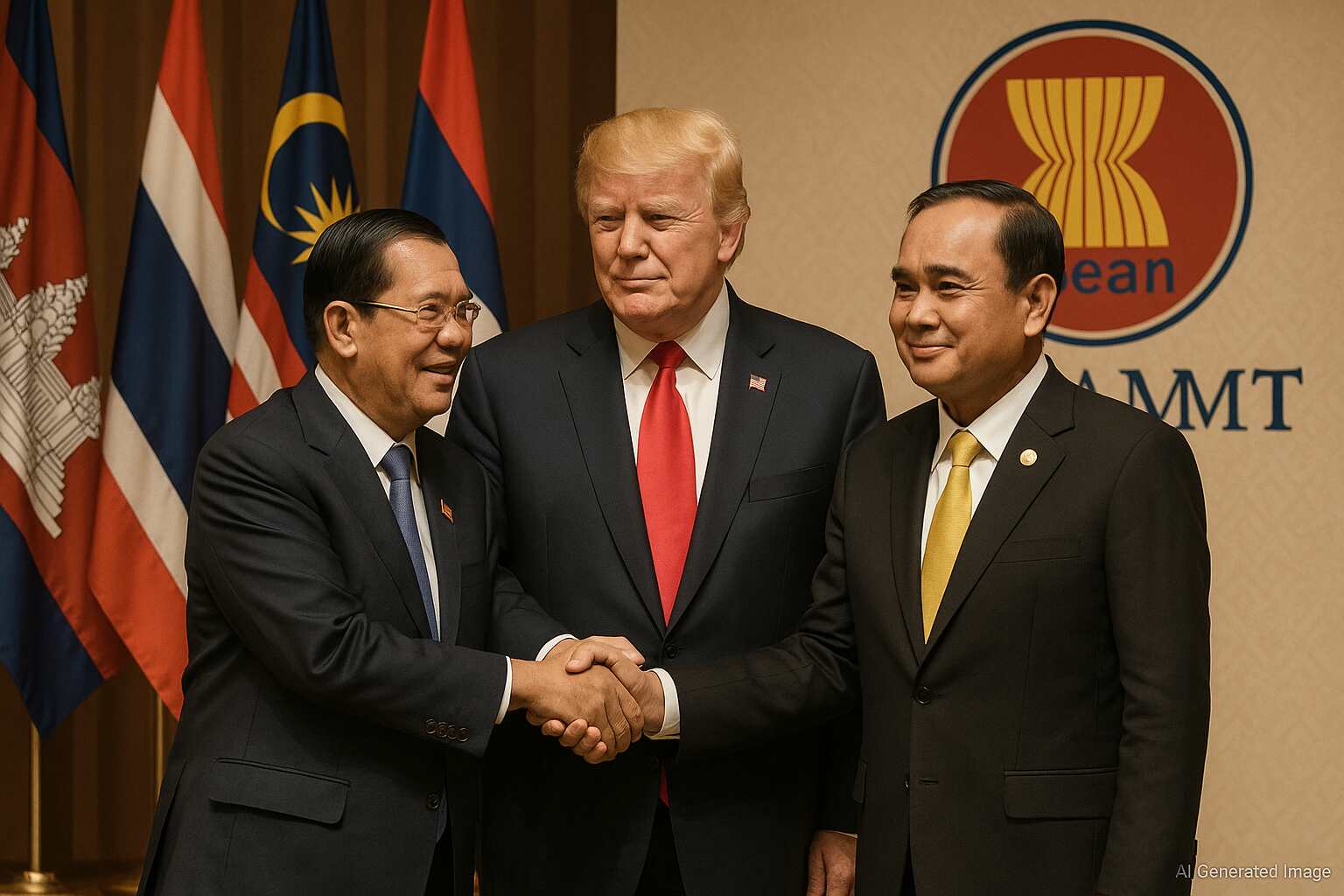
In a surprising yet symbolic move, US President Donald Trump is set to oversee a peace agreement between Cambodia and Thailand at the upcoming ASEAN Summit, signaling Washington’s renewed interest in stabilizing Southeast Asia’s regional conflicts. The announcement was made by Malaysia’s Foreign Minister, who revealed that both nations had agreed in principle to a peace roadmap under US mediation.
This marks the first time in over a decade that the United States will play a direct role in resolving an intra-ASEAN territorial and diplomatic dispute. For Trump, who recently reignited a trade standoff with China, this initiative offers a chance to project American leadership in Asia’s fast-changing power balance.
The background: Decades of quiet tensions
While Thailand and Cambodia have long shared cultural and historical ties, their relationship has also been marked by border tensions and nationalistic rivalries. The flashpoint remains the Preah Vihear temple area, a UNESCO World Heritage site perched along the two countries’ mountainous border.
In 2011, the dispute escalated into deadly clashes that left soldiers dead on both sides and displaced thousands of civilians. Despite rulings from the International Court of Justice (ICJ) affirming Cambodia’s sovereignty over parts of the area, political and military frictions persisted — occasionally flaring up through border skirmishes or diplomatic stand-offs.
The renewed effort toward peace, insiders say, was prompted by recent ASEAN discussions around regional defense and trade integration, where both nations saw the value of cooperation over confrontation.
(Read more: ASEAN’s evolving role in conflict resolution and Why the Preah Vihear dispute remains unresolved).
The Trump factor: America’s return to the ASEAN table
Donald Trump’s presence at the ASEAN Summit this year already carried major diplomatic weight. His decision to mediate the Cambodia–Thailand peace deal shows a clear attempt to reassert US influence in Southeast Asia, a region where China’s economic footprint has grown rapidly.
According to Malaysia’s Foreign Minister Zambry Abdul Kadir, the proposed agreement has been quietly facilitated through months of dialogue involving senior US State Department officials and representatives from both Phnom Penh and Bangkok.
“President Trump will serve as a neutral overseer, not an enforcer,” Kadir said in a press briefing. “The idea is to create a durable peace framework that allows both sides to manage territorial disputes without military escalation.”
Washington’s renewed involvement follows years of declining US participation in ASEAN under previous administrations. The White House now appears eager to demonstrate that American diplomacy can still shape the region’s security and trade architecture.
What the peace framework could include
According to early reports, the Cambodia–Thailand Peace Framework will likely include:
- Joint demarcation committees to settle lingering border claims.
- Demilitarized buffer zones around the Preah Vihear temple area.
- Cross-border economic cooperation projects to boost tourism and trade.
- ASEAN-led peace monitoring mechanism, supported by neutral observers.
Both countries have already agreed to a temporary freeze on border fortification, and there are plans to launch joint tourism initiatives highlighting shared cultural heritage.
For Cambodia, led by Prime Minister Hun Manet, the agreement could signal a shift away from years of reliance on Chinese political and military backing. For Thailand, it’s an opportunity to strengthen ties with Washington while maintaining ASEAN harmony.
Regional reactions: cautious optimism
Across Southeast Asia, the announcement has sparked cautious optimism. ASEAN members like Singapore, Indonesia, and Vietnam have welcomed the news, calling it a “positive step toward self-managed peace.”
However, regional analysts have noted that Trump’s involvement comes at a politically sensitive time — as his trade tariffs on China have reignited tensions that spill into ASEAN economies.
“Trump’s mediation could be both a peace gesture and a geopolitical statement,” says political scientist Dr. Supalak Ganjanakhundee of Bangkok University. “If he successfully brings Cambodia and Thailand to the table, it strengthens the US hand in ASEAN diplomacy just as China struggles to maintain influence through its Belt and Road projects.”
Cambodia’s perspective: balancing peace and independence
For Phnom Penh, the peace deal is a strategic balancing act. Cambodia has long been viewed as one of China’s closest allies in ASEAN, often aligning with Beijing on regional resolutions.
But under Prime Minister Hun Manet, who succeeded his father Hun Sen, there is a growing desire to diversify Cambodia’s foreign relations — particularly in defense and trade. The peace initiative with Thailand, under American oversight, could serve as a test of Cambodia’s diplomatic independence.
“This is about sovereignty through cooperation,” said a Cambodian government source quoted by local media. “We are not turning away from China, but we are showing that Cambodia can work with all partners — including the US — for peace.”
Thailand’s approach: stability first
For Thailand, domestic politics have made stability a key priority. Prime Minister Srettha Thavisin, who has faced economic challenges and coalition pressures, sees the peace deal as a diplomatic win that reinforces Thailand’s leadership in ASEAN.
Bangkok’s focus is on economic recovery and tourism revival, both of which benefit from peaceful borders. Thai officials say that improved cross-border relations with Cambodia could open up trade corridors and attract joint investments in transport and energy sectors.
Thailand’s Foreign Minister, Parnpree Bahiddha-Nukara, described the peace plan as “a pragmatic step toward long-term harmony,” noting that the two sides had already held multiple technical-level meetings in recent months.
The ASEAN angle: quiet diplomacy pays off
ASEAN, often criticized for its slow decision-making, has been quietly instrumental in building the momentum behind this peace process. Over the past year, ASEAN’s rotating chairs — including Malaysia — have worked to de-escalate member-state conflicts through dialogue rather than public confrontation.
Malaysia’s Foreign Ministry confirmed that ASEAN’s Political-Security Community division played a behind-the-scenes role in facilitating communication between Bangkok and Phnom Penh.
“This is ASEAN diplomacy at its best — slow, patient, and quietly effective,” said a senior Malaysian diplomat. “The fact that both countries are signing under ASEAN auspices shows that the bloc’s role as a peace enabler remains relevant.”
(Also read: How ASEAN handled the Myanmar crisis differently).
The bigger picture: Trump’s Asia comeback
For President Trump, this peace facilitation is more than a regional gesture — it’s part of a larger geopolitical strategy.
After years of focusing on tariffs and trade disputes, the Trump administration’s renewed diplomatic posture in Asia suggests an attempt to counter China’s expanding influence. From defense partnerships with the Philippines to trade overtures with Vietnam and Malaysia, Washington is building a multi-layered presence in the Indo-Pacific once again.
Analysts see the Cambodia–Thailand deal as a symbolic victory for Trump’s “peace through power” diplomacy — especially amid global criticism of his aggressive trade policies.
“By overseeing this peace process, Trump wants to showcase that he can negotiate deals, not just impose tariffs,” said Laura Rosen, a Washington-based Asia analyst. “It’s a soft power comeback — framed in the optics of leadership, even if the groundwork was laid by diplomats.”
Challenges ahead
Despite the diplomatic optimism, the road ahead is not simple.
Experts warn that nationalist sentiments in both Thailand and Cambodia could disrupt the fragile progress if local groups view the agreement as compromising territorial pride.
In addition, questions remain over implementation — especially regarding troop withdrawal and land demarcation. “Signing a deal is one thing; sustaining peace on the ground is another,” notes Thai security expert Kavi Chongkittavorn.
ASEAN will need to ensure that the peace mechanism is enforceable and transparent, particularly since past agreements have faltered due to lack of follow-through.
The human side of the conflict
For villagers along the border regions, peace is not a headline — it is a lifeline.
Residents near Sisaket province in Thailand and Preah Vihear in Cambodia have lived under intermittent fear for years, with periodic clashes forcing evacuations. Local economies have suffered, schools have been disrupted, and families have lived under the shadow of armed troops.
A Cambodian farmer quoted by local news said simply, “We just want the border to be quiet. We are tired of being afraid.”
If the new peace framework holds, it could restore livelihoods, tourism, and cross-border trade that have been frozen for more than a decade.
Conclusion: A test for diplomacy in divided times
The Cambodia–Thailand peace deal, under the watch of Donald Trump and ASEAN, could mark a rare diplomatic success in an era defined by economic conflicts and geopolitical divisions.
For ASEAN, it’s an affirmation that regional unity can deliver peace without external coercion. For the US, it’s a chance to redefine its role — not as a superpower imposing will, but as a mediator of cooperation.
Whether this agreement becomes a long-term success or another short-lived truce will depend on how deeply both nations commit to reconciliation. But for now, Southeast Asia — and the world — is watching a fragile hope take shape, with the potential to transform a historic rivalry into a symbol of pragmatic peace.
Related Posts

Stay Informed With the Latest & Most Important News
Previous Post
Next Post


Advertisement