

Now Reading: How Australian Scientists Sharpened James Webb Telescope’s Vision From a Million Kilometres Away
-
01
How Australian Scientists Sharpened James Webb Telescope’s Vision From a Million Kilometres Away

How Australian Scientists Sharpened James Webb Telescope’s Vision From a Million Kilometres Away

Sydney, October 15 (Behind The Headlines):
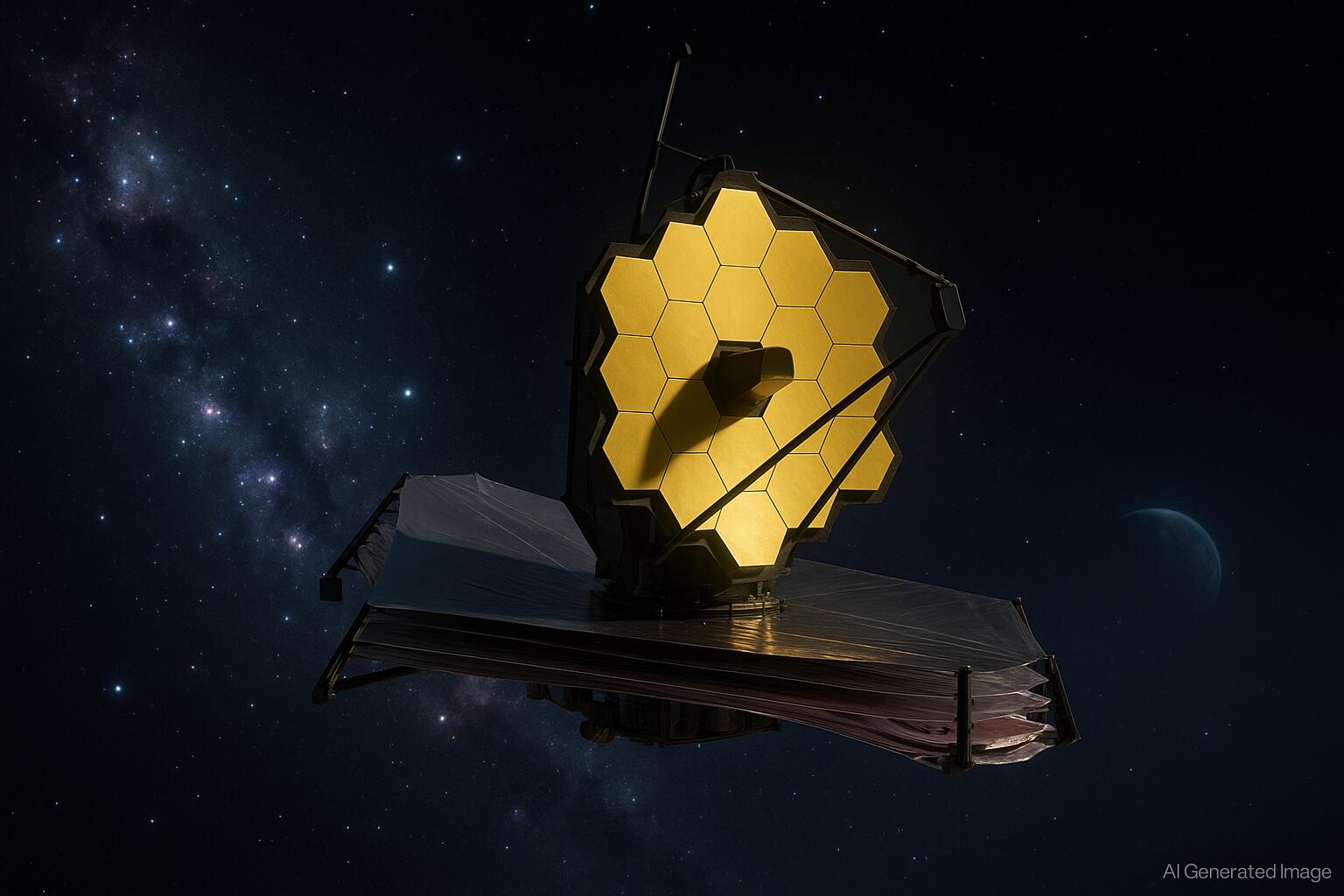
In one of the most remarkable feats of modern astronomy, a team of Australian scientists helped fine-tune the James Webb Space Telescope’s (JWST) vision — from nearly 1 million kilometres away. Their contribution, made from a remote lab on Earth, has helped the telescope produce some of the clearest images of the universe ever recorded.
The work demonstrates how human ingenuity and machine precision can collaborate across cosmic distances — rewriting what is possible in the field of deep-space imaging.
The challenge: aligning mirrors a million kilometres away
When NASA launched the James Webb Space Telescope in December 2021, its mirror alignment posed one of the greatest engineering challenges in modern science. The 18 hexagonal mirrors had to work together with nanometre precision — smaller than the width of a human hair — to produce sharp, focused cosmic images.
That’s where Australia came in. A specialist team from the University of Sydney and the Australian National University (ANU) developed advanced wavefront sensing and optical correction algorithms that helped align the telescope’s mirrors remotely.
Using a technique known as phase retrieval, the scientists analyzed patterns of starlight collected by JWST’s cameras and corrected for distortions caused by micro-vibrations, temperature fluctuations, and optical aberrations.
(Related: How Indian IT companies are adapting to global tech reform)
Precision from Earth: a scientific milestone
Operating from nearly a million kilometres away — at JWST’s Lagrange Point 2 orbit — the telescope sends streams of image data to ground stations. The Australian team’s software processes this data to interpret how light behaves when reflected off the telescope’s mirrors.
By measuring these light distortions in real time, the scientists guided NASA engineers to adjust each of the 18 mirrors with atomic precision.
Dr. Barnaby Norris, an optical physicist from the University of Sydney, called it “a cosmic-scale eye test — where the patient is a million kilometres away.”
The successful calibration improved JWST’s imaging sharpness by more than 30%, allowing it to capture clearer and more detailed visuals of early galaxies, distant stars, and exoplanet atmospheres.
Global collaboration at its best
The mission highlights the deep collaboration between NASA, the European Space Agency (ESA), and the Canadian Space Agency (CSA) — with Australia serving as a vital partner in optical data analysis.
Australia’s computational astronomy units have long contributed to global telescope projects, from Square Kilometre Array radio observatories to Hubble repair analytics. JWST represents their most complex challenge yet.
Dr. Jessica Speedie from ANU’s Research School of Astronomy described it as “the most delicate tuning operation ever done in astronomy.” She added that each mirror’s shape and tilt had to be aligned with precision to the billionth of a meter to ensure light waves met perfectly at the telescope’s focal point.
(You may also like: Google to spend $15 billion on AI data centre in biggest India investment)
What makes Webb’s vision unique
The James Webb Telescope is humanity’s window into the early universe — capable of seeing light that has travelled for over 13 billion years. Its infrared sensors allow scientists to look beyond dust clouds that once hid galaxies from view.
After the calibration, the telescope has produced stunning high-resolution images of star nurseries, black hole jets, and galaxy clusters like the Carina Nebula and Stephan’s Quintet.
The telescope’s near-perfect optical alignment has also helped confirm the presence of water vapour and methane on several exoplanets, expanding research into potentially habitable worlds.
Australia’s growing space ambitions
The success of JWST has given Australia new momentum in its push to become a key player in the global space technology ecosystem.
The country has recently launched programs through the Australian Space Agency to strengthen its footprint in satellite imaging, optical systems, and AI-based space analytics.
Canberra’s renewed focus on high-tech innovation could see more partnerships with NASA and ESA in upcoming missions, such as the Lunar Gateway and Exoplanet Imaging projects.
“The Webb collaboration showed that even from Earth, Australia’s expertise can change how humanity sees the universe,” said Dr. Norris.
The bigger picture: science without borders
What makes this story remarkable is not just the distance involved, but the philosophy behind it. Science, as the JWST mission proves, is no longer defined by geography.
From Silicon Valley’s data servers to Canberra’s optics labs, global scientists now work in real time on machines orbiting millions of kilometres away.
The James Webb Telescope is not just a NASA achievement — it is a testament to how human intelligence, collaboration, and precision engineering can collectively expand the frontiers of knowledge.
The Editorial Team of Behind The Headlines notes that Australia’s role in sharpening JWST’s vision symbolizes the power of cross-border innovation — a reminder that even the universe’s farthest lights can be reached through teamwork and science.
Related Posts


Stay Informed With the Latest & Most Important News


Advertisement









Advertisement
