

Now Reading: India’s Growth Hits 6.6%: IMF Says Tariffs Can’t Slow It
-
01
India’s Growth Hits 6.6%: IMF Says Tariffs Can’t Slow It


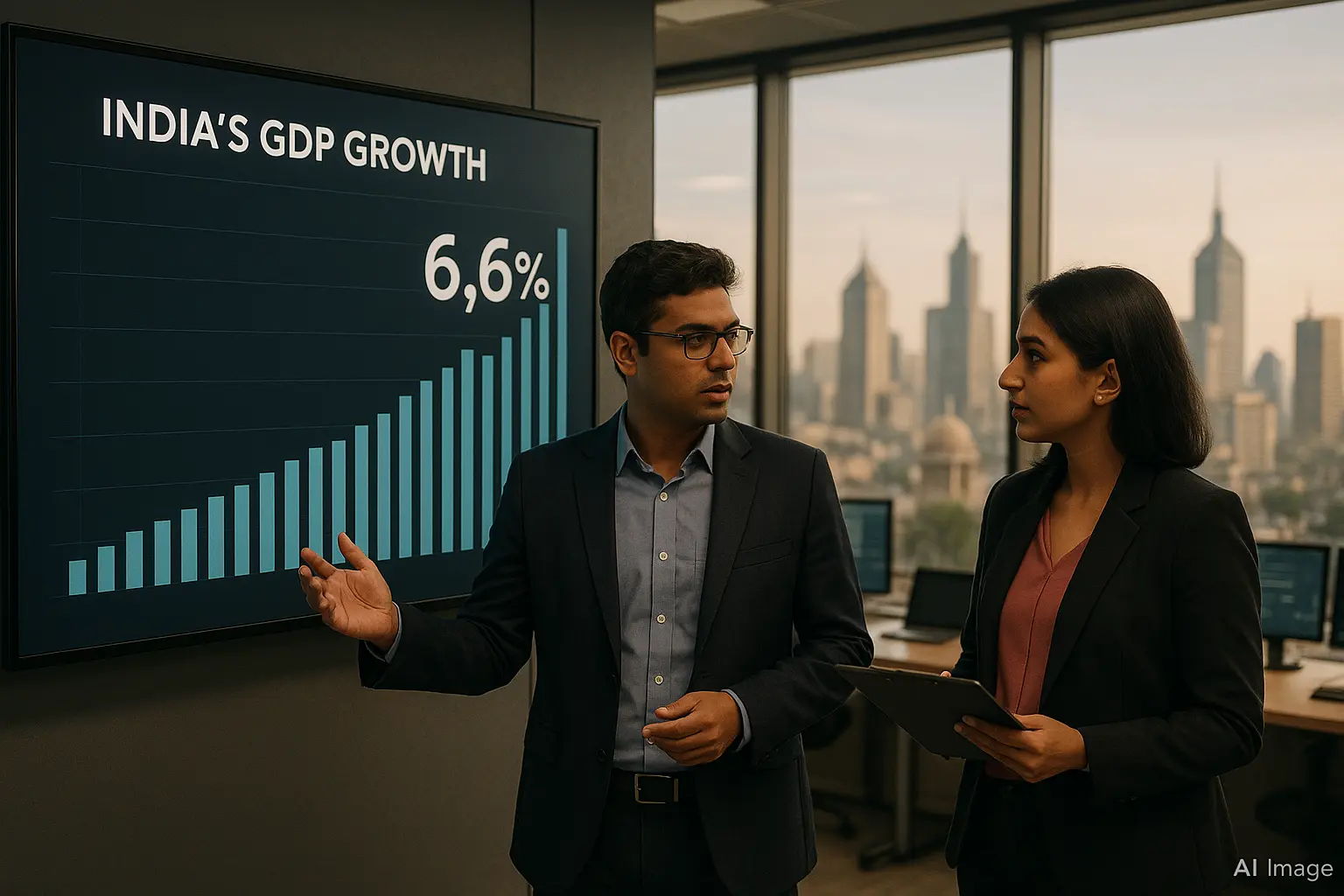
India’s economic engine continues to roar. The International Monetary Fund (IMF) has revised its growth forecast for India to 6.6 percent for FY 2025-26, reaffirming that global tariff pressures and trade tensions are unlikely to derail the country’s strong momentum. The report positions India well ahead of China, whose growth is expected to remain around 4.8 percent — further cementing India’s place as the fastest-growing major economy in the world.
The IMF’s assessment underlines a simple truth: India’s growth is no longer dependent on external winds. Domestic consumption, manufacturing revival, and steady investment inflows are keeping the economy on track even amid global uncertainty.
The Details Behind the Forecast
The upward revision from 6.3 to 6.6 percent reflects confidence in India’s internal resilience. The IMF highlights strong macroeconomic management, capital-expenditure-led fiscal policy, and robust private investment as key pillars.
While global trade continues to suffer from tariff barriers — including those imposed by the U.S. and Europe — India’s export base has diversified into high-value sectors such as electronics, automobiles, pharmaceuticals, and digital services. These factors are cushioning the country against global headwinds.
Another important driver is India’s rural and urban consumption story. Despite inflationary pressures, real household spending remains healthy, aided by stable employment and a rebound in rural demand after good monsoons.
(Read: “How India’s Domestic Demand Is Driving Post-Pandemic Recovery”)
Why Tariffs Aren’t Slowing India Down
IMF analysts point out that while tariffs can slow global trade volumes, their effect on India has been limited because of three reasons:
- Domestic-led economy: Nearly 60 percent of India’s GDP is driven by domestic demand, reducing reliance on exports.
- Diversified trade partners: India’s outreach to ASEAN, Africa, and West Asia has softened the blow from any single-market disruption.
- Strategic industrial policy: Schemes such as PLI (Production Linked Incentive) have boosted self-reliance and manufacturing exports, particularly in electronics and renewables.
This resilience makes India an outlier among emerging markets still struggling to shake off tariff-driven slowdown effects.
A Tale of Two Economies: India vs China
While India’s momentum grows, China faces slower consumption and a real-estate crisis. The IMF projects China’s growth at 4.8 percent — its lowest in over a decade.
India’s demographic advantage, digital transformation, and reform-driven growth stand in contrast. Experts note that India’s macro story is not about short bursts of expansion but about sustained stability. The IMF forecasts India will remain above 6 percent through 2030 if current policy trends continue.
(Read: “China’s Economic Slowdown: How India Is Emerging as a Bright Spot in Asia”)
Key Sectors Powering the Economy
- Manufacturing & Make in India: The government’s push for industrial corridors and incentives for electronics, EVs, and semiconductors is drawing global investors seeking alternatives to China.
- Services & Tech: IT, fintech, and AI-driven exports remain strong. India now accounts for nearly 60 percent of the world’s outsourced tech services.
- Infrastructure & Energy: Massive spending on highways, railways, and renewable energy projects is creating jobs and improving logistics.
- Finance & Consumption: The digital-payments revolution continues to deepen financial inclusion and support small-business growth.
Together, these sectors contribute to a more balanced economy — one less dependent on a single growth driver.
Expert Reactions and Market Sentiment
Economists call the IMF update “a vote of confidence in India’s fundamentals.” Equity markets reacted positively, with benchmark indices touching fresh highs on optimism that India will remain a global growth leader through the next decade.
Finance ministry officials said the IMF’s findings reinforce the government’s long-term strategy of combining fiscal discipline with infrastructure expansion. They stressed that India’s fiscal deficit path remains credible, and inflation is expected to remain within the RBI’s target range.
Global investors echoed similar optimism. Fund houses in Singapore and London have increased allocations to Indian equities, citing structural growth and policy continuity as key attractions.
Global Context: The World Slows While India Rises
The IMF’s World Economic Outlook shows the global economy expanding by 3.2 percent, with advanced economies struggling near 2 percent. In contrast, India’s 6.6 percent marks a clear divergence.
Even as global trade flows slow under protectionism, India’s position in the global south makes it a critical hub for manufacturing relocation. Supply-chain diversification strategies by multinational corporations are increasingly labelled the “India Plus One” model.
This dynamic is reshaping not just South Asia but also global trade geography.
The Bigger Picture: What This Means for India’s Future
Sustaining 6 percent plus growth requires more than momentum. Experts highlight several priorities:
- Reforms: Continued focus on labour and land reforms, tax simplification, and ease of doing business.
- Education and Skilling: A younger workforce must be trained for advanced industries and digital jobs.
- Infrastructure Financing: Expanding public-private partnerships for transport, housing, and energy projects.
- Sustainability: Maintaining growth without environmental damage through green energy and urban planning.
If these align, India could sustain its role as the world’s growth engine well into the 2030s.
(Read: “India 2030: Can Reforms Keep the 6% Growth Story Alive?”)
Conclusion
The IMF’s 6.6 percent forecast is more than a number — it’s a reflection of India’s economic maturity. While tariffs and geopolitical tensions test other economies, India’s blend of domestic strength, policy stability, and entrepreneurial spirit continues to shine.
As the world searches for growth in a divided global economy, India’s story stands as a reminder that self-reliance and open innovation can coexist. The challenge now is to turn this momentum into long-term resilience — keeping the focus on jobs, equity, and sustainability.
Related Posts


Stay Informed With the Latest & Most Important News
Previous Post
Next Post

Advertisement








Advertisement