

Now Reading: Brazilian Model Reacts to Rahul Gandhi’s Haryana Vote Fraud Claim
-
01
Brazilian Model Reacts to Rahul Gandhi’s Haryana Vote Fraud Claim

Brazilian Model Reacts to Rahul Gandhi’s Haryana Vote Fraud Claim

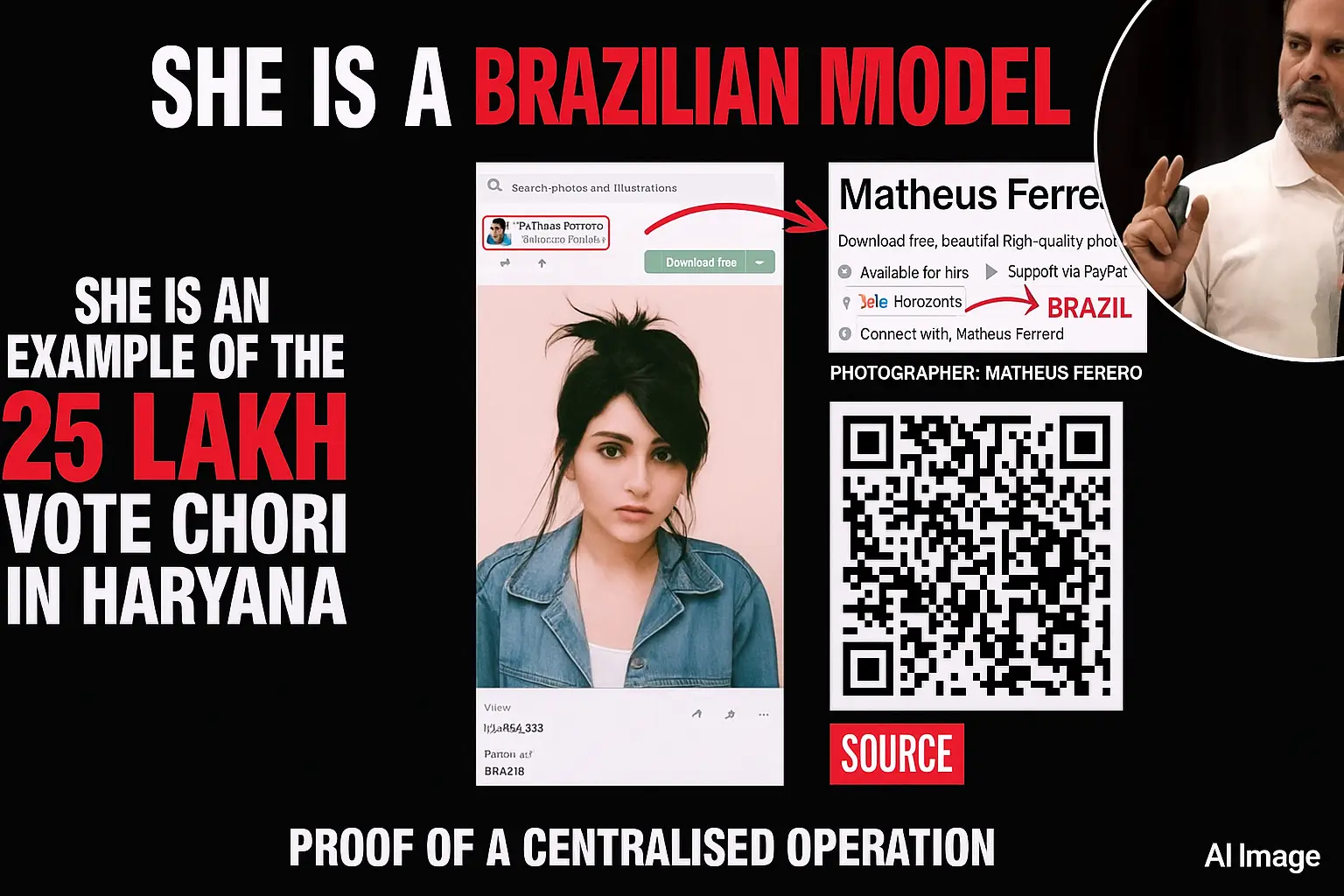
The controversy over alleged vote fraud in Haryana took a global turn when a Brazilian model reacted to the claim that her image was used to cast multiple ballots in the state. The Editorial Team of Behind The Headlines reports on how a local Indian electoral accusation became a subject of international curiosity and diplomacy.
Details & Background
At a press conference, Rahul Gandhi presented a photograph of a woman he said was a Brazilian model and claimed that the same image appeared in Haryana voter lists under different names, purportedly to cast 22 votes across ten booths.
The woman was identified by media as Larissa Nery (also reported as Larissa Rocha Silva), a hair-salon operator from Belo Horizonte in Brazil’s Minas Gerais region, who said that the image is old, she has no connection to Indian elections and she was shocked when her photo started circulating.
The claim by Gandhi came as part of larger allegations that about 25 lakh fraudulent entries existed in Haryana’s 2024 Assembly polls — roughly 12% of the electorate — and that 1 in 8 voters was a fake identity.
The Indian Election Commission (IEC) responded by asking Gandhi to submit his evidence under oath, questioning the basis of the allegations.
Analysis
The International Twist
What begins as an Indian electoral dispute quickly becomes global when a Brazilian national finds herself unexpectedly caught up in it. The use of her image raises questions about data security, cross-border identity misuse, and the chain of evidence in election-fraud claims.
Credibility and Evidence on the Line
Gandhi’s claim rests heavily on the image appearing multiple times in the electoral rolls. But the model denies any involvement, and the IEC says no first-hand objections were raised during polling. This leaves questions about how the evidence was sourced, verified and presented.
Political Stakes in Haryana and Beyond
For the opposition, these revelations serve to question the integrity of the 2024 Haryana elections and galvanise their narrative ahead of the upcoming Bihar polls. For the ruling side, the international dimension can be used to suggest sensationalism or mis-representation. The image and its origin become part of the wider political battle over electoral legitimacy.
Reactions / Statements
- Larissa Nery said in a video: “They are using an old photo of me … I must have been 18–20.” She added journalists started contacting her salon and social-media account asking about the “voting in India” claims.
- A BJP spokesperson challenged Gandhi to provide full proof and accused him of distracting from current elections.
- Independent fact-checking agencies noted that the photo’s online availability and social-media reuse complicate claims of its use in Indian electoral rolls.
Bigger Picture / Future Impact
This episode highlights the vulnerability of electoral systems to international and digital identity misuse. If indeed photos of individuals from abroad are found in voter rolls, it would demand urgent review of verification processes. For Indian political discourse, this incident could influence how claims of vote-fraud are presented — with higher demands for verifiable evidence rather than rhetorical charges. For future elections, especially in states like Bihar, allegations of fake voters and duplicate entries might gain more traction and scrutiny.
Conclusion
What began as an allegation of large-scale “vote chori” in Haryana has expanded into a cross-border identity controversy involving a Brazilian model. Whether the image was used in Indian electoral fraud or simply became a viral mis-identification, the episode underscores the need for transparency, robust documentation and caution in political claims. The Editorial Team of Behind The Headlines will continue to monitor how this develops, how the IEC responds and what it means for Indian democracy.
Internal Links
- See our in-depth analysis of the ‘vote chori’ claims in Haryana.
- Explore how identity verification and duplicate-voter risks are shaping Indian elections in 2025.
Related Posts


Stay Informed With the Latest & Most Important News
Previous Post
Next Post

Advertisement




Advertisement
