

Now Reading: Trump announces first phase of Gaza peace deal agreed by Israel and Hamas
-
01
Trump announces first phase of Gaza peace deal agreed by Israel and Hamas


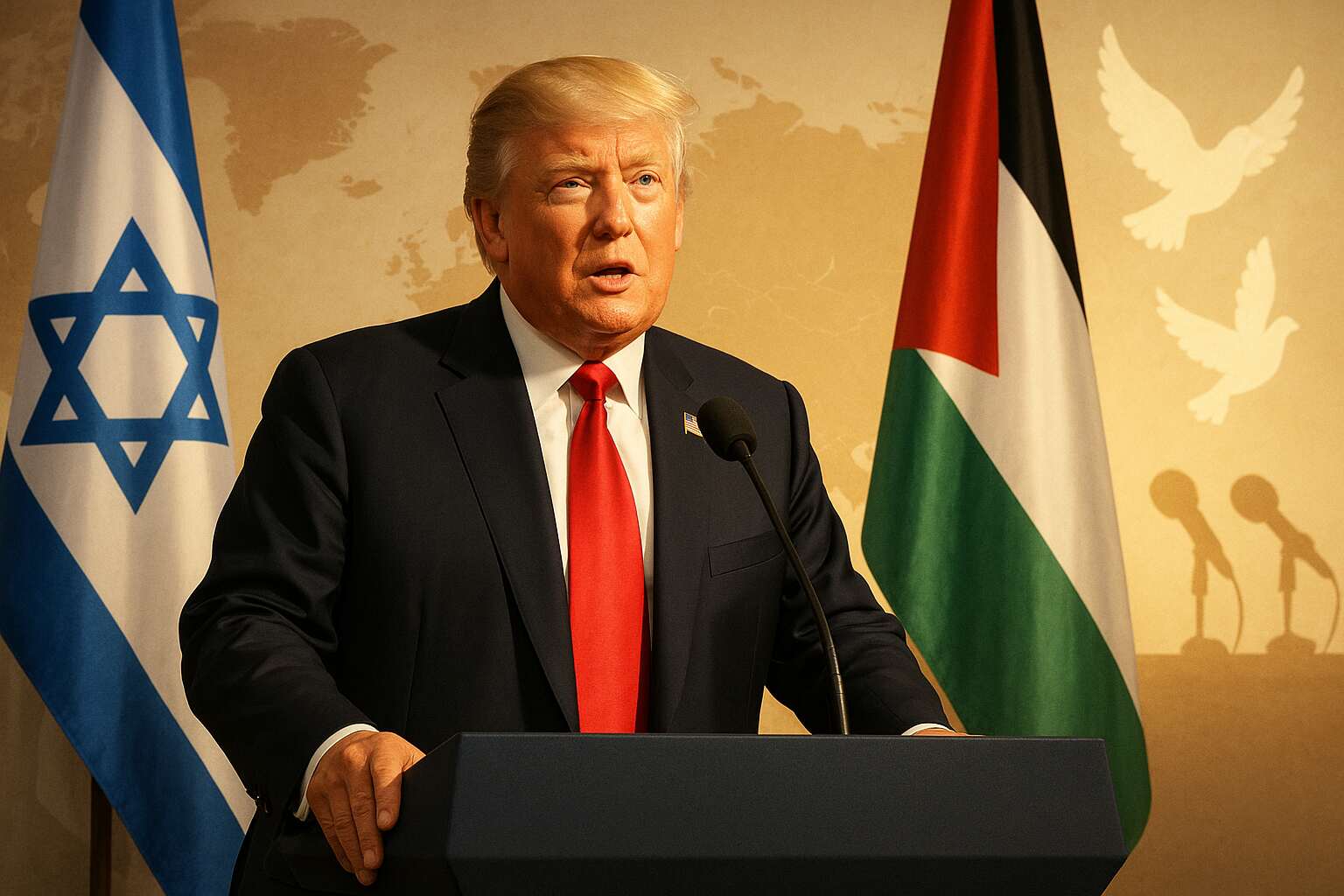
Former US President Donald Trump has announced that Israel and Hamas have agreed to the first phase of a Gaza peace deal, marking a potential turning point in one of the world’s longest-running conflicts.
The announcement was made during a late evening briefing in Washington, where Trump described the agreement as a “first real path to ending the suffering.” The deal reportedly includes humanitarian measures, a pause in hostilities, and a roadmap for further negotiations.
The Editorial Team of Behind The Headlines examines what this development means for both sides, the global community, and the future of Middle East diplomacy.
The first phase of the Gaza peace deal
According to Trump, the first stage of the peace framework will focus on humanitarian access, prisoner exchanges, and a mutual pause in hostilities.
The plan is divided into three stages, beginning with a temporary ceasefire expected to last six weeks. During this period, both sides will halt offensive operations while international agencies begin delivering food, medicine, and reconstruction supplies to Gaza.
Subsequent stages will include political talks and security arrangements, monitored by regional powers including Egypt and Qatar.
This structure mirrors earlier peace frameworks but differs in its focus on small, verifiable steps designed to build trust gradually between Israel and Hamas.
(Read — Israel-Gaza ceasefire efforts: why past negotiations failed)
How the deal took shape
Diplomatic insiders say the agreement followed weeks of secret discussions involving American, Egyptian, and Qatari mediators. The talks intensified after a series of humanitarian appeals from the United Nations and international NGOs.
Officials close to the process said multiple communication channels were used to maintain confidentiality. Trump reportedly held direct phone calls with Israeli Prime Minister Benjamin Netanyahu and Egyptian President Abdel Fattah El-Sisi before making the announcement public.
A former Middle East envoy told Behind The Headlines that this framework “was built through multiple conversations, not a single round of negotiation,” emphasizing that “it’s more about restoring minimal trust than achieving complete peace.”
Humanitarian priorities in focus
The first phase is largely humanitarian, aiming to address the immediate crisis in Gaza. Hospitals have been overwhelmed, food supplies have collapsed, and thousands of civilians have been displaced.
Under the agreement, United Nations convoys will be allowed to operate along designated safe corridors, supervised jointly by Egyptian and international peace monitors. This system is expected to bypass some of the logistical barriers that previously hindered relief efforts.
For civilians trapped in Gaza, even a temporary pause could bring relief from months of airstrikes and shortages. Aid organizations have already begun preparing for renewed access to affected regions.
(Also read — UN warns of Gaza’s health crisis as supplies dwindle)
Israel’s position
For Israel, the deal provides an opportunity to stabilize border conditions while maintaining its core security priorities. The Israeli government has emphasized that any truce must guarantee the end of rocket attacks and infiltration attempts from Gaza.
Israeli forces are expected to maintain aerial surveillance during the truce and reserve the right to respond if terms are violated.
Prime Minister Netanyahu has described the talks as “a responsible step toward peace,” though his coalition remains divided over long-term engagement with Hamas. For many in Israel, the deal is a cautious but necessary move after months of costly operations.
Hamas’s conditional acceptance
Hamas has accepted the first phase as a humanitarian agreement rather than a full ceasefire.
A spokesperson from the group’s Doha office said that “ending the suffering of our people requires immediate action, even if this is only a first step.” Hamas leaders have also called for complete withdrawal of Israeli forces, an end to the economic blockade, and international guarantees for future Palestinian representation.
Despite these conditions, the decision to move forward suggests that Hamas is seeking breathing space for civilians and for its own governance structure in Gaza.
Trump’s diplomatic positioning
The Gaza peace deal also carries political weight for Donald Trump. It represents his attempt to reassert American influence in Middle East diplomacy after years of shifting alliances.
Trump has framed the announcement as proof that the United States can still broker meaningful agreements in volatile regions. Analysts view it as both a humanitarian gesture and a strategic move designed to restore Washington’s credibility as a global negotiator.
The challenge ahead lies in implementation. Experts warn that without strong regional enforcement, the deal may face the same pitfalls that derailed earlier ceasefire efforts.
(Related analysis — Trump’s Middle East legacy: from Abraham Accords to Gaza diplomacy)
Global and regional reactions
The international community has reacted with cautious optimism.
The United Nations Secretary-General welcomed the agreement, urging both parties to “turn this announcement into immediate relief for civilians.” European leaders echoed similar sentiments, calling it a “first step toward meaningful peace.”
Reactions from the region were mixed. Iran and Turkey warned that temporary truces would not resolve the underlying causes of conflict unless long-term political solutions were addressed.
Egypt and Qatar, who helped broker the deal, have pledged continued involvement to ensure both sides uphold their commitments.
Expert perspective
Analysts are divided on whether this agreement can evolve into something lasting. Some believe it signals genuine fatigue among warring parties, while others fear it could merely pause fighting until both sides regroup.
Middle East analyst Reem Khoury said, “Peace in this region rarely comes in one stroke. It’s always a sequence of fragile pauses that may lead to something permanent.”
The inclusion of international monitors and the humanitarian-first focus may increase the chances of sustainability compared to earlier attempts.
The role of Egypt and Qatar
Egypt’s mediation experience and Qatar’s financial influence were critical in securing this breakthrough. Cairo helped design the ceasefire’s verification mechanism, while Doha worked to ensure funding channels for humanitarian support remain transparent.
This coordination reflects a growing pattern in the region — Arab states acting as pragmatic stabilizers rather than ideological actors. Their involvement also ensures that future phases of the deal retain Arab legitimacy.
Impact on Gaza and Israel
In Gaza, the news of the agreement has brought cautious hope. Residents have started preparing for the possible arrival of aid convoys, and local leaders are urging compliance from all sides to ensure that relief reaches the people.
In Israel, the reaction has been mixed. Some view the pause as an opportunity to recover hostages and restore normalcy to southern towns. Others worry that Hamas will use the lull to rebuild its military infrastructure.
Public debate within Israel’s parliament reflects this divide, balancing humanitarian empathy with security caution.
A fragile path forward
While the announcement has generated global attention, the agreement remains fragile. Each side will face domestic and political pressures that could undermine progress.
The next six weeks will serve as a critical test of commitment. If the ceasefire holds and humanitarian relief is delivered effectively, both parties could enter the second stage of talks with renewed confidence.
Diplomats say the next phases could involve border arrangements, economic reconstruction, and eventual political dialogue about Gaza’s governance.
The bigger picture
This development extends beyond Gaza. It is part of a broader reshaping of regional power balances where countries like India, Saudi Arabia, and Japan have growing stakes in stability and trade through the Middle East.
A lasting peace could help stabilize energy markets, improve humanitarian coordination, and reframe the United States’ engagement in the region under Trump’s foreign policy narrative.
(Read — Energy and peace: why the Middle East still shapes global stability)
Conclusion
The first phase of the Gaza peace deal between Israel and Hamas marks a rare moment of convergence after years of violence and mistrust.
It is not yet peace — but it is a pause, an opening for dialogue, and a test of whether diplomacy can still hold meaning in one of the world’s most divided regions.
The Editorial Team of Behind The Headlines believes that the coming weeks will reveal whether this moment will be remembered as the beginning of a new chapter or another fragile ceasefire destined to collapse under old tensions.
For now, the world watches cautiously, hoping that from exhaustion and loss, a new willingness for coexistence might emerge.
Read More:
- Israel-Gaza ceasefire efforts: why past negotiations failed
- Trump’s Middle East legacy: from Abraham Accords to Gaza diplomacy
- Energy and peace: why the Middle East still shapes global stability
Related Posts


Stay Informed With the Latest & Most Important News
Previous Post
Next Post

Advertisement







Advertisement
