

Now Reading: India–Australia Defence Dialogue: Rajnath Singh’s ‘Productive Talks’ Signal Deeper Strategic Alignment
-
01
India–Australia Defence Dialogue: Rajnath Singh’s ‘Productive Talks’ Signal Deeper Strategic Alignment

India–Australia Defence Dialogue: Rajnath Singh’s ‘Productive Talks’ Signal Deeper Strategic Alignment

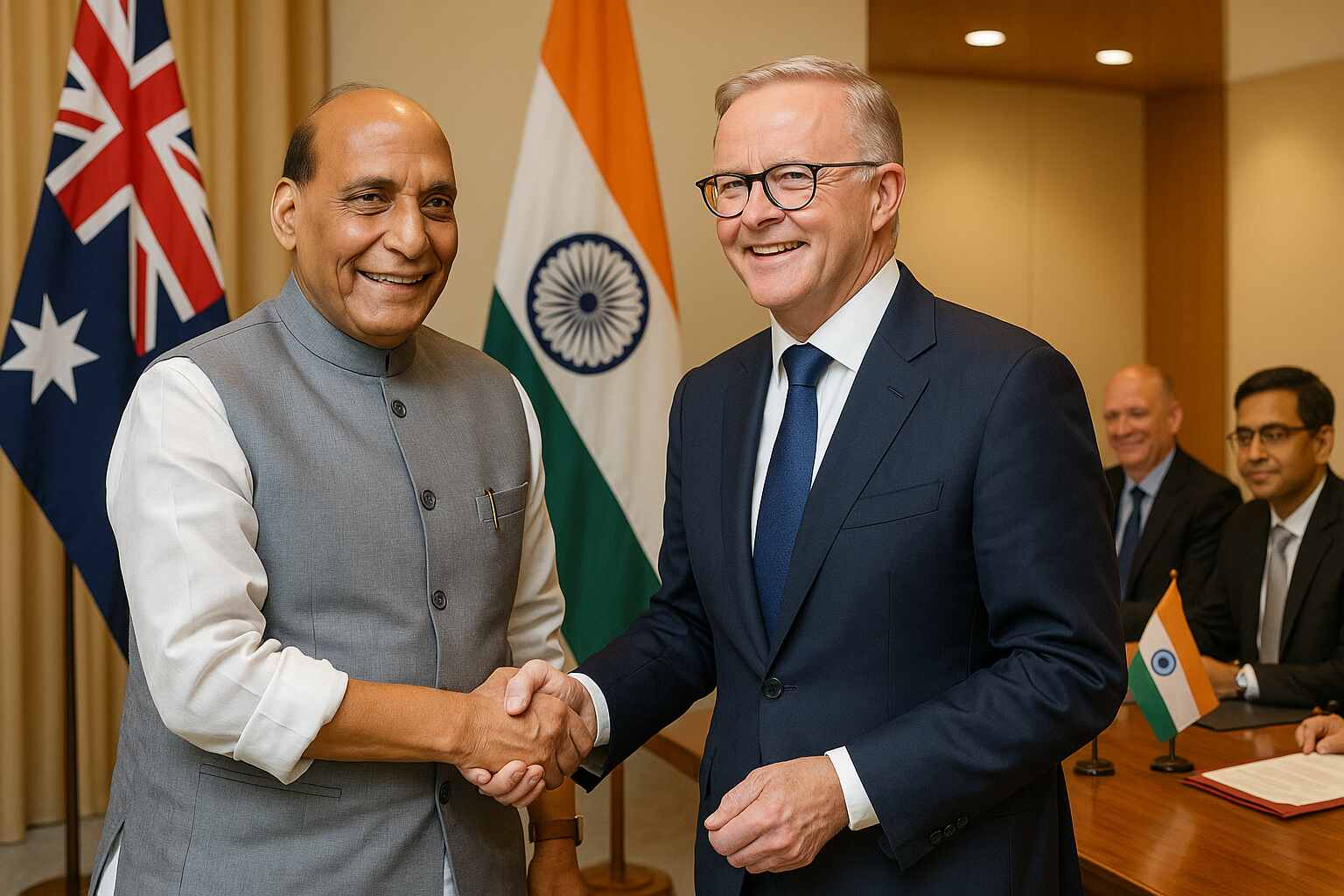
India’s defence diplomacy continues to gain momentum as Defence Minister Rajnath Singh held “productive and forward-looking discussions” with Australian Prime Minister Anthony Albanese and Defence Minister Richard Marles in Canberra.
The meetings, part of Singh’s official visit to Australia, come at a critical time when the Indo-Pacific region faces increasing strategic challenges from aggressive posturing by regional powers.
Both sides reaffirmed their commitment to freedom of navigation, mutual security, and regional stability, emphasizing that the India–Australia partnership has evolved from symbolic cooperation to substantive strategic action.
The Editorial Team of Behind The Headlines examines how these talks deepen bilateral trust, strengthen defence supply chains, and redefine the Indo-Pacific equation in a changing world.
Strengthening a Strategic Pillar
India and Australia have emerged as two vital pillars of the Quad Alliance, along with Japan and the United States. The Singh–Albanese meeting underscored that both nations now view their partnership as “essential to maintaining a free, open, and resilient Indo-Pacific.”
The dialogue covered joint military exercises, maritime domain awareness, and defence technology sharing. Singh described the discussions as “extremely positive and focused on long-term collaboration.”
While past India–Australia interactions were limited to naval cooperation, this meeting moved beyond symbolic gestures to actionable frameworks — joint patrols, cyber-security cooperation, and even co-development of advanced defence systems.
(Read — “India–Japan Maritime Pact: Strengthening the Indo-Pacific Chain”)
Rajnath Singh’s Indo-Pacific Vision
For Rajnath Singh, the visit isn’t just diplomacy — it’s strategic signalling.
India’s Defence Minister used the visit to reinforce a simple message: that New Delhi’s partnerships in the Indo-Pacific are not transactional, but transformational. Singh’s interactions with PM Albanese highlighted shared goals of securing maritime routes, combating transnational threats, and promoting technological innovation in defence production.
The meeting also reflects India’s broader shift toward multi-alignment, engaging democracies that share its vision of an open, rules-based global order.
In Canberra, Singh emphasized India’s readiness to jointly design and manufacture critical defence platforms, expanding the ‘Make in India’ initiative to global partnerships — a move Australia welcomed amid its own push for domestic manufacturing of strategic assets.
Defence Minister Richard Marles: Bridging Policy with Pragmatism
Richard Marles, Australia’s Defence Minister, has been instrumental in translating strategic intent into policy action. His meeting with Rajnath Singh focused on operational coordination between the two militaries — a domain often overlooked in high-level dialogues.
Both ministers agreed on enhanced cooperation in joint logistics, information-sharing, and intelligence exchange. They also reaffirmed a focus on defence startups and innovation ecosystems, signalling a departure from traditional defence diplomacy toward a model driven by joint research and technology.
Marles termed the discussions “one of the most substantive engagements India and Australia have ever had.” His remarks reflect Canberra’s growing confidence that partnership with India is not just an option but a necessity in the evolving Indo-Pacific order.
(Also read — “Quad Summit 2025 Preview: What India Plans to Bring to the Table”)
A New Chapter in Defence Production
One of the strongest outcomes of the meeting was a renewed push for defence co-production and industrial collaboration.
Both sides identified areas where Indian PSUs and Australian defence firms could co-develop technologies — particularly in unmanned aerial systems, naval surveillance, and AI-based threat detection.
Officials from both nations confirmed the setting up of a working group to explore industrial tie-ups under India’s iDEX (Innovation for Defence Excellence) framework. The group will also address supply-chain bottlenecks and reduce dependency on third-country components.
By doing so, India and Australia aim to strengthen their strategic autonomy — ensuring that critical defence systems are resilient against global disruptions.
Maritime Focus: Securing the Indo-Pacific
The maritime domain continues to be the backbone of India–Australia cooperation. The two navies have increased joint exercises under AUSINDEX, and both leaders reaffirmed commitment to freedom of navigation and overflight.
Rajnath Singh reiterated India’s position that peaceful seas are essential for regional prosperity, and emphasized the need for transparency in the Indo-Pacific.
Australia, meanwhile, expressed its willingness to expand joint naval operations, including humanitarian and disaster-relief missions, aligning with India’s vision of “Security and Growth for All in the Region” (SAGAR).
Defence Tech and Cyber Security
Another critical outcome was a joint understanding to enhance cooperation in cyber defence and space security.
Both nations face similar cyber threats from state and non-state actors. The ministers agreed to create dedicated cyber-training programs for armed forces and intelligence personnel, and to work toward shared threat intelligence.
They also discussed joint development in satellite navigation, missile tracking, and quantum communications.
For India, these partnerships are crucial as it positions itself as a defence technology exporter, not just a buyer. For Australia, such collaborations fill crucial capability gaps and deepen integration with Asian allies.
(Related story — “India’s Cyber Command Upgrade: Why 2025 Could Be a Game Changer-0
,987b,vrm8enwb6q5”)
Geopolitical Context: Why Now Matters
This dialogue takes place at a time when the Indo-Pacific is witnessing increased militarization and strategic contestation. From tensions in the South China Sea to supply-chain disruptions, the region’s stability has global consequences.
For both India and Australia, China’s assertive maritime posture serves as a shared concern. However, the tone of the talks avoided confrontation and emphasized deterrence through cooperation.
By deepening defence relations, the two democracies are signalling that strategic stability will come from collective strength, not confrontation.
Economic and Technological Spin-Offs
Beyond defence, the dialogue also explored economic synergies. Australian firms are eyeing India’s vast defence-manufacturing market, while Indian companies are seeking access to Australia’s critical minerals for weapons and aerospace production.
A bilateral agreement on mineral processing for defence tech is reportedly under discussion, linking Australia’s lithium and rare-earth production with India’s manufacturing capacities.
Such cross-sectoral collaboration may soon form the economic backbone of the India–Australia defence partnership.
The Broader Picture: Trust in Action
Unlike earlier times when India–Australia cooperation was high on rhetoric but low on delivery, today’s engagement demonstrates trust in action.
Both countries now hold annual 2 + 2 ministerial dialogues, joint military exercises, and academic exchange programs for strategic studies.
Rajnath Singh’s warm reception in Canberra underscores that the partnership has moved from diplomacy to deployment — from statements to structures.
For the first time, Indian officers may soon join Australian defence institutions for advanced training programs, reflecting the level of mutual confidence.
Regional Reactions
Regional observers have noted the deepening ties with cautious optimism.
Japan and the U.S. — both Quad partners — have welcomed the development as a “reinforcement of democratic cooperation.” Meanwhile, ASEAN nations view India and Australia as balancing powers capable of keeping maritime routes open and trade secure.
China’s state media, however, has downplayed the visit, calling it “routine.” Yet diplomatic insiders believe Beijing is watching closely, aware that the India–Australia axis is gradually maturing into a security reality.
India’s Defence Diplomacy Evolution
Under Rajnath Singh’s leadership, India’s defence outreach has become multi-layered — focused equally on partnerships, production, and positioning.
Singh’s emphasis on strategic independence allows India to engage with global partners without compromising sovereignty. His meetings in Australia are part of a larger pattern — converting goodwill into geopolitical capital.
For the NDA government, this aligns with Prime Minister Narendra Modi’s broader foreign-policy vision — where Bharat emerges as a net security provider in the Indo-Pacific.
Analysis: A Partnership of Purpose
The Singh–Albanese engagement marks a new phase of trust-based defence cooperation.
Both nations are investing in joint deterrence and technological sovereignty. Their shared commitment to rule-based order and freedom of navigation underscores the ideological backbone of this partnership.
For New Delhi, cooperation with Canberra opens a Western Pacific flank that complements its Indian Ocean presence. For Australia, India offers strategic depth and operational reach that smaller allies cannot provide.
Together, they represent the centre of gravity for democratic resilience in the Indo-Pacific.
The Road Ahead
The coming months will test how swiftly both nations can convert dialogue into deliverables. The working groups established under this visit are expected to meet again ahead of the 2025 Quad Summit.
If implemented effectively, these collaborations could lead to:
- Joint development of next-generation naval surveillance systems.
- Defence tech innovation partnerships under the iDEX framework.
- Cyber security drills and shared satellite tracking.
- Coordinated humanitarian response operations in the Pacific.
Such tangible outcomes would redefine the India–Australia security compact for decades to come.
Conclusion
Rajnath Singh’s “productive” talks with PM Albanese and Defence Minister Marles are more than diplomatic niceties — they represent the coming-of-age of India–Australia defence relations.
In a region where strategic equations change fast, the two nations are building something enduring: trust built on shared responsibility.
As the Indo-Pacific narrative continues to evolve, the partnership between New Delhi and Canberra stands out not as a reaction, but as a reassurance — that democracies can still define the future through cooperation, not confrontation.
The Editorial Team of Behind The Headlines believes this visit will be remembered as a turning point in India’s defence diplomacy — one where strategy met substance, and goodwill met geopolitics.
Read More
- India–Japan Maritime Pact: Strengthening the Indo-Pacific Chain
- Quad Summit 2025 Preview: What India Plans to Bring to the Table
- India’s Cyber Command Upgrade: Why 2025 Could Be a Game Changer
Related Posts



Stay Informed With the Latest & Most Important News
Previous Post
Next Post

Advertisement








Advertisement
