
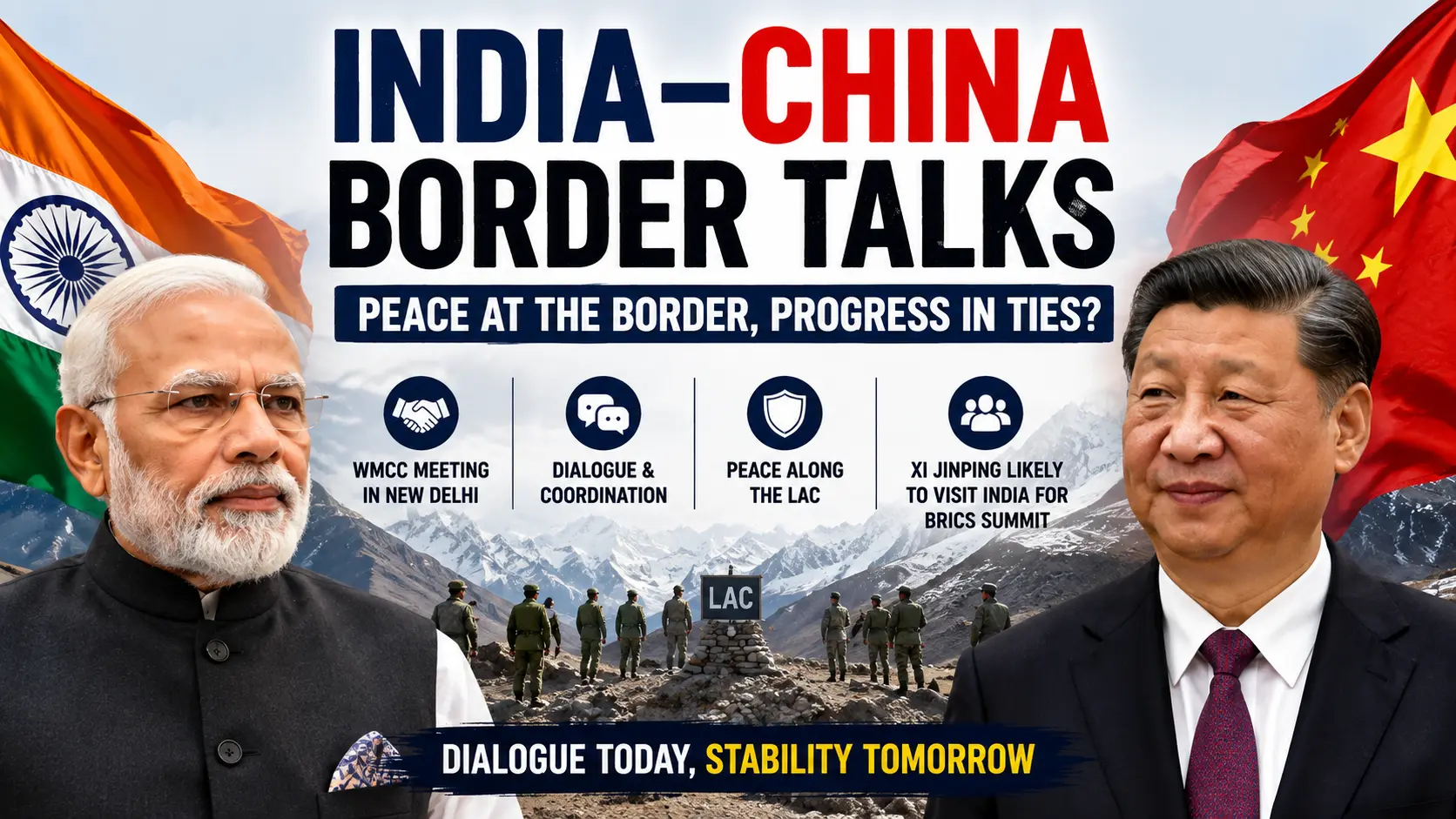
For the first time in years, India and China appear to be making cautious but steady diplomatic progress. Officials from both countries met in New Delhi this week for the 36th meeting of the Working Mechanism for Consultation and Coordination (WMCC) on border affairs, where they agreed that maintaining peace along the Line of Actual Control (LAC) is essential for improving overall bilateral relations.
The meeting comes at a significant time. Reports suggest Chinese President Xi Jinping is likely to visit India next month for the BRICS Summit, potentially marking his first visit to India since the deadly Galwan Valley clash in 2020.
What Happened at the WMCC Meeting?
The WMCC is a diplomatic mechanism established in 2012 to help India and China manage border issues through dialogue before they escalate into military confrontations.
During the latest round of talks held in New Delhi:
Both sides reviewed the situation along the LAC.
Officials discussed border management and coordination mechanisms.
India and China agreed to continue using diplomatic and military communication channels to prevent misunderstandings.
They reiterated that peace and stability at the border are essential for normalising bilateral ties.
While the meeting did not produce a breakthrough on the boundary dispute itself, it reflected a willingness to keep communication open.
Why Is This Meeting Important?
Relations between India and China have remained strained since June 2020, when soldiers from both sides clashed in the Galwan Valley in eastern Ladakh.
The confrontation resulted in casualties on both sides and pushed bilateral relations to their lowest point in decades. Since then:
Tens of thousands of troops have remained deployed along the border.
Multiple rounds of Corps Commander-level military talks have been held.
Diplomatic negotiations have gradually led to disengagement at several friction points, although some issues remain unresolved.
The latest WMCC meeting is viewed as another step in the gradual effort to stabilise relations.
Could Xi Jinping Visit India?
According to multiple reports, Xi Jinping is expected to attend the BRICS Summit in New Delhi later this year.
If the visit takes place, it would be:
Xi's first visit to India since 2019.
His first visit after the Galwan clashes.
An opportunity for a fresh meeting with Prime Minister Narendra Modi amid improving diplomatic engagement.
Neither Beijing nor New Delhi has officially confirmed the visit, but preparations and diplomatic engagements have fuelled speculation that the summit could become an important milestone in India-China relations.
What Is Still Unresolved?
Despite recent progress, the core boundary dispute remains unresolved.
Several sensitive sectors along the LAC continue to require careful management, and both countries maintain a significant military presence in border areas.
The WMCC itself does not negotiate the final boundary settlement. Instead, it focuses on:
Preventing military incidents.
Improving communication.
Managing day-to-day border issues.
Supporting military-level discussions.
The actual boundary dispute continues to be handled through separate diplomatic and political mechanisms.
Why Are Relations Improving Now?
Experts believe several factors are encouraging both countries to maintain dialogue:
Regional stability remains important for Asia's two largest economies.
Trade between India and China continues despite political tensions.
Both countries are influential members of BRICS and the Shanghai Cooperation Organisation (SCO).
Neither side appears interested in another prolonged military confrontation along the Himalayas.
At the same time, analysts caution that improved dialogue does not necessarily mean the border dispute has been resolved.
What Does This Mean for India?
For India, stable border conditions allow greater diplomatic and economic engagement without compromising national security.
A successful BRICS Summit featuring Xi Jinping could:
Reduce diplomatic tensions.
Improve political communication.
Create momentum for further confidence-building measures.
Encourage continued military disengagement where possible.
However, Indian officials have consistently maintained that normal bilateral relations depend on lasting peace and tranquillity along the border.
The Bigger Picture
The India-China relationship remains one of cooperation mixed with competition.
The latest WMCC talks show that despite unresolved territorial differences, both countries recognise the importance of sustained dialogue. Whether that translates into a lasting improvement will depend on developments along the Line of Actual Control and the outcome of future high-level political engagements.
If Xi Jinping's visit to India materialises during the BRICS Summit, it could become the most significant diplomatic interaction between the two neighbours since the Galwan crisis—but expectations remain measured, with both sides likely to prioritise stability over dramatic breakthroughs.