
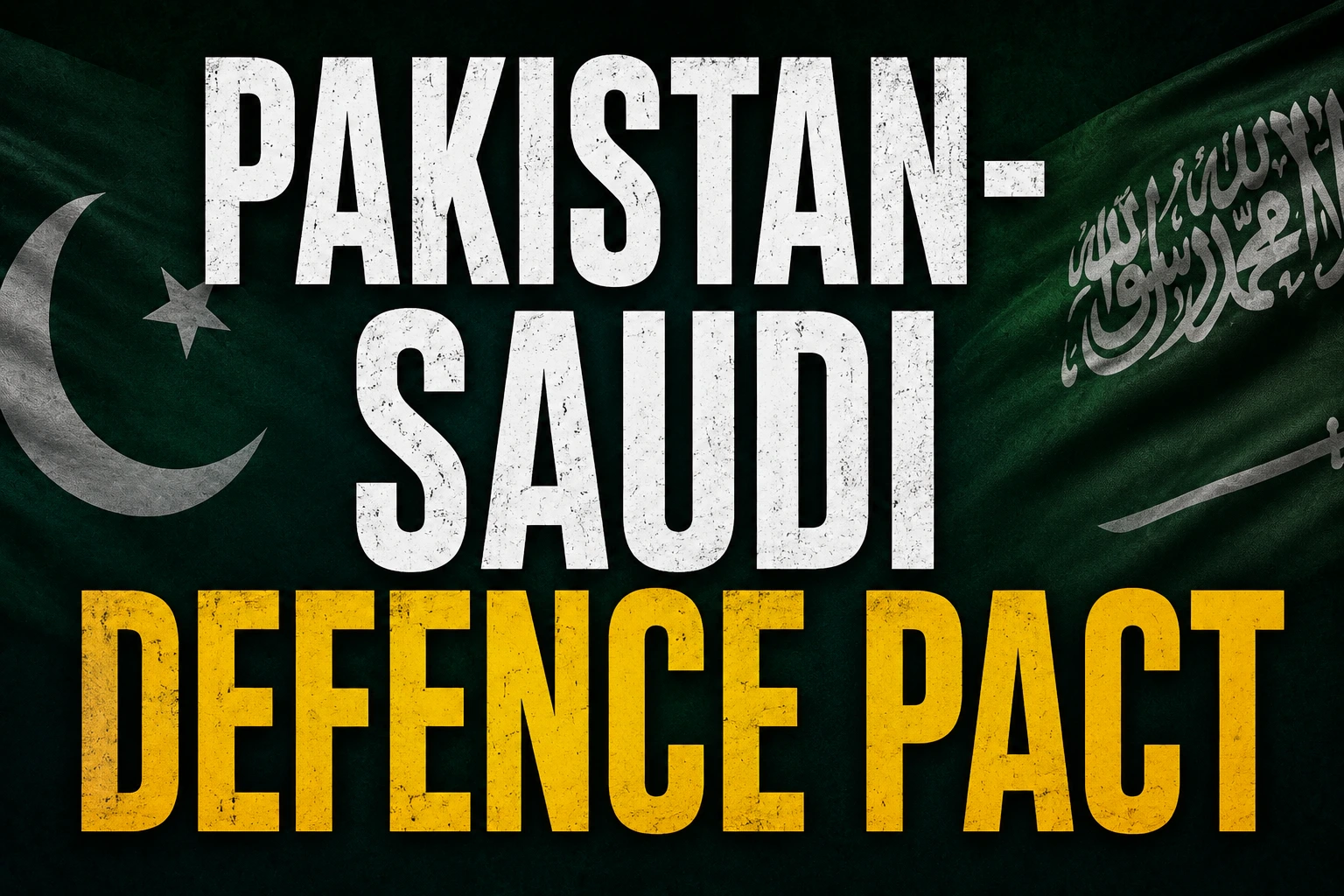
A celebratory song released after Pakistan and Saudi Arabia signed a defence pact has drawn widespread attention online.
Pakistan and Saudi Arabia signed the Strategic Mutual Defence Agreement (SMDA) in Riyadh on September 17, 2025, declaring that an attack on either country would be treated as an attack on both. Soon after the signing, a song titled “Ahdal Yazul” was released to celebrate the partnership, with references to the two countries’ friendship, shared faith and joint defence. The song was released by Riyadh-based Desert Beat Records and was promoted online as the “official song” of the strategic pact. The Editorial Team of Behind The Headlines reports that the song itself became a subject of online discussion, with users questioning the unusually celebratory presentation of a serious military agreement.
What is the Saudi-Pakistan defence pact?
The agreement was signed by Saudi Crown Prince and Prime Minister Mohammed bin Salman and Pakistan Prime Minister Shehbaz Sharif at Al-Yamamah Palace in Riyadh. Its central provision is straightforward: aggression against one country will be considered aggression against both. The pact formalises decades of military cooperation between the two countries and comes at a time of heightened security tensions across West Asia. Pakistan has historically provided military training and personnel support to Saudi Arabia, while Riyadh has been an important economic partner for Islamabad.
The agreement, however, should not automatically be interpreted as a new three-country defence alliance involving Turkey. Turkey has close military and political relations with Pakistan and Saudi Arabia, and there has been speculation about a broader regional security grouping, but the Saudi-Pakistan pact itself is bilateral. The song and its online reception have nevertheless been discussed alongside the wider idea of closer cooperation among Pakistan, Saudi Arabia and Turkey. The difference is important because a formal mutual-defence commitment exists between Saudi Arabia and Pakistan, while Turkey is not a signatory to that agreement.
Why did the song become controversial online?
The criticism was less about the existence of a song and more about how a military agreement was being celebrated. The Arabic-language track presents the pact in highly patriotic and emotional terms, describing Saudi Arabia and Pakistan as brothers and highlighting their shared commitment to defence and security. Its release immediately after the signing made it look, to some social-media users, more like a promotional anthem than a conventional diplomatic or military communication. The song subsequently accumulated hundreds of thousands of views on video platforms, showing that the controversy also helped amplify it.
That online reaction also needs context. Calling the song “ridiculed” reflects the tone of sections of social media, rather than an official reaction from Saudi Arabia or Pakistan. Supporters of the pact welcomed the song as a cultural expression of the countries’ long-standing relationship. Others mocked the idea of producing an anthem around a defence agreement, particularly because the pact carries serious strategic implications involving military cooperation and regional security. In other words, the same song was seen by supporters as a celebration of friendship and by critics as an over-the-top presentation of geopolitics.
Why is the pact important?
The agreement gives a formal structure to a relationship that has existed for decades. Pakistan has maintained a military presence and training relationship with Saudi Arabia for years, while Saudi Arabia has been an important economic partner for Pakistan. The new pact effectively raises the political and military stakes of that relationship by putting a mutual-defence commitment in writing.
The timing is equally important. The Middle East has experienced repeated military confrontations and growing uncertainty over regional security arrangements. Pakistan's role has also expanded beyond its traditional South Asian security concerns, with Islamabad becoming more involved in diplomatic efforts connected to conflicts in West Asia. Pakistan subsequently deployed fighter aircraft and other military assets to Saudi Arabia under the defence pact when regional tensions escalated, demonstrating that the agreement has implications beyond symbolism.
Does the pact mean Pakistan will automatically fight every war involving Saudi Arabia?
Not necessarily.
The phrase “an attack on one is an attack on both” creates a strong political commitment, but the precise operational consequences depend on the circumstances and the agreement's implementation.
That distinction matters because military alliances can involve different levels of obligation — from consultations and intelligence cooperation to deployment of troops, aircraft or air-defence systems.
Reports in 2026 showed that Pakistan did deploy military assets to Saudi Arabia under the pact during a period of heightened regional tensions. That suggests the agreement has practical security consequences, but it does not mean that every future Saudi military operation would automatically result in Pakistani forces entering combat.
Where does Turkey fit into the story?
Turkey is important to the broader geopolitical picture because Ankara has maintained close defence ties with Islamabad and has also developed significant relations with Riyadh.
Pakistan and Turkey have conducted joint military exercises, while Turkish defence cooperation with Pakistan includes naval and aviation cooperation. Pakistan's 2025 AMAN maritime exercise, for example, included Turkish naval personnel.
But this should not be confused with the Saudi-Pakistan treaty.
Saudi Arabia and Pakistan signed the mutual-defence pact. Turkey did not sign it.
The idea of a larger Pakistan-Saudi-Turkey security grouping is therefore a broader geopolitical discussion, not the legal structure of the agreement itself.
Why does the song matter at all?
On the surface, the song may appear trivial compared with a major defence agreement.
But the reaction shows how modern diplomacy increasingly plays out on social media.
A treaty that would traditionally have been discussed through government statements, diplomatic briefings and strategic analysis was accompanied almost immediately by a highly produced musical tribute. The song gave social-media users something visual and emotional to react to, turning a complicated geopolitical agreement into a cultural moment.
That is why the response was so divided.
For supporters, it represented Saudi-Pakistani brotherhood.
For critics, it became an easy target for memes and jokes.
And for observers, it offered an unusual glimpse into how governments and societies increasingly use popular culture to communicate geopolitical relationships.
The bigger picture
The song may eventually disappear from the news cycle, but the defence agreement is likely to remain important.
For Saudi Arabia, Pakistan offers a long-established military relationship and access to one of the world's largest Muslim-majority armed forces, including a nuclear-armed state. For Pakistan, closer defence ties with Riyadh offer strategic, diplomatic and potentially economic advantages.
The agreement also reflects a broader change in West Asian security politics, where countries are increasingly looking to diversify partnerships rather than rely entirely on one external security provider.
So, while the song became the lighter and more entertaining part of the story, the agreement behind it is anything but trivial.
The real question is not whether the song was catchy or embarrassing.
It is how far Saudi Arabia and Pakistan are prepared to take their new mutual-defence commitment when the next serious regional crisis arrives.