
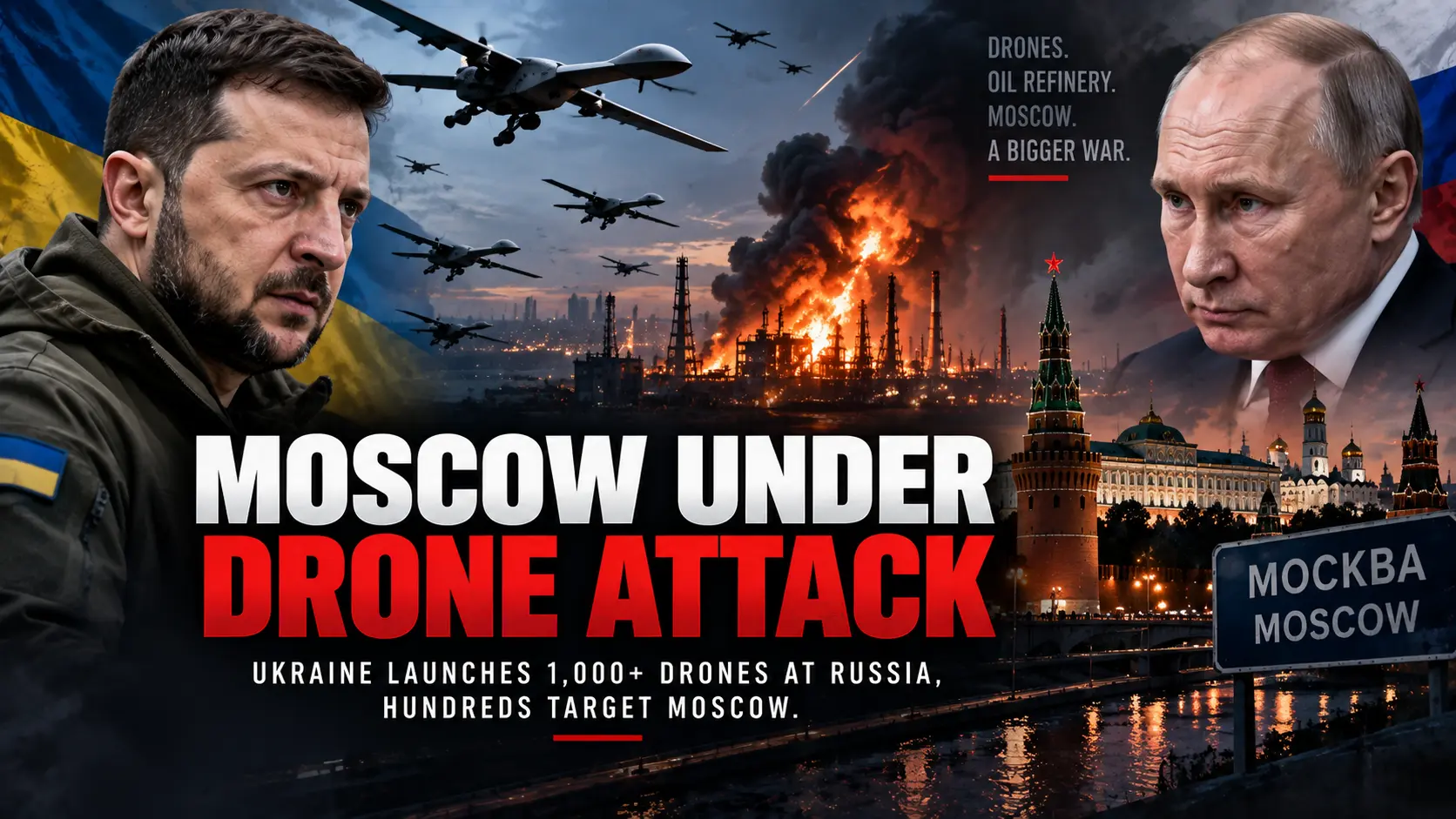
The unprecedented barrage hit Moscow-area infrastructure, including an oil refinery, as Russia held the final day of its parliamentary elections.
Ukraine launched more than 1,000 drones toward Russia overnight, with hundreds heading for Moscow and surrounding areas in one of the largest long-range attacks of the war.
The Editorial Team of Behind The Headlines reports that the strikes damaged a Moscow oil refinery and residential buildings, killed at least two people and injured 20 in the wider Moscow region, according to Russian regional authorities. Russia said its air defences intercepted or destroyed a much larger number of drones across the country.
What happened in Moscow?
Moscow Mayor Sergei Sobyanin said 450 drones heading toward the capital were destroyed, describing the attack as unprecedented.
A facility at the Moscow Oil Refinery was damaged, while a drone strike on a residential building caused further destruction. In the Ramenskoye district, around 400 residents, including 70 children, were evacuated after an apartment block was affected.
Moscow regional Governor Andrei Vorobyov said two people were killed in separate incidents and 20 others were injured.
The Russian Defence Ministry said it had shot down 1,110 Ukrainian drones across Russia, Crimea and the Black Sea. Separately, Moscow authorities said more than 1,600 drones had been intercepted since Saturday, including the 450 directed toward Moscow. These figures refer to different reporting periods and geographic areas.
Why was the oil refinery targeted?
The Moscow refinery is strategically important to Russia's fuel supply.
The facility processed around 11.6 million tonnes of crude in 2024, producing millions of tonnes of petrol and diesel. Ukrainian attacks on Russian refining infrastructure have increasingly focused on reducing the country's ability to process crude and supply petroleum products.
Ukrainian President Volodymyr Zelenskyy said the latest operation targeted Russian oil and logistics infrastructure. He argued that damaging these facilities could reduce the financial resources supporting Russia's war effort.
Ukraine has not officially claimed responsibility for every reported strike, however, and battlefield claims from either side can be difficult to independently verify.
The timing is politically significant
The attack came on the third and final day of Russia's parliamentary elections.
Sobyanin accused Ukraine of attempting to disrupt the voting, while saying the attack failed to achieve that objective. Russia was also conducting voting in Crimea and in four Ukrainian regions that Moscow claims to have annexed.
Kyiv considers those elections in occupied Ukrainian territory illegitimate.
The timing has therefore added a political dimension to an already significant military operation.
Ukraine's long-range strategy
Ukraine has increasingly relied on domestically produced long-range drones to strike targets deep inside Russian territory.
The strategy has particularly focused on:
Oil refineries
Fuel storage facilities
Logistics centres
Military infrastructure
Energy installations
The objective is to increase the economic and logistical cost of Russia's military campaign while demonstrating that Russian territory remains vulnerable to Ukrainian long-range weapons.
Zelenskyy said the latest operation involved drones as well as domestically developed missiles, including the Flamingo and Pelican systems.
Russia's energy sector under pressure
The attacks come as Russia's oil-refining industry is already facing disruption.
Repeated strikes on refineries have contributed to fuel-supply problems in some regions, while refinery outages can reduce the availability of petrol and diesel and put upward pressure on domestic fuel prices.
The Moscow refinery attack therefore matters beyond the immediate physical damage. Any prolonged disruption to refining capacity could affect Russia's domestic fuel market and export flows.
A wider drone war
The latest escalation is not happening in isolation.
Russia and Ukraine have both dramatically expanded the use of drones during the conflict. The technology has become central to reconnaissance, battlefield attacks and long-range strikes.
Ukraine's attack on Moscow came shortly after Russia launched another wave of drones against Ukrainian territory. Ukraine's Air Force reported that Russia had launched 138 drones overnight, with 101 shot down or otherwise neutralised, according to Ukrainian authorities.
The two sides have also continued striking energy infrastructure despite recent claims by US President Donald Trump that Russia and Ukraine had agreed to stop targeting each other's energy facilities.
What does this mean for the war?
The attack demonstrates how the conflict is increasingly extending beyond the conventional frontline.
Russia and Ukraine are using long-range drones to attack economic infrastructure hundreds of kilometres from active combat zones. For Moscow, repeated strikes on refineries and logistics facilities create additional security and economic challenges. For Kyiv, the ability to reach targets deep inside Russia provides another way of imposing costs without relying solely on battlefield advances.
But the strikes also carry risks of further escalation, particularly when civilian buildings are affected.
What happens next?
The immediate focus will be on the extent of the damage to the Moscow refinery and whether production can continue normally.
Russia is also likely to strengthen air-defence deployments around Moscow and other strategic infrastructure. Ukraine, meanwhile, is expected to continue developing longer-range drone and missile capabilities.
The latest attack shows that even as ground fighting remains concentrated along the front, the economic and technological dimensions of the Russia-Ukraine war are moving deeper into both countries' territory.