
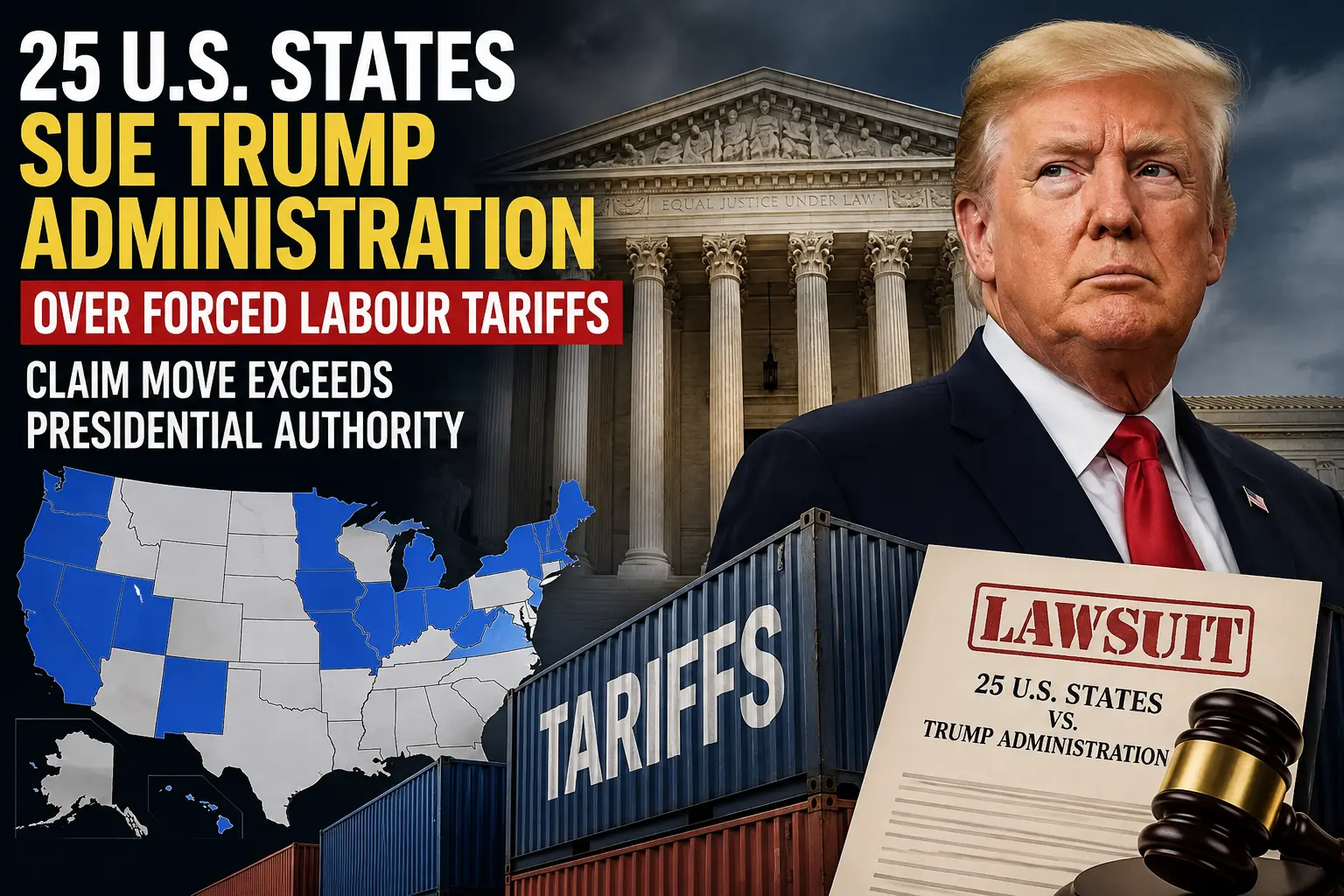
A coalition of 25 U.S. states has filed a legal challenge against the Trump administration over tariffs imposed on imports allegedly linked to forced labour, arguing that the measures exceed the President's authority under U.S. trade laws. The lawsuit adds a new legal dimension to the administration's expanding use of tariffs as part of its broader trade and economic strategy and could have implications for future executive actions on international commerce.
What Is the Case About?
The lawsuit, filed by a group of state attorneys general, contests tariffs introduced by the Trump administration on goods identified as being produced with forced labour. The states argue that while the U.S. government has powers to restrict imports associated with forced labour under existing legislation, imposing broad tariff measures requires explicit congressional authorisation.
According to the plaintiffs, the administration has relied on emergency and executive powers in a manner that exceeds the limits established by federal law. They contend that tariff policy falls primarily within Congress's constitutional authority to regulate international trade and taxation.
The Trump administration, however, has defended the measures as part of its responsibility to protect U.S. economic interests, enforce trade laws and address human rights concerns within global supply chains.
Why Are Forced Labour Imports a Policy Issue?
The United States has increasingly strengthened measures to prevent goods produced with forced labour from entering its market. One of the most significant legislative steps was the Uyghur Forced Labor Prevention Act (UFLPA), which came into effect in 2022.
The law creates a rebuttable presumption that goods manufactured wholly or partly in China's Xinjiang Uyghur Autonomous Region are produced using forced labour unless importers can demonstrate otherwise. Enforcement is carried out by U.S. Customs and Border Protection (CBP), which has detained or denied entry to thousands of shipments under the legislation.
The current legal dispute, however, is not over the objective of preventing forced labour but over whether the executive branch can impose additional tariff-based measures without fresh approval from Congress.
What Are the Constitutional Questions?
The lawsuit centres on the separation of powers under the U.S. Constitution.
Congress holds the constitutional authority to regulate foreign commerce and establish tariffs. Over the years, lawmakers have delegated limited powers to presidents under statutes such as the Trade Expansion Act of 1962, the Trade Act of 1974, and the International Emergency Economic Powers Act (IEEPA).
The states argue that the administration has interpreted these delegated powers too broadly. They maintain that while presidents can act in specific emergency situations, permanent or wide-ranging tariff policies require legislative approval.
The administration is expected to argue that existing statutes provide sufficient legal authority for its actions and that the measures are necessary to protect national interests and uphold labour standards.
What Could Be the Economic Impact?
If the courts rule against the administration, the decision could affect existing tariff policies and limit the scope of future presidential actions on trade.
Businesses importing affected products could face changes in compliance requirements, while manufacturers and retailers may need to reassess sourcing strategies depending on the outcome of the litigation.
The case may also influence how future administrations use executive authority in trade policy, particularly when addressing issues linked to human rights, national security or economic emergencies.
What Happens Next?
The lawsuit will proceed through the federal court system, where judges will examine whether the administration acted within the authority granted by Congress.
Regardless of the eventual outcome, the case is expected to clarify the balance between executive power and congressional authority in U.S. trade policy. It also comes at a time when tariffs, supply-chain resilience and labour standards continue to play a central role in international economic relations.