

Now Reading: Bihar SIR: Supreme Court Suggests Paralegal Support to Help Voters File Objections Against Exclusion
-
01
Bihar SIR: Supreme Court Suggests Paralegal Support to Help Voters File Objections Against Exclusion

Bihar SIR: Supreme Court Suggests Paralegal Support to Help Voters File Objections Against Exclusion

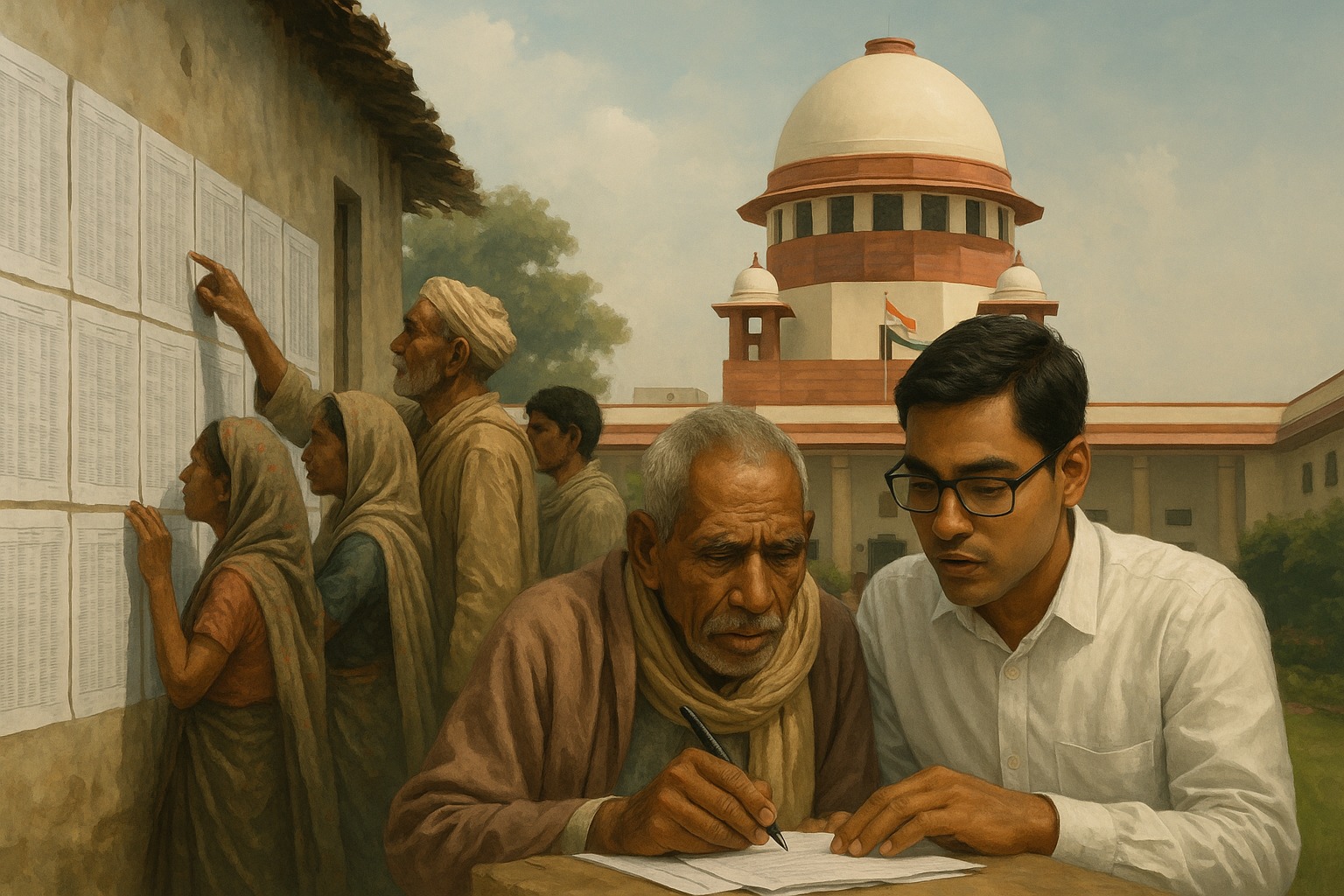
The Supreme Court of India has stepped into the heart of Bihar’s unfolding electoral controversy, highlighting concerns over the Statewide Identification Register (SIR) process and possible voter exclusion. In a significant observation, the Court emphasized the need for paralegal volunteers to assist voters in filing objections if their names are omitted from the rolls. This development reflects judicial recognition of the systemic challenges ordinary citizens face in asserting their voting rights and underscores the role of legal aid in safeguarding democracy.
The editorial team of Behind The Headlines has carefully examined the facts and implications, presenting a detailed account of this crucial intervention.
What Is Bihar’s SIR and Why It Matters
The Statewide Identification Register (SIR) has been introduced as part of Bihar’s voter roll management exercise. The initiative aims to verify and authenticate voter lists, ensuring only eligible citizens are included and eliminating duplication or errors.
However, in practice, the SIR process has raised widespread concerns:
- Reports of eligible voters being excluded due to documentation errors.
- Lack of awareness campaigns, leaving rural and marginalized communities at risk of being left out.
- Limited access to grievance mechanisms, as many voters lack the literacy or resources to file objections.
Given Bihar’s complex demographic and socio-economic landscape, these challenges could disenfranchise large numbers of citizens—making judicial intervention timely and necessary.
Supreme Court’s Observations
Hearing a batch of petitions challenging the fairness of the SIR exercise, the Supreme Court underscored that the right to vote, though statutory, is the bedrock of democracy. The bench stressed that bureaucratic or technical hurdles must not obstruct citizens from participating in the electoral process.
Key directions and observations included:
- Need for paralegal volunteers: The Court recommended that the State Legal Services Authorities (SLSAs) deploy paralegals in affected districts to help voters draft and submit objections.
- Simplified procedure: Authorities were urged to make objection filing less cumbersome, reducing paperwork and streamlining grievance redressal.
- Awareness campaigns: The Court highlighted the need for door-to-door and panchayat-level outreach, ensuring voters know their rights and deadlines for objections.
- Strict timelines: The Election Commission and Bihar administration were asked to publish clear schedules for objection handling, ensuring voters are not left in uncertainty.
Why Paralegal Volunteers Are Critical
The Court’s suggestion to involve paralegals addresses a ground reality: many rural and semi-urban voters lack the literacy, legal knowledge, or confidence to challenge administrative errors.
Paralegals, often trained under the National Legal Services Authority (NALSA), can bridge this gap by:
- Assisting with form filling and ensuring documents are complete.
- Acting as community educators to spread awareness of rights.
- Helping escalate cases where local officials refuse to cooperate.
- Providing pro bono support in areas where lawyers are scarce.
This measure could empower thousands of voters otherwise at risk of being silently excluded.
Political and Social Repercussions
The controversy around Bihar’s SIR exercise comes at a politically sensitive time. With elections approaching, parties have accused each other of using the process to manipulate voter lists.
- Ruling coalition: Keen to defend the SIR as a transparency measure, yet under fire for lapses.
- Opposition parties: Alleging that large-scale exclusions target specific communities and castes, potentially skewing the electoral field.
- Civil society groups: Warning that flawed implementation could repeat past voter roll controversies, undermining trust in democracy.
The Supreme Court’s intervention has, therefore, added a layer of judicial oversight to what was fast becoming a purely political blame game.
Voter Exclusion as a Democratic Threat
Electoral integrity does not end at ballot counting; it begins with the voter list. Exclusion from rolls is as damaging as suppression at polling stations. For Bihar, where migration, poverty, and low literacy complicate documentation, the threat is particularly stark.
The editorial board notes three urgent concerns:
- Marginalized groups at risk: Dalits, women, migrant laborers, and minorities face disproportionate chances of being excluded.
- Documentation barriers: Many citizens lack updated voter IDs, Aadhaar links, or proof of residence.
- Loss of faith: Repeated exclusion risks alienating communities from the democratic process, weakening long-term participation.
International and National Parallels
Globally, voter roll controversies are not new. From the United States’ voter ID battles to African states’ flawed roll revisions, courts have frequently been called upon to safeguard suffrage. India itself has witnessed similar debates in Assam’s National Register of Citizens (NRC), where bureaucratic hurdles left millions in limbo.
Bihar’s SIR controversy falls into this global pattern—showing that administrative zeal must never outweigh citizens’ rights.
Supreme Court as a Guardian of Rights
By suggesting paralegal involvement, the Supreme Court reaffirmed its role as the protector of democratic access. The bench reminded the State that inclusivity and accessibility are non-negotiable in electoral processes.
This judicial push is not just about Bihar—it sets a precedent for other states considering similar roll revisions. It also signals that citizen-friendly mechanisms, not bureaucratic rigidity, must guide democratic reform.
Editorial Perspective
The editorial team of Behind The Headlines believes that while the intention behind Bihar’s SIR is sound—ensuring accurate and transparent rolls—the execution has been deeply flawed. By not prioritizing accessibility and awareness, the State risks disenfranchising precisely those voters it should be empowering.
The Supreme Court’s call for paralegal support is both practical and compassionate. It recognizes the power of grassroots legal aid in bridging systemic gaps. Going forward, Bihar must:
- Launch mass awareness drives in multiple languages.
- Ensure timely, transparent grievance redressal.
- Work closely with civil society and legal aid groups.
Only then can the SIR process move from controversy to credibility.
Related Posts



Stay Informed With the Latest & Most Important News
Advertisement







Advertisement
