

Now Reading: Lucknow protest: Sahara staff demand pending salaries, PF
-
01
Lucknow protest: Sahara staff demand pending salaries, PF


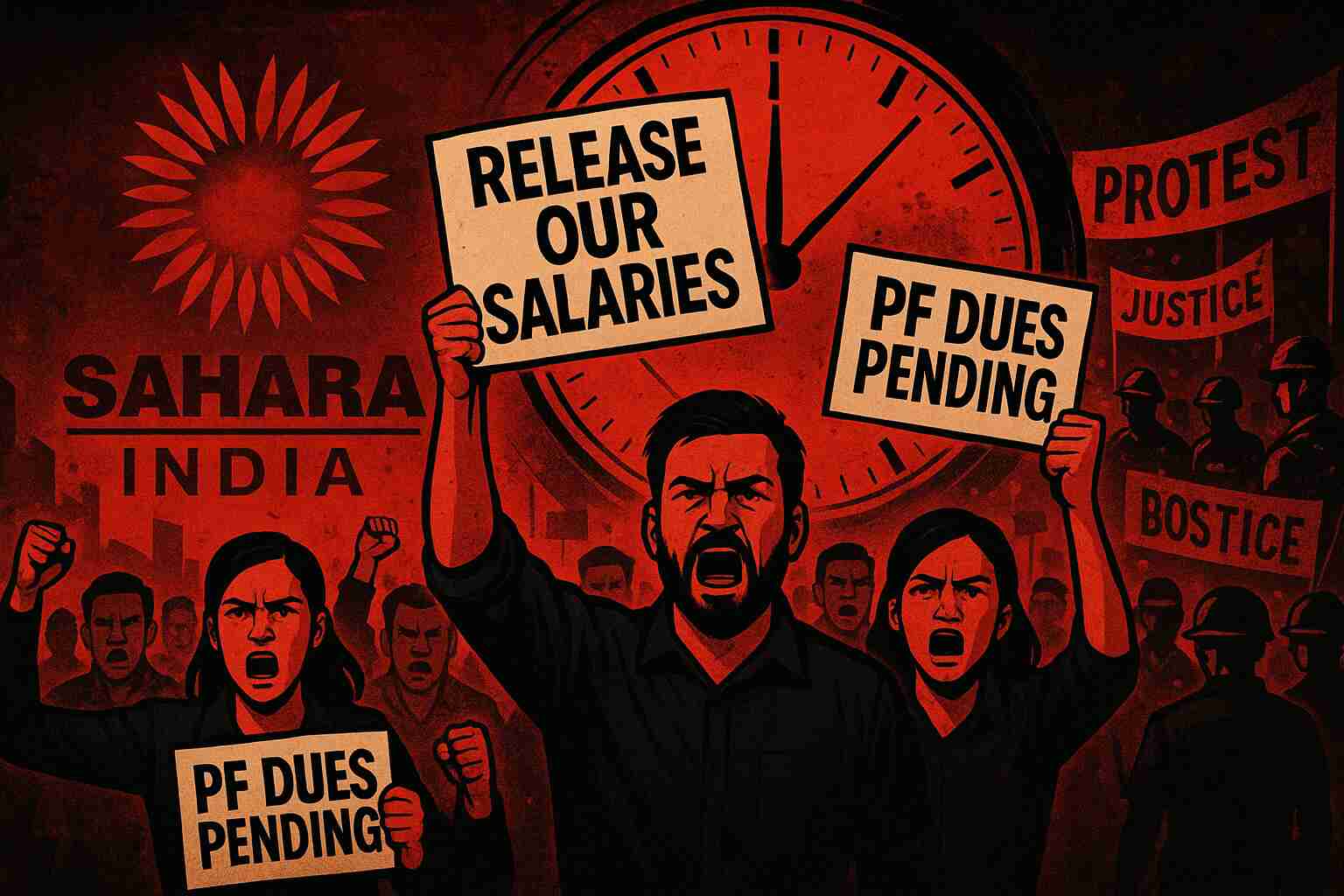
The ongoing crisis surrounding the Sahara Group has once again spilled onto the streets, this time in Lucknow, where hundreds of its employees staged protests demanding the release of their long-pending salaries and provident fund (PF) dues. For years, Sahara has been embroiled in financial disputes, regulatory actions, and leadership crises. But at the heart of this corporate collapse lies the silent suffering of its employees, who face uncertain futures without the security of their earned money.
As Bihar, Uttar Pradesh, and other states grapple with employment concerns, the Sahara case has become a striking reminder of what happens when a corporate giant collapses without safeguarding its workforce.
Why the protests erupted in Lucknow
The protests were organized by Sahara employees who claim they have been deprived of their dues for several years. They allege:
- Non-payment of salaries for months, in some cases even years.
- Provident fund dues that were deducted but never deposited with authorities.
- Lack of clarity on whether their savings will ever be returned.
Gathering in Lucknow, the protestors raised slogans, held placards, and demanded government intervention. The anger is not just about delayed payments but also about what they see as betrayal of trust by the Sahara Group.
👉 Read how employees across India are raising similar concerns
Sahara’s decline: A brief background
The Sahara Group was once among India’s most powerful conglomerates, spanning finance, real estate, media, hospitality, and sports. Known for its flamboyant founder Subrata Roy, the group enjoyed decades of growth before running into regulatory troubles.
- The Supreme Court vs Sahara case over allegedly illegal financial schemes led to strict actions.
- Properties were seized, funds frozen, and the group struggled to maintain operations.
- Lakhs of small investors and employees were left uncertain about their money.
While Sahara’s legal battle continues, its employees—many of whom dedicated decades of service—remain unpaid and insecure.
Employee voices from the protest
The protests in Lucknow were filled with emotional testimonies:
- “We gave our youth to this company, and now in our 50s we don’t even have PF security,” said one protestor.
- “My children’s education is at risk because my salary has not been paid for 18 months,” said another employee.
- Women employees alleged harassment and negligence by senior officials who refused to address their concerns.
Such statements underline how the human cost of corporate collapse is often ignored while attention remains on legal battles.
Legal complications around salaries and PF
The Employees’ Provident Fund Organisation (EPFO) mandates that PF contributions must be deposited monthly. In Sahara’s case, employees claim deductions were made but never transferred. This raises serious legal violations.
- Labour laws clearly state that non-payment of PF is a punishable offense.
- The Supreme Court’s ongoing case has largely focused on investor refunds, but employee claims have been sidelined.
- Experts say unless a dedicated mechanism is created, employees may have to wait indefinitely.
👉 Explore how labour disputes are shaping corporate accountability in India
Government and regulatory silence
Despite repeated protests, employees claim neither the central government nor state authorities have taken concrete action.
- The UP government has acknowledged protests but not provided a clear plan.
- The Union Labour Ministry has yet to step in with an independent investigation.
- Regulators like SEBI are focused on investor refunds, leaving employee issues unaddressed.
This lack of response has intensified anger among employees, who feel abandoned by both the company and the system.
Broader impact of Sahara’s downfall
The Sahara case is not just about one company but also about the larger crisis of corporate governance in India.
- Investor trust has been shaken, as lakhs of small investors await refunds.
- Employee morale across similar financial firms has been impacted, with many fearing similar fates.
- The shadow economy of chit funds and non-banking schemes has been exposed, prompting stricter oversight.
For the common employee, however, the debate is not about corporate laws but about survival—whether they can pay rent, send children to school, and live with dignity.
Analysis: Why Sahara employees deserve urgent justice
The plight of Sahara employees highlights three critical failures:
- Failure of corporate responsibility: Companies must ensure employee dues are protected regardless of financial trouble.
- Failure of regulation: While regulators focused on investor protection, employees were left unprotected.
- Failure of governance: State and central governments have not prioritized workers’ rights in this case.
Experts argue that unless employees are safeguarded in corporate collapses, India’s labour market will continue to see mistrust and exploitation.
Bigger picture for India’s workforce
Sahara’s crisis serves as a case study in what India must urgently reform:
- Employee protection funds to guarantee salaries and PF even if a company collapses.
- Corporate governance reforms ensuring transparency in financial dealings.
- Labour law enforcement so that companies cannot default on PF contributions without penalties.
With India aiming to expand its economy and attract global investors, protecting workers must become central to corporate policy.
Backlinks for context
- How India’s labour laws protect employee rights
- The Supreme Court’s ongoing battle with Sahara Group
- Why investor and employee protection must go hand in hand
Conclusion
The protests in Lucknow are more than just an outcry for salaries. They represent the crisis of trust between employees and corporations. Sahara’s downfall has not only damaged investor faith but also destroyed the lives of countless workers who built the company with their dedication.
Unless urgent steps are taken by courts, regulators, and the government, the Sahara protest could set a dangerous precedent—that companies can collapse without being held accountable for their workers’ dues.
The Sahara protest is not just about one company—it is a reminder of how corporate power must always be balanced with employee rights.
Related Posts



Stay Informed With the Latest & Most Important News
Previous Post
Next Post


Advertisement








Advertisement
