

Now Reading: Gold hits record $3,900/oz as yen weakens, rate cut hopes rise
-
01
Gold hits record $3,900/oz as yen weakens, rate cut hopes rise


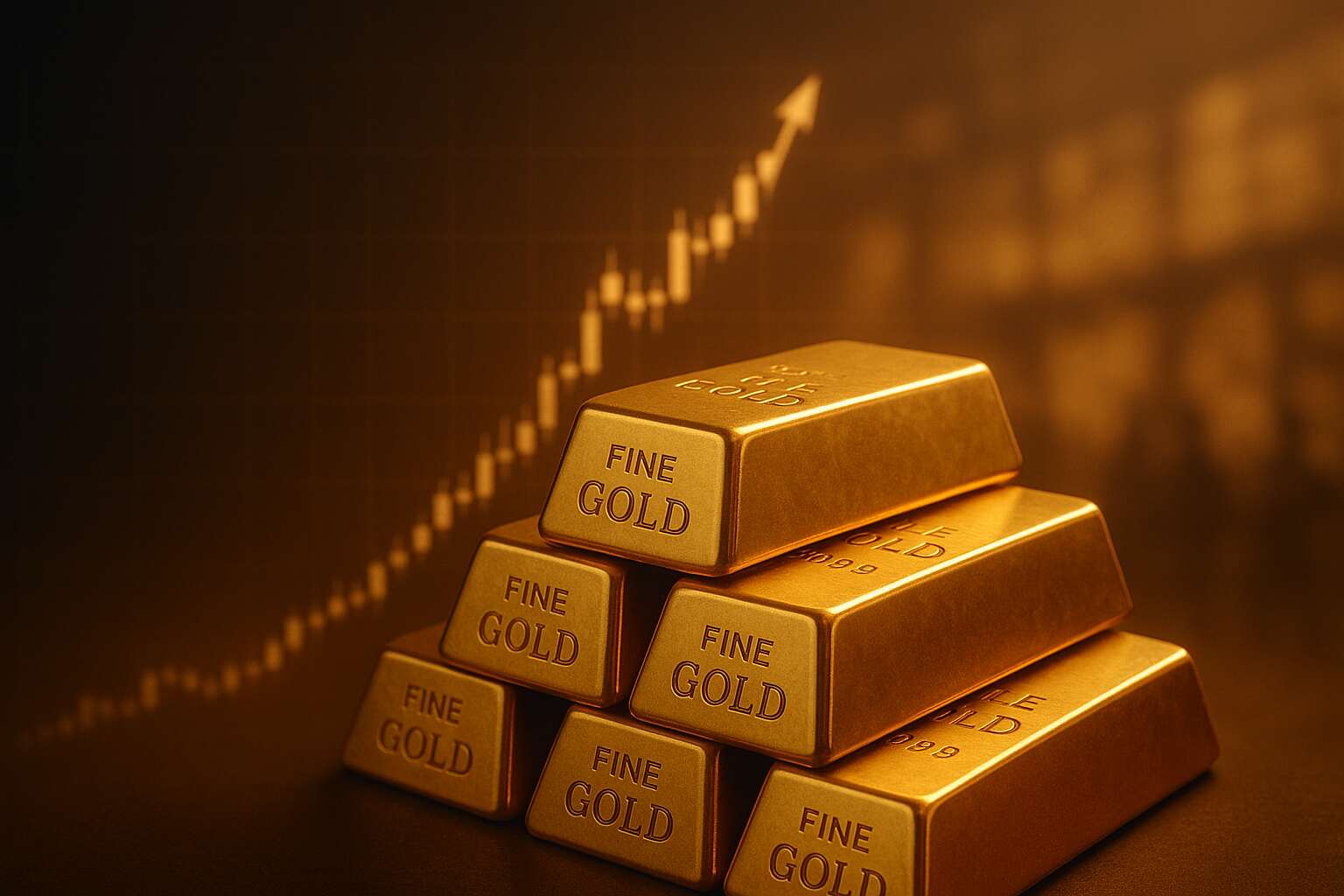
Global precious metals markets are witnessing a new high: gold hits record $3,900/oz as currency and interest rate dynamics shift rapidly. The yen’s steep depreciation against the dollar, combined with growing speculation of a US Federal Reserve easing cycle, has propelled investor appetite for bullion. In this report, the Behind The Headlines editorial team analyzes the triggers, implications, reactions, and future outlook for gold’s rally.
What’s driving the surge?
Yen collapse amplifies demand for safe havens
A key factor behind gold’s ascent is a sharp fall in the Japanese yen. The yen’s weakness makes gold more attractive to global investors, especially those holding other currencies, prompting increased demand in Asian and global markets.
As the yen slides, Japanese and regional investors often shift allocation into bullion as a hedge against currency risk—adding upward pressure on gold prices.
US rate cut expectations lift gold
The market has increasingly priced in the possibility of US interest rate cuts in the coming months. Lower real yields reduce the opportunity cost of holding non-yielding assets such as gold, thereby boosting its appeal.
Further, commentary from Fed officials hinting at possible dovish shifts has reinforced the expectation that rate cuts are on the horizon. This sentiment is fueling speculative inflows into gold futures and ETFs.
Macro and risk sentiment at play
Broader global uncertainties—geopolitical tensions, inflation persistence, shaky banking sectors—are enhancing gold’s role as a safe-haven asset. Investors are redistributing some portfolio allocation into gold to hedge against downside risks.
Currency volatility, monetary policy divergence, and shifting bond yields are all converging to make this rally more sustainable than a short-term spike.
How high has gold climbed?
Gold futures have broken through historic resistance levels, with spot prices passing the $3,900 per ounce mark—the highest ever recorded. This new peak reflects the combined momentum from yen depreciation, speculative positioning, and macro uncertainties.
In multiple markets including London, New York, and Singapore, gold trades are reflecting strong global demand, with premiums widening in some Asian centers.
Analysts report that open interest in gold futures and physical demand via bullion ETFs are reaching fresh highs. Some forecasting models suggest key psychological levels, such as $4,000/oz, may now lie within reach if current momentum holds.
Market analysis & technical perspective
From a technical lens, gold’s rally has breached long-term resistance zones, validating a bullish breakout. Momentum indicators (RSI, MACD) point to continued strength, though overbought conditions may invite short-term pullbacks.
Support zones are now established near prior resistance levels—between $3,700/oz and $3,800/oz—which may act as zones of consolidation if profit-taking emerges.
On the demand side, inflows into gold-backed ETFs, central bank buying, and physical demand in Asia (notably from India, China, Japan) are reinforcing upward pressure.
Supply constraints such as mining disruptions, depleting low-cost reserves, and higher extraction costs add structural support to the rally.
Reactions from markets, central banks, and investors
Major institutional investors and hedge funds have increased long bets on gold futures, viewing it as a core allocation in a volatile environment. Commodity strategists are revising their forecasts upward, now modeling $4,100–$4,200/oz as possible near-term targets.
Central banks, particularly in emerging markets, are also showing interest in bolstering reserves with gold, amidst concerns over foreign exchange volatility.
In Asia, retail bullion sales (coins, bars) are seeing higher demand, especially in countries with cultural affinity toward gold.
Conversely, some bond investors warn of complacency: if rate cuts are delayed, real yields may reassert downward pressure on precious metals.
Why this matters: macro, portfolios & policy
Portfolio diversification and inflation hedge
Gold’s rally reinforces its role as a portfolio diversifier and inflation hedge. In environments of monetary uncertainty and weak real yields, allocation to gold can be a stabilizing force.
Central bank reserve strategy
For countries holding large foreign exchange reserves, increased gold allocations may serve as a buffer against currency declines and volatility.
Impact on demand and sectors
Higher gold prices incentivize mining companies to ramp up production and exploration. Jewelry and consumer demand may soften in price-sensitive markets, though prestige demand often holds resilient.
Policy implications
Monetary authorities will be watching inflation and yield curves closely. Should gold remain elevated, it may constrain aggressive easing or fiscal stimulus plans, especially in inflation-conscious economies.
Risks, critiques, and headwinds
Overbought territory and pullbacks
Given the rapid pace of gains, gold may face short-term corrections or consolidation. Any hawkish surprises from central banks, especially the Fed, could trigger downward pressure.
Rate cut timing uncertainty
If the US Fed delays or scales back rate cuts, real yields could rise, reducing gold’s attractiveness. Bond markets might reprice expectations downward.
Strengthening US dollar risk
Gold is inversely correlated with the dollar. If the dollar strengthens unexpectedly—due to safe-haven demand or policy shifts—gold could face headwinds.
Physical demand constraints
In some markets, especially for physical gold, supply chain bottlenecks, premium markups, import duties, and local regulation can dampen demand response despite strong pricing.
The bigger picture: gold in today’s monetary landscape
Gold’s ascent to record highs reflects deeper structural shifts: monetary policy divergence, currency volatility, and cautious investor sentiment are redefining safe-haven flows. The yen’s depreciation is a vivid reminder of how exchange rates can cascade into commodity markets.
The metals complex is also seeing parallel strength (silver, platinum) as investors rotate into real assets. Gold’s structural case may now be stronger than in past cycles—if global liquidity stays accommodative and rate cuts materialize.
This rally adds to the narrative of shifting balance between fiat currencies and real assets, bringing back the relevance of gold as a monetary anchor.
What to watch next
- Official signals from the US Federal Reserve on rate cuts or policy guidance
- Movements in major central bank gold allocations
- Retail bullion demand trends in India, China, Japan
- Dollar index strength or weakness surprises
- Inflation data, global growth outlooks, geopolitical tensions
- Technical signals: reversal patterns, support holds, volatility spikes
Conclusion
The surge of gold above $3,900/oz is not a mere short-lived spike but potentially the start of a higher base in precious metals pricing—driven by yen weakness, hawkish-to-dovish pivots in central banking, and broad macro uncertainty. The coming months are crucial: whether momentum consolidates, corrects, or extends further upward will depend on policy decisions, currency flows, and investor confidence.
Behind The Headlines will continue to monitor price action, institutional flows, and global monetary shifts.
Reader Engagement
- Link to our earlier analysis: Behind The Headlines on “Role of Gold ETFs in Indian Portfolios”
- Link to our feature: Gold vs. Cryptocurrencies — Safe Havens Compared
Related Posts


Stay Informed With the Latest & Most Important News
Previous Post
Next Post


Advertisement









Advertisement
