

Now Reading: Bihar Election 2025: Polls on November 6 & 11, Counting on November 14
-
01
Bihar Election 2025: Polls on November 6 & 11, Counting on November 14

Bihar Election 2025: Polls on November 6 & 11, Counting on November 14

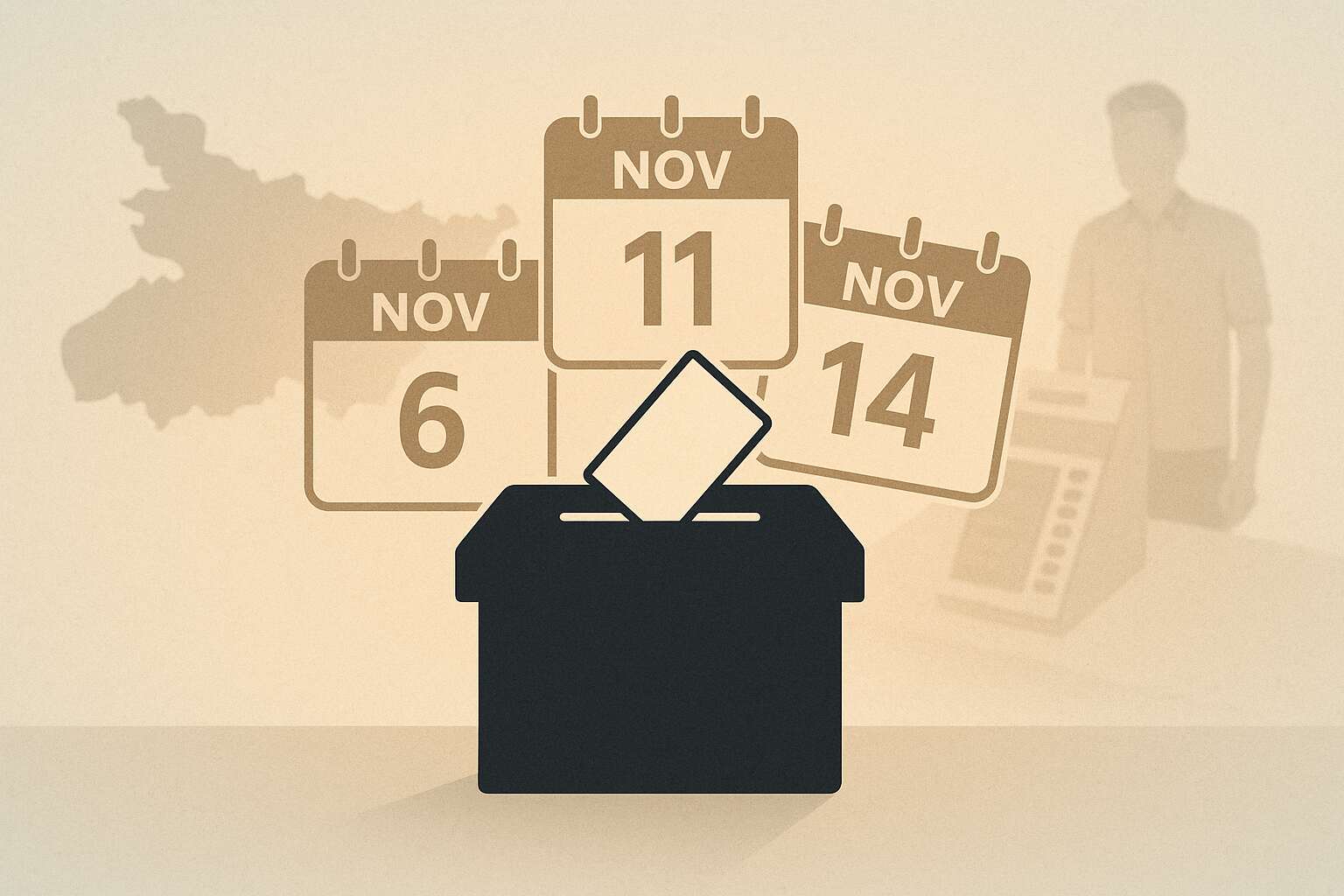
The Election Commission of India has announced the much-awaited Bihar Assembly Election 2025 schedule. The 243-seat assembly will go to polls in two phases — November 6 and November 11, with the counting of votes on November 14.
With this announcement, the political temperature across Bihar has surged. Major alliances have launched full-scale campaigns, and administrative preparations have intensified. The Editorial Team of Behind The Headlines breaks down the complete schedule, voter roll changes, key political stakes, and the bigger picture shaping this high-stakes state election.
Election Schedule and Key Phases
The Election Commission will conduct the Bihar Assembly polls in two compact phases, signaling confidence in logistical readiness.
- Phase 1: Polling on November 6 for 121 constituencies
- Phase 2: Polling on November 11 for 122 constituencies
- Counting: Scheduled for November 14, followed by the declaration of results
Notifications for Phase 1 will be issued by October 10, while for Phase 2 by October 13. The Model Code of Conduct is now in effect across the state, restricting government announcements and public projects until results are declared.
Voter Roll and Special Revision (SIR)
Ahead of the polls, Bihar underwent a Special Intensive Revision (SIR) of the electoral roll for the first time in over two decades.
The revision led to:
- Over 7.42 crore voters registered in total
- Nearly 3.6 lakh deletions due to duplication, death, or ineligibility
- Around 21 lakh new voters added to the rolls
The Election Commission described this as the “most extensive and transparent cleanup of voter data” since 2000. However, the move has stirred political debate, with opposition parties alleging mass deletions that could impact turnout.
To improve accessibility, the EC capped the voter count per booth at 1,200 and introduced a mobile deposit facility for document verification. Approximately 470 observers — including general, police, and expenditure observers — will oversee the process to ensure transparency.
(Read our detailed report on Bihar Voter List Revision and Roll Cleanup Impact)
Political Landscape and Alliances
The battle lines
The 2025 Bihar Assembly election will see a direct contest between two major alliances:
- NDA (National Democratic Alliance) — led by JD(U) and BJP
- INDIA Bloc (Mahagathbandhan) — led by RJD and Congress
In addition, Prashant Kishor’s Jan Suraaj Party is set to contest all 243 seats, seeking to disrupt the established arithmetic of both major camps.
Issues dominating the campaign
Key voter concerns include unemployment, inflation, farm distress, and infrastructure development. While the ruling alliance projects governance stability and welfare delivery, the opposition is focusing on corruption, youth migration, and job creation.
Caste-based mobilization remains central to campaign strategy. Both alliances are recalibrating seat distributions to appeal to EBC, Dalit, and minority segments.
(Also read Inside Bihar’s Political Arithmetic: What Shapes 2025’s Battle Lines)
Ground Realities and Election Readiness
The Election Commission has announced multiple measures to ensure smooth conduct of polling across Bihar’s 38 districts.
- In flood-prone regions, polling officials will reach booths by boat.
- Horse patrols are being deployed in remote and forested areas.
- CCTV monitoring and webcasting will be active in sensitive booths.
- Voter awareness drives are being conducted through local media and college campuses.
Officials emphasized that no constituency will exceed 1,200 voters per booth, reducing congestion and enhancing voter experience.
Analysis: What Makes Bihar 2025 Different
1. Shorter campaign window
By limiting the election to two phases, the EC has shortened campaign time. This benefits organized parties with robust ground networks while posing a challenge for smaller or newer outfits.
2. Roll cleanup controversy
The large number of deletions from the voter list may trigger voter anxiety, especially in rural regions. If not addressed promptly, it could lead to reduced participation or disputes on polling day.
3. Youth factor
With more than 21 lakh new voters registered, the youth vote could emerge as a decisive force. Employment guarantees, education, and digital infrastructure will likely dominate speeches and manifestos.
4. Security and transparency
The EC’s decision to deploy 470 observers underscores its intent to minimize malpractice. This election will also test the new “mobile deposit” and “live monitoring” systems across thousands of booths.
Political Reactions
Soon after the announcement, both alliances released statements claiming advantage.
- NDA leaders expressed confidence in their governance record and welfare delivery.
- INDIA Bloc members criticized the voter roll deletions and alleged selective omissions in key districts.
- Jan Suraaj Party said it would focus on a “clean, issue-based” campaign, positioning itself as a reformist alternative.
Political analysts note that a compact polling window could amplify early momentum — whoever dominates Phase 1 might psychologically tilt Phase 2 outcomes.
The Bigger Picture
The Bihar polls carry national implications. They are the first major state election since the Lok Sabha polls and will test the stability of opposition alliances. The outcome could redefine regional leadership, influence federal resource negotiations, and shape future coalition equations.
At stake are not just 243 assembly seats but Bihar’s broader narrative: governance credibility versus promises of change.
(Explore our archive story Bihar’s Battle for Balance: From Mandal to Modernization)
What Lies Ahead
In the weeks leading up to polling:
- Candidate lists for both alliances will finalize by mid-October.
- Voter slips will be distributed by the end of October.
- Security deployments and mock drills will be completed in all districts.
- The EC will release awareness campaigns under “Vote for Bihar” drive targeting first-time voters.
Conclusion
With polling on November 6 and 11 and results on November 14, the Bihar Assembly Election 2025 is set to be one of the most closely watched contests in recent years.
It will test political adaptability, the credibility of the electoral roll revision, and the strength of grassroots campaigning. Above all, it will reaffirm whether Bihar’s democracy can deliver both participation and performance.
Related Posts



Stay Informed With the Latest & Most Important News
Previous Post
Next Post


Advertisement









Advertisement
