

Now Reading: Google’s Willow Chip Quantum Breakthrough: What It Means for the Future
-
01
Google’s Willow Chip Quantum Breakthrough: What It Means for the Future

Google’s Willow Chip Quantum Breakthrough: What It Means for the Future

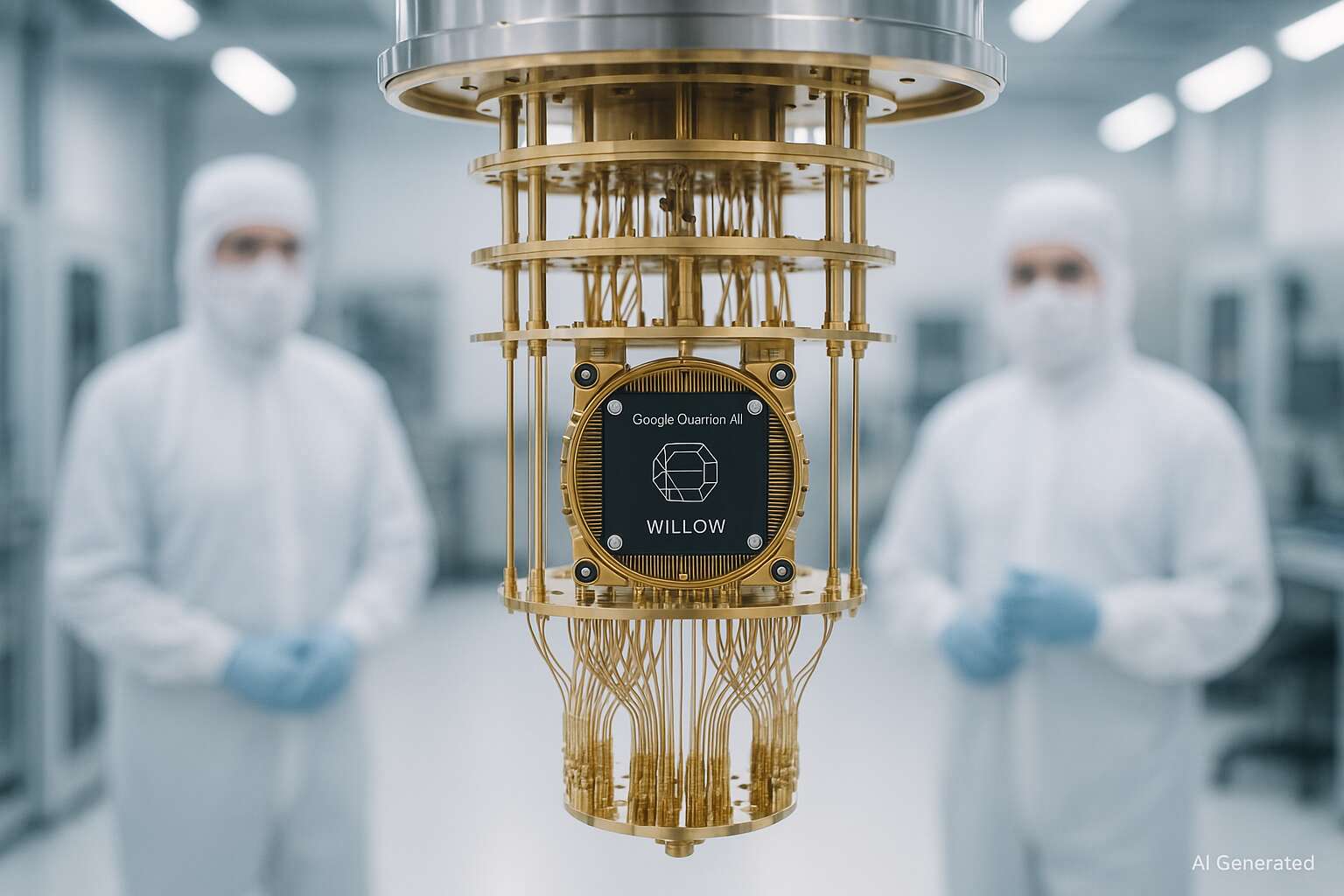
Google has taken a major step in the world of advanced computing with the introduction of its new quantum processor called Willow. The chip represents a major breakthrough in the quest to build practical and powerful quantum computers.
Within the first 100 words, the breakthrough marks a key milestone where Google has managed to reduce computing errors while scaling up the number of qubits — the fundamental units of quantum computation. In simple terms, the Willow chip performs complex calculations faster and more accurately than any classical supercomputer could. This progress could open new paths for innovations in artificial intelligence, material science, cybersecurity, and medical research.
The achievement signals that quantum computing, once a theoretical dream, is now moving closer to real-world application.
What is the Willow Chip?
The Willow chip is a superconducting quantum processor built by Google’s Quantum AI division. Unlike traditional computer chips that use bits (0s and 1s), Willow operates on qubits, which can exist in multiple states simultaneously. This gives quantum machines the ability to perform calculations at speeds unimaginable for classical systems.
But quantum technology has long struggled with instability and errors. Each qubit is extremely delicate, losing information easily due to environmental noise. Google’s Willow chip addresses this issue through error correction — a process that keeps qubits stable for longer periods.
Engineers working on Willow found that as they increased the number of physical qubits, the overall error rate actually decreased. This reversal of the usual pattern is a huge scientific milestone, showing that scaling quantum chips can actually improve performance.
Why Willow Is a Game-Changer
The Willow chip’s success doesn’t just lie in speed; it lies in reliability. For the first time, researchers demonstrated that large-scale quantum error correction can work consistently.
That means quantum computers are inching closer to becoming truly useful — capable of solving real-world problems instead of just scientific experiments. The chip’s design also shows that Google’s hardware team has mastered the balance between expanding qubit counts and maintaining coherence.
According to industry experts, this could lead to breakthroughs in three key areas:
- Artificial Intelligence (AI): Quantum processors like Willow can analyze massive datasets faster, helping in AI model training and decision-making.
- Drug Discovery: Simulating molecules at the quantum level can shorten research cycles and enable faster development of new medicines.
- Cybersecurity: As quantum power grows, the need for quantum-safe encryption will become essential for protecting data.
This achievement is more than a scientific success — it’s a technological revolution in the making.
From Quantum Supremacy to Quantum Utility
Back in 2019, Google announced it had achieved “quantum supremacy,” meaning its quantum computer solved a problem that no supercomputer could solve in reasonable time. But critics argued that the task had little practical value.
The Willow chip changes that perception. Instead of focusing only on speed, Google has shifted its attention toward quantum utility — using quantum systems to solve meaningful problems.
Willow’s stability and speed improvements make it one of the first quantum processors to cross that threshold. It can handle complex mathematical operations, optimize logistics problems, and even simulate materials at an atomic level.
For the world of science and business, this represents a turning point from experimental research to usable technology.
A Leap in Quantum Hardware Design
The Willow chip integrates thousands of connections in a cryogenic environment to keep temperatures close to absolute zero. This cooling is vital because qubits can only function in an ultra-cold, noise-free environment.
By using advanced materials and design techniques, Google engineers managed to extend the lifespan of qubits — a feat that had previously been one of the biggest challenges in the field.
The result is a machine that can maintain a “quantum state” long enough to complete complex computations with fewer errors. It’s a step closer to building fault-tolerant quantum computers, systems that can perform useful tasks continuously without crashing due to noise or instability.
The Broader Impact on Technology
The success of Willow will have ripple effects across the tech ecosystem. Competitors such as IBM, Intel, and startups around the world are now racing to match or exceed Google’s progress.
It also sets the stage for a new wave of innovation in hardware design, cloud-based quantum services, and hybrid computing models that combine classical and quantum processing.
This progress comes at a time when artificial intelligence, chip manufacturing, and computing efficiency are becoming central to global economic power. (Read our related coverage: “AI Chip Revolution: How India Is Catching Up”).
If Google continues at this pace, the next generation of processors might not just outperform classical computers — they could redefine the meaning of computing itself.
Reactions from the Scientific Community
Scientists and technology leaders have praised the Willow chip as one of the most impressive advancements in quantum hardware. Many see it as a step toward solving one of the longest-standing problems in computing — managing qubit errors at scale.
However, researchers also caution that a fully functional quantum computer is still years away. Achieving commercial use will require millions of stable qubits, advanced error correction, and massive engineering investments.
Even so, the progress made with Willow proves that these goals are no longer out of reach. It shows that the industry’s roadmap toward practical quantum machines is realistic.
Challenges That Remain
Despite the excitement, quantum computing still faces major hurdles. Producing large, stable qubit arrays is extremely difficult. Each chip must operate in near-perfect conditions, and scaling them up without losing accuracy remains a challenge.
Moreover, developing quantum algorithms that take advantage of such systems will require deep collaboration between physicists, mathematicians, and software engineers.
Another key issue is energy and cost. Quantum systems need special cryogenic equipment and consume significant resources, making them expensive to build and maintain.
Yet, as seen with Willow, every challenge overcome pushes the technology closer to mainstream adoption.
The Future: From Labs to Real-World Use
Google’s announcement is not just a milestone for research — it’s a signal that quantum computing is entering a phase of early utility. Within the next few years, we may see quantum services being integrated into cloud platforms, allowing businesses and researchers to run specific tasks on quantum hardware remotely.
This could eventually revolutionize industries ranging from finance to logistics, where optimization and speed are critical. Governments too are expected to invest more in quantum-safe communication networks to prepare for the post-quantum era.
For India and other emerging economies, this moment offers both challenge and opportunity. Investments in quantum research, education, and manufacturing could help nations stay relevant in the next technological revolution. (You can also read: “Inside Quantum Race: Why Big Tech Is Betting on Qubits”).
The Bigger Picture
The Willow chip represents more than just one company’s success. It reflects humanity’s growing capability to control the invisible — manipulating particles smaller than atoms to build machines that can think and calculate at an entirely new level.
Just as the transistor transformed the 20th century, quantum chips like Willow could transform the 21st. They could lead to cleaner energy solutions, smarter AI, and faster innovation in nearly every industry.
Quantum technology may still be in its infancy, but its potential is boundless. Every small step forward, such as Willow’s breakthrough, brings the world closer to a future where computing power knows no limits.
Conclusion
Google’s Willow chip is not just another lab experiment; it’s a glimpse into the future of technology. By reducing errors while increasing qubit capacity, Google has moved closer to building practical, reliable quantum computers.
The journey from “quantum supremacy” to “quantum utility” has officially begun. With each breakthrough, the line between imagination and reality becomes thinner.
As quantum computing evolves, it will influence everything — from how we discover new medicines to how artificial intelligence learns. The Willow chip is proof that the future of computing has already started taking shape inside the world’s most advanced labs.
Read More:
Sensex jumps over 700 points, Nifty 50 above 26,000 — 5 key reasons behind today’s market rally
Related Posts



Stay Informed With the Latest & Most Important News
Previous Post
Next Post


Advertisement









Advertisement
