

Now Reading: Katta, cruelty, corruption: PM Modi blames RJD’s ‘jungle raj’
-
01
Katta, cruelty, corruption: PM Modi blames RJD’s ‘jungle raj’

Katta, cruelty, corruption: PM Modi blames RJD’s ‘jungle raj’

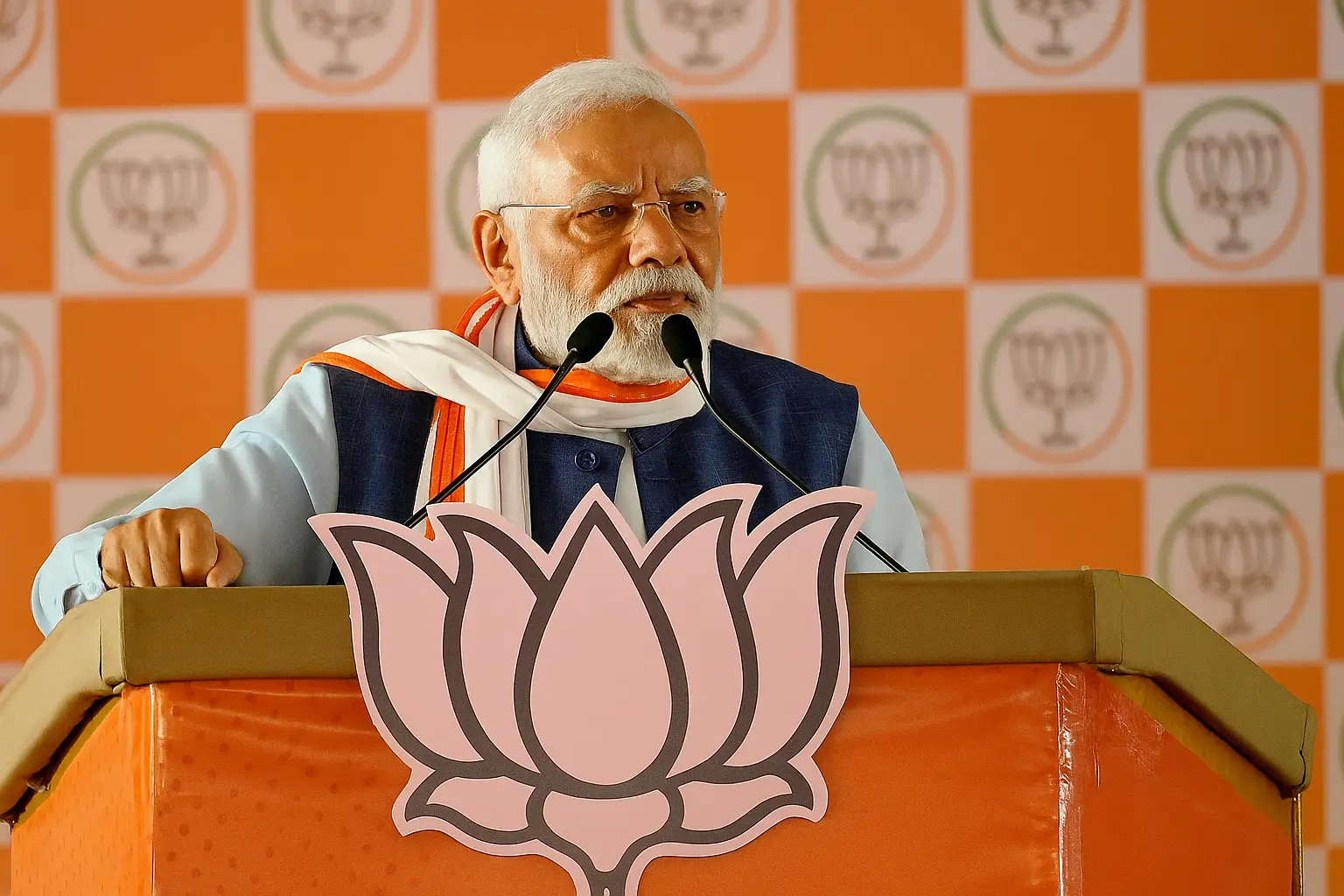
The Editorial Team of Behind The Headlines reports that Narendra Modi sharply attacked the Rashtriya Janata Dal (RJD) during a rally in Bihar, accusing the party of leading an era of “jungle raj” characterised by illegal guns (katta), cruelty and corruption. Modi said the people of Bihar must not return to that period of misgovernance and instead vote for the alternative offered by the Bharatiya Janata Party-led alliance. His remarks came just days before the 2025 Bihar assembly elections, making law-and-order the central theme of his campaign pitch.
Details / Background
As the 2025 Bihar legislative assembly polls draw near, Prime Minister Modi addressed a massive rally in Arrah, Bihar, where he laid out his critique of the RJD-Congress alliance with pointed language. He claimed that under previous RJD-led administrations the state had suffered from rampant lawlessness, coercion with firearms, and systematic corruption. He listed “katta (country-made guns), cruelty, bad governance and corruption” as hallmarks of what he called RJD’s “jungle raj”.
Modi contrasted that with what he described as the National Democratic Alliance’s (NDA) development-oriented manifesto for Bihar, which includes a promise to generate one-crore jobs and convert Bihar into a hub of cottage industries. He said that the RJD-Congress alliance’s document is a “bundle of lies” and warned voters that returning the “jungle raj folks” to power would erode the gains the state has made.
The term “jungle raj” has long been used in Bihar political discourse to describe a period where law enforcement was weak, political patronage strong, and criminality allegedly tolerated. Modi’s invocation of it aims to remind voters of that narrative and tie it to the RJD-Congress alliance’s past governance.
Analysis
Modi’s rhetoric is strategically timed. With the Bihar elections imminent, law and order has emerged as a key battleground issue. By focusing on “jungle raj”, the BJP and its allies are seeking to frame the election as a choice between development and disorder.
First, the strategy seeks to shift voter attention away from purely caste-based politics or local resentments, and place it on governance and safety. Modi’s reference to illegal guns (“katta”) and cruelty emphasises the threat element—portraying the opposition as a force of fear. This framing asks the electorate: do you want a government that will protect you or one that will allow chaos?
Second, the criticism of the opposition manifesto as lies works to challenge the credibility of the RJD-Congress alliance, especially among younger voters and those concerned with employment and economic progress. The promise of one-crore jobs, and linking it with Make in India and cottage industries, attempts to present a contrasting vision of hope and growth.
Third, invoking past lawlessness taps into collective memory. Many voters in Bihar may associate earlier decades with higher crime, weaker institutions, and fewer job opportunities. By reviving that memory, the NDA campaign tries to motivate voters to avoid a return to those years.
However, this tactic does carry risks. For one, calling the opposition’s promise a “bundle of lies” may be seen as dismissive by supporters of the RJD and Congress who feel their concerns are real. Also, focusing largely on negatives (past lawlessness) may leave less space for the NDA to talk in depth about current issues such as unemployment, migration, education and infrastructure. Voters may ask: what has changed now?
Finally, the analysis must note that election messaging often simplifies complex realities. While Modi’s rhetoric is powerful, local outcomes may still hinge on grassroots factors: candidate selection, caste equations, local governance delivery, and campaign execution on the ground. The “jungle raj” narrative will have to be matched by visible improvements in public perception and day-to-day governance if it is to convert to votes.
Reactions / Statements
On stage, Prime Minister Modi accused the opposition of not only poor governance but of actively eroding Bihar’s identity. He claimed that the RJD-Congress alliance was engaging in appeasement politics and supporting infiltration, and that their manifesto lacked a genuine vision for the youth of Bihar.
From the RJD side, senior leaders dismissed the “jungle raj” tag as political theatrics. They argued that the real issues facing Bihar—such as unemployment, migration of youth, and inadequate infrastructure—have not been addressed by the current government. Some spokespersons even compared Modi’s speech to a “downpour of lies”, suggesting that the BJP was offering grandiose promises without delivery.
Local voters and civil society in several districts expressed mixed reactions. Some older residents recalled a time when fear and coercion shaped political life and welcomed the Prime Minister’s reference to that era. Others felt the narrative did not reflect present-day concerns, emphasising joblessness and rural distress instead of past gun violence.
The Election Commission and media watchers have noted the intensification of campaign language and warned of possible violations of the model code of conduct. The “jungle raj” theme, by its nature, raises the emotional stakes of the campaign and could lead to sharper confrontations on the ground.
Bigger Picture / Future Impact
The BJP-led campaign’s spotlight on the “jungle raj” narrative may shift the election calculus in Bihar in several ways.
Politically, if the narrative resonates, it could help the NDA reclaim seats in regions where the RJD has historically been strong. It might attract voters who are primarily concerned about law, order and governance rather than caste identity alone.
In terms of governance, a vote based on law-and-order concerns could push the next government to prioritise institutional reforms: strengthening police, reducing local coercion by local strongmen, improving judicial delivery and enhancing citizen safety.
On the other hand, if the electorate feels that talk has replaced action, the narrative may lose ground. Youth voters who prioritise jobs, migration relief, infrastructure, and digital opportunities may demand more than just a critique of past misrule—they may ask for concrete results now. The NDA will need to demonstrate that the “jungle raj” era is genuinely in the past, not just in rhetoric.
For the opposition, the challenge will be to reclaim the narrative. They may need to shift from defending past governance to proposing credible future alternatives—linking local issues to delivery rather than simply reacting to the “jungle raj” tag.
At the national level, Bihar’s election outcome may reflect the broader mood toward governance vs. populism. If the “jungle raj” narrative works in Bihar, similar strategies may appear in other states where law and order concerns are prominent. If it fails, it may signal that voters demand performance more than politics of fear.
Finally, for voters, the focus may gradually move from historical grievances to current performance. Candidates and parties will increasingly be judged on what they have done recently and what they propose to do, rather than primarily on what their opponents did decades ago.
Conclusion
Prime Minister Modi’s invocation of the “jungle raj” charge against the RJD is a bold move in the lead-up to the Bihar assembly elections. By emphasising themes of illegal arms, cruelty, corruption and misgovernance, he has framed the contest as a choice between disorder and development. Whether that framing will translate into votes remains to be seen—but one thing is clear: the narrative has shifted, and the competition is no longer just about caste politics or regional alliances. The electorate of Bihar is being asked to choose not just a party, but a future.
The Editorial Team of Behind The Headlines will continue to monitor how this narrative unfolds on the ground, whether the promises hold, and which issues finally sway the voter.
nternal Links (to related Behind The Headlines stories)
Related Posts


Stay Informed With the Latest & Most Important News
Previous Post
Next Post
Advertisement





Advertisement
