
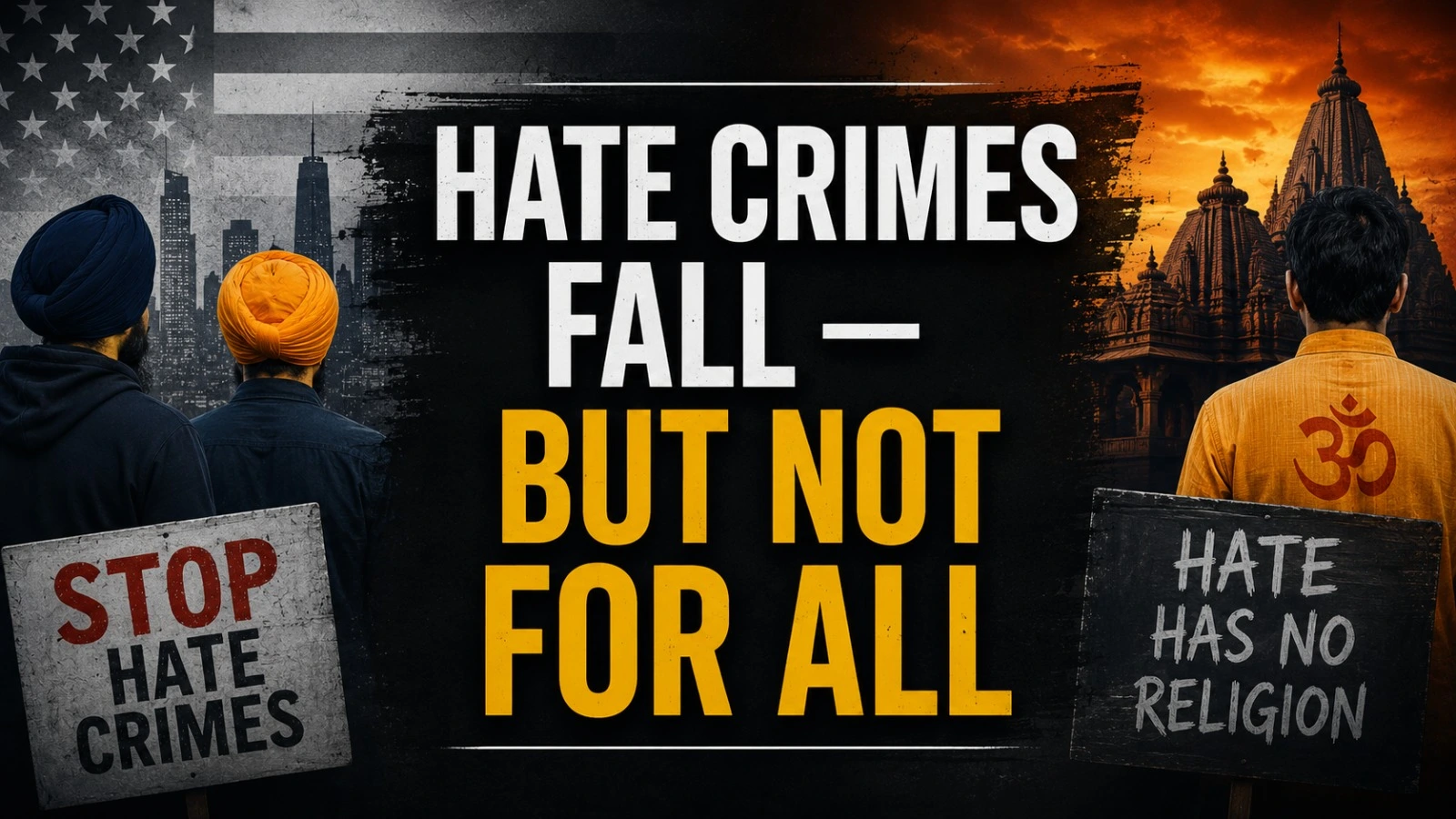
New FBI data shows a sharp rise in reported anti-Sikh and anti-Hindu hate-crime incidents in the US, highlighting a persistent problem for religious minorities even as the overall number of hate crimes declined.
Hate crimes in the United States declined overall in 2025, but the trend was not uniform across religious communities. New FBI data shows that reported incidents targeting Sikhs and Hindus increased, raising concerns about the safety of two Asian-American communities. Anti-Sikh incidents rose by about 24.6%, while anti-Hindu incidents increased by around 12% compared with 2024.
The Editorial Team of Behind The Headlines reports that the numbers are important not because they suggest that Sikhs or Hindus are facing the largest volume of hate crimes in America, but because they show an increase against communities that account for a relatively small share of the US population. At the same time, FBI data needs to be read carefully because hate-crime statistics depend on incidents being reported to law-enforcement agencies and correctly classified. The FBI itself maintains separate categories for anti-Hindu and anti-Sikh religious bias in its hate-crime data collection.
What does the new FBI data show?
According to the data highlighted in reports on the FBI's latest hate-crime statistics, anti-Sikh hate-crime incidents increased from 142 in 2024 to 177 in 2025, a rise of roughly 24.6%.
Anti-Hindu incidents increased from 25 to 28, representing a rise of about 12%.
The absolute numbers are relatively small compared with the total number of hate crimes recorded across the United States.
But the percentage increases are significant because they show that the decline in overall hate crime did not benefit every religious community equally.
So, are hate crimes increasing in America?
Overall, no.
That is one of the most important distinctions in this story.
The FBI data shows an overall decline in reported hate-crime incidents, while some categories—including anti-Sikh and anti-Hindu bias—moved in the opposite direction.
In other words:
America's overall hate-crime numbers may be improving, but certain communities are still experiencing an increase in targeted incidents.
This is why looking only at the national total can hide important differences between communities.
What is a hate crime?
A hate crime is not simply a crime committed against someone who belongs to a particular religion, race or community.
The defining element is bias or prejudice as a motivating factor.
For example, an assault becomes a hate crime when investigators establish that the offender was motivated, at least in part, by hostility towards the victim's religion, race, ethnicity or another protected characteristic.
The FBI's hate-crime data collection covers multiple categories, including anti-Hindu and anti-Sikh religious bias.
This distinction matters because not every crime involving a Hindu or Sikh victim is automatically classified as anti-Hindu or anti-Sikh.
There must be evidence of the relevant bias.
Why are anti-Sikh incidents particularly concerning?
The Sikh community has historically faced a unique problem in the United States.
Visible religious symbols—including turbans and beards worn by many Sikh men—can make Sikh Americans targets of mistaken identity or prejudice.
In some cases, attackers have reportedly confused Sikhs with members of other communities, particularly Muslims, because of stereotypes surrounding appearance.
That creates a complicated question for law enforcement:
Was the victim targeted because the attacker specifically hated Sikhs, or because the attacker believed the victim belonged to another group?
The FBI's classification depends on the bias identified in the reported incident.
This makes accurate reporting particularly important.
Why are anti-Hindu numbers significant despite being smaller?
The number of reported anti-Hindu incidents remains much lower than several other religious-bias categories.
But the increase is notable because Hindu Americans have historically had comparatively low visibility in US hate-crime statistics.
An increase from 25 to 28 incidents may appear numerically small, but it represents a measurable rise in reported cases.
It also demonstrates why percentage changes can sometimes look dramatic when the starting number is small.
A rise of three incidents produces a 12% increase in this case.
That does not mean that anti-Hindu hate crime is suddenly widespread across America.
It means the reported number went up.
Does the FBI data capture every hate crime?
No.
This is perhaps the most important limitation when interpreting the figures.
The FBI's hate-crime statistics are based on information submitted by participating law-enforcement agencies.
That means an incident generally needs to be:
Reported to authorities;
Recognised as potentially bias-related;
Investigated or classified appropriately; and
Included in the data submitted to the FBI.
If victims do not report incidents, or if investigators do not identify bias as a motivation, the incident may not appear in the hate-crime statistics.
The FBI provides specific guidance to law-enforcement agencies on identifying and reporting bias-motivated offences.
Could the increase partly reflect better reporting?
Yes.
This is an important possibility and one that should not be ignored.
An increase in reported hate crimes can result from an actual rise in incidents.
But it can also partly reflect greater awareness and improved reporting.
If members of a community become more willing to approach police, or if law-enforcement agencies become better at recognising religious bias, recorded numbers can rise even without an equivalent increase in the underlying number of incidents.
That does not make the data meaningless.
It simply means the figures should be interpreted as reported hate crimes, rather than a perfect measurement of every incident occurring in the country.
How serious is the problem compared with other religious groups?
Anti-Sikh and anti-Hindu hate crimes are not the largest religious-bias categories in the United States.
Jewish, Muslim and several other religious communities have historically recorded significantly higher numbers of reported hate crimes.
For example, FBI data from previous years has consistently shown anti-Jewish bias accounting for a substantial share of religiously motivated offences.
This context is important.
The latest data does not suggest that anti-Hindu or anti-Sikh hate crime has suddenly become America's biggest hate-crime problem.
Instead, it highlights a worrying increase within two specific communities.
Why does this matter for Indian Americans?
The Hindu and Sikh populations in the United States include large numbers of people with Indian and South Asian backgrounds.
The data therefore has significance beyond religious identity.
It touches on questions of immigration, race, ethnicity and identity in an increasingly diverse America.
A person may be targeted because of their religion, appearance, ethnicity or a combination of factors.
That can make identifying the exact motivation behind an attack complicated.
For Indian-American communities, the latest figures are therefore a reminder that economic success and social integration do not automatically eliminate discrimination.
Is this connected to politics?
Hate crimes are often influenced by wider social and political tensions, but the FBI data itself does not establish a single cause for the increase in anti-Hindu or anti-Sikh incidents.
It would therefore be misleading to attribute the rise to one political party, one ideology or one event without evidence.
The more defensible conclusion is that bias-motivated crime remains a problem even when the broader national trend is moving downward.
Understanding why particular communities experience increases requires examining individual incidents, local conditions and broader social attitudes.
What does the FBI's classification tell us?
The fact that the FBI separately tracks anti-Hindu and anti-Sikh bias is itself significant.
Its hate-crime data collection explicitly includes both categories under religious bias.
That means law-enforcement agencies have a framework for recording these incidents instead of simply placing every religiously motivated offence into a broad category.
More detailed data can help policymakers and community organisations identify patterns.
It can also help law enforcement understand where additional outreach or prevention may be required.
What should communities take from the data?
The figures should not create panic.
They should encourage awareness and reporting.
If a person believes they have been targeted because of their religion, documenting the incident and reporting it to the appropriate authorities can help create a clearer picture of the problem.
Community organisations can also play a role by educating people about what constitutes a hate crime and how to report it.
Without reporting, authorities may underestimate the scale of the problem.
What happens next?
The immediate challenge is to determine whether the increase in anti-Sikh and anti-Hindu incidents represents a sustained trend or a temporary movement in annual data.
One year's figures are not enough to establish a long-term pattern.
Researchers and policymakers will need to examine the numbers over several years while also considering changes in reporting practices.
The FBI's Crime Data Explorer provides public access to crime and law-enforcement data, allowing researchers and the public to examine trends over time.
The bigger picture
The latest figures tell a more complicated story than simply saying “hate crimes are rising in America.”
They aren't rising overall according to the latest data.
But the national decline does not mean every community is becoming safer.
For Sikhs, reported hate-crime incidents increased substantially in 2025. For Hindus, they also moved higher, although from a much smaller base.
The numbers also come with an important caveat: they represent reported and recorded incidents, not every act of discrimination or hostility experienced by members of these communities.
That makes the trend worth watching rather than sensationalising.
The real warning is not that America is facing a new wave of anti-Hindu or anti-Sikh violence.
It is that even when the overall hate-crime trend improves, smaller religious communities can still experience a very different reality.