
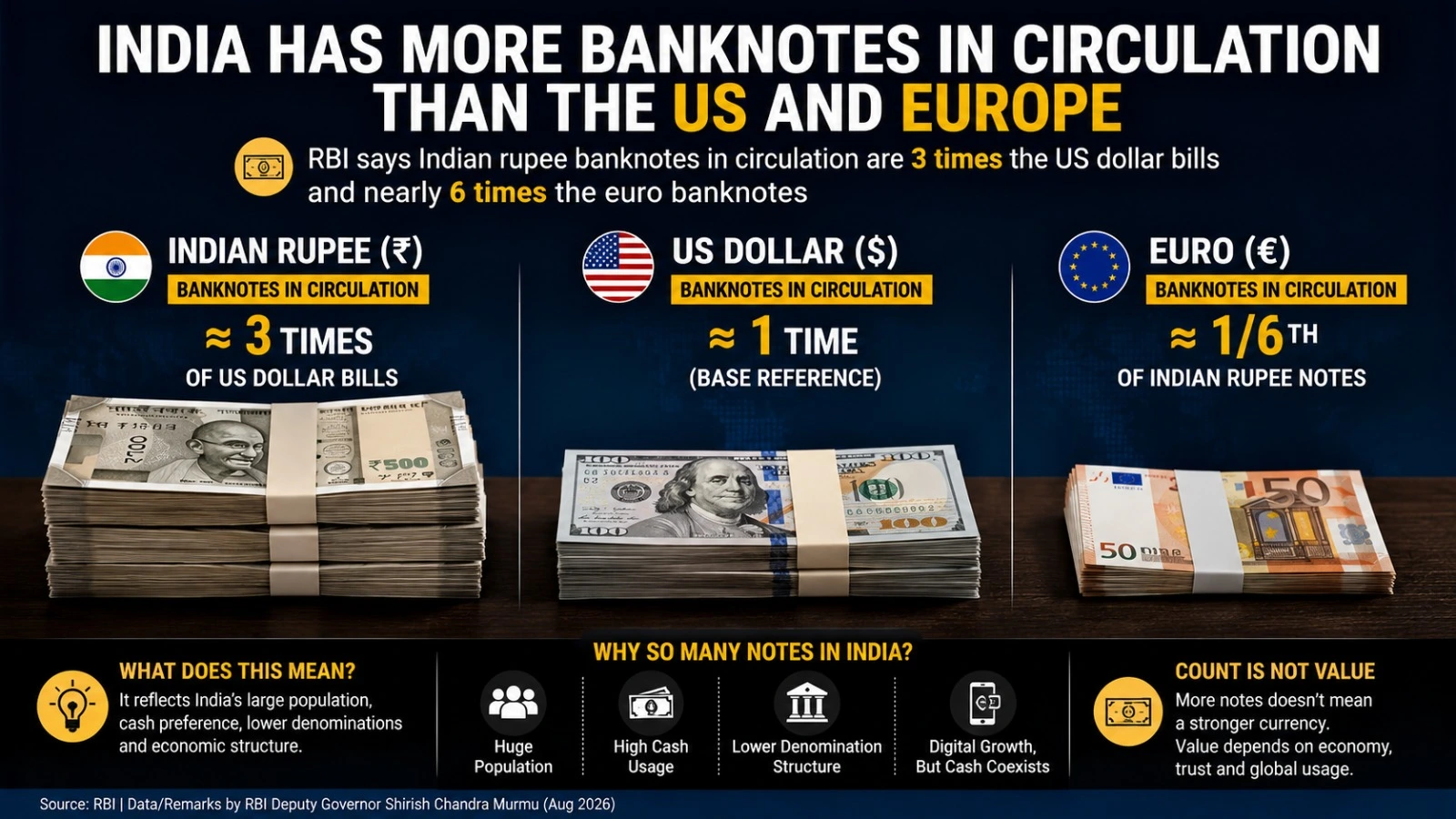
RBI Deputy Governor Shirish Chandra Murmu says the number of Indian rupee banknotes in circulation is three times that of US dollar bills and nearly six times that of euro notes. But does that mean the rupee is more widely used globally? Not quite.
India has more physical banknotes in circulation than either US dollar or euro notes, according to a recent observation by Reserve Bank of India (RBI) Deputy Governor Shirish Chandra Murmu. Murmu said Indian rupee notes in circulation are roughly three times the number of US dollar bills and nearly six times the number of euro banknotes.
The number may sound surprising because the US dollar and euro are among the world's most widely used currencies, including outside their home economies. But the comparison is about the number of physical notes, not their international importance, exchange value or total monetary worth. The Editorial Team of Behind The Headlines reports that the figure instead highlights how heavily India continues to rely on physical cash despite the rapid growth of digital payments such as UPI.
What exactly did the RBI say?
RBI Deputy Governor Shirish Chandra Murmu pointed out that the sheer number of Indian banknotes in circulation is significantly higher than the number of US dollar and euro notes.
According to the figures cited by him, the number of rupee banknotes is around three times the number of US dollar bills and almost six times the number of euro notes.
That does not mean ₹1 is more valuable than $1 or €1.
It also does not mean that the rupee is more widely accepted internationally.
The comparison is simply about how many individual physical banknotes are circulating.
That distinction is important.
Why does India have so many notes?
The first reason is India's enormous population.
India has more than 1.4 billion people, creating a massive potential demand for physical currency.
Even when a large portion of the population uses digital payments, cash remains important for everyday transactions, particularly in smaller towns, rural areas and parts of the informal economy.
The second factor is the structure of India's cash economy.
Cash is still used for a wide range of transactions, including retail purchases, transportation, small businesses, agricultural activity and payments where digital infrastructure or acceptance may not always be convenient.
The result is a very large number of banknotes moving between people, businesses and banks.
But isn't India becoming a digital economy?
Absolutely.
India has emerged as one of the world's largest digital-payment markets, particularly because of the rapid adoption of UPI.
This creates an interesting contradiction.
On one side, India has built one of the world's most advanced real-time digital-payment ecosystems.
On the other, it continues to maintain an enormous stock of physical currency.
The two trends can exist simultaneously.
Digital payments are particularly convenient for formal transactions, online purchases and person-to-person transfers.
Cash remains attractive where transactions are small, connectivity is limited or people simply prefer physical money.
The growth of UPI therefore does not automatically mean that demand for banknotes disappears.
Does the number of banknotes indicate how rich a country is?
No.
This is one of the biggest misconceptions that can arise from the comparison.
The number of banknotes in circulation is influenced by several factors, including:
Population
Economic activity
Inflation
Interest rates
Payment habits
Currency denominations
Cash preferences
Banking penetration
Digital-payment adoption
The RBI has also highlighted that these factors influence the quantity of currency required by an economy.
Consider two countries.
One may use mostly high-value banknotes.
Another may rely heavily on lower denominations.
Even if both economies have similar amounts of money circulating, the second country could require many more individual notes.
Therefore, counting notes is not the same as measuring money.
What about the US dollar?
The US dollar has a unique position in the global financial system.
US currency is widely held outside the United States, including as a store of value and reserve currency.
The US Bureau of Engraving and Printing produces Federal Reserve notes in denominations ranging from $1 to $100, while older US currency designs remain legal tender.
A significant amount of US currency is believed to circulate outside the United States.
Therefore, the number of dollar notes cannot simply be compared with the number of rupee notes to determine which currency is more important.
The dollar's importance comes from its international use, financial-market role, reserve-currency status and acceptance in global trade, not from the number of pieces of paper printed.
And what about the euro?
The euro is similarly used across multiple countries.
Euro banknotes circulate throughout the euro area and are also held outside the region.
As of April 2025, around 30 billion euro banknotes were in circulation, according to published data on euro banknotes.
Again, this figure represents physical notes, not the total amount of euros in existence through bank deposits and other forms of money.
This is important because modern economies do not operate solely on physical cash.
A large part of money exists electronically in bank accounts.
So why does the RBI care about the number of notes?
Because physical currency is expensive to produce and manage.
Banknotes need to be:
Printed
Transported
Stored
Distributed
Authenticated
Sorted
Replaced when damaged
Old or damaged notes have to be withdrawn from circulation and replaced with new ones.
The larger the number of banknotes in circulation, the greater the operational and financial burden on the currency-management system.
This is one reason the RBI is exploring ways to increase the lifespan of banknotes, including the possible use of polymer-based materials.
Why is the RBI looking at polymer notes?
Traditional paper-based banknotes deteriorate over time.
Lower-denomination notes generally change hands frequently and can become dirty or damaged relatively quickly.
If the lifespan of a note can be increased, the RBI and the banking system can potentially reduce the number of replacement notes that need to be printed and distributed.
Polymer banknotes are already used in several countries because they can be more durable and resistant to moisture.
The RBI's interest in extending note life is therefore not necessarily about printing fewer notes immediately.
It is about reducing the long-term cost of managing such a large currency stock.
Does India's huge note circulation mean people are using more cash?
Not necessarily.
This is where the story becomes more interesting.
The number of notes in circulation is a stock, while transactions are a flow.
Imagine someone withdraws ₹10,000 from a bank.
That money can move between several people over the following weeks or months.
The same notes can therefore support many transactions without the total number of notes changing dramatically.
Similarly, a person may withdraw cash but keep it at home.
That note remains part of the currency stock even though it is not actively changing hands.
So, the number of notes does not directly tell us how frequently people are using cash.
What does this say about India's cash economy?
It shows that India remains a hybrid payments economy.
Digital payments are growing at extraordinary speed, but cash has not disappeared.
Instead, Indians are increasingly using different payment methods depending on the situation.
A consumer might use UPI to pay a restaurant bill, a card for an online purchase and cash at a local market.
This flexibility is one reason physical currency can remain significant even as digital payments expand.
Is the rupee becoming more important than the dollar or euro?
No.
The RBI's comparison should not be interpreted as a measure of global currency power.
The US dollar remains the dominant global reserve and transaction currency, while the euro is one of the world's major international currencies.
The rupee's physical circulation being higher in number does not change that.
A ₹500 note and a $100 bill are both one banknote.
But their monetary values are very different.
This is why the value of currency in circulation is a more meaningful economic measure than simply counting the number of notes.
Why is this story important now?
The observation comes at an interesting moment for India's payments ecosystem.
India is simultaneously trying to reduce dependence on physical cash through digital payments while ensuring that cash remains accessible and reliable for those who need it.
The RBI therefore has to manage two systems at once.
It must support India's rapidly expanding digital-payment infrastructure.
And it must continue producing, distributing and maintaining billions of physical banknotes.
The challenge is to make the cash system more efficient without compromising access to currency.
What happens to the ₹2,000 note?
The RBI's currency-management strategy has also changed following the withdrawal of the ₹2,000 denomination from circulation.
The note was withdrawn from circulation in 2023, although it continues to remain legal tender.
The composition of India's currency stock therefore continues to evolve.
Lower and medium denominations remain particularly important for everyday transactions, while digital payments increasingly handle transactions that might previously have required cash.
The bigger picture
The headline number—three times the dollar and nearly six times the euro—sounds like a contest between currencies.
It isn't.
It tells us something much more basic about the Indian economy:
India still has an enormous appetite for physical cash, even while becoming one of the world's biggest digital-payment markets.
The rupee's huge banknote circulation reflects India's population, economic scale, cash habits and denomination structure.
At the same time, the RBI's focus on increasing the lifespan of banknotes shows that managing physical currency at this scale comes with a significant cost.
The future is therefore unlikely to be simply cash versus digital.
India is moving towards a system where both coexist.
UPI may have changed how millions of Indians pay.
But the humble rupee note is clearly not disappearing yet.