
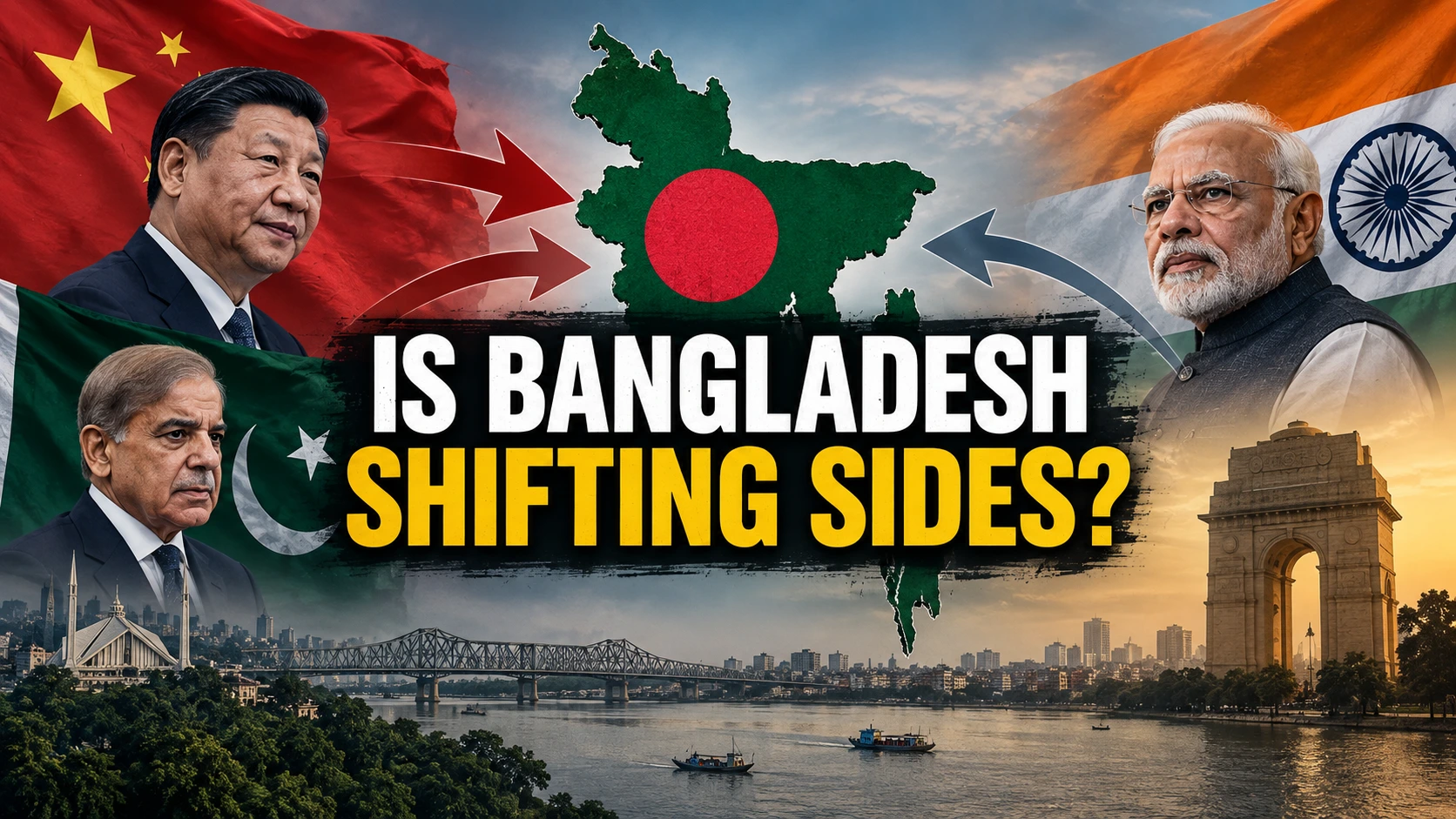
A proposed Chinese fighter-jet deal, growing defence contacts with Pakistan and interest in a new Saudi-Turkey-Pakistan security pact are raising questions about Bangladesh’s foreign-policy direction. But Dhaka has not formally chosen sides.
Bangladesh’s foreign policy is showing signs of a significant recalibration.
Over the past few weeks, Dhaka has moved closer to China on defence procurement, opened the door to deeper military engagement with Pakistan and expressed interest in joining the newly created Mecca Joint Defence Agreement, which currently brings together Saudi Arabia, Türkiye and Pakistan.
At the same time, Bangladesh’s planned engagement with India has faced uncertainty.
Taken individually, none of these developments amounts to a formal strategic realignment. But taken together, they indicate that Bangladesh is exploring a wider set of partnerships at a time when its relationship with India has become increasingly complicated.
The Editorial Team of Behind The Headlines reports that the key question is not whether Bangladesh has already joined a China-Pakistan camp. It has not. The more important question is whether Dhaka is moving from its traditional policy of balancing multiple powers towards a more security-focused relationship with countries that have interests different from India.
What has changed in Bangladesh’s foreign policy?
Bangladesh has traditionally followed the principle of “friendship towards all, hostility towards none.”
The approach allowed Dhaka to maintain relations with India while simultaneously developing strong economic and defence ties with China and maintaining diplomatic relations with Pakistan.
That balancing act is now facing a new test.
Bangladesh is advancing discussions on acquiring Chinese J-10CE fighter aircraft, while also exploring broader defence cooperation. Separately, Dhaka has indicated that it views the Mecca Joint Defence Agreement positively and could consider joining it.
At the same time, relations with India remain strained over several political and security issues, including the presence of former Prime Minister Sheikh Hasina in India.
The result is a foreign-policy environment in which Dhaka appears increasingly willing to explore alternatives.
Why is China becoming more important?
China is not a new strategic partner for Bangladesh.
Beijing has been one of Dhaka’s most important defence suppliers for roughly two decades. Chinese equipment already forms a substantial part of Bangladesh’s military inventory, including aircraft, naval vessels, tanks and missile systems.
The proposed acquisition of J-10CE fighter jets therefore represents an extension of an existing relationship rather than a sudden decision to abandon India.
But the aircraft themselves are strategically significant.
Bangladesh has been looking to modernise its air force, and the J-10CE offers a relatively affordable modern multirole fighter compared with several Western alternatives.
Reports indicate that Bangladesh is working towards a deal involving around 20 aircraft, while earlier discussions had mentioned a larger number. The precise number, cost and delivery arrangements have remained subject to negotiations.
Why does the J-10CE matter to India?
The J-10CE is already operated by Pakistan.
Its importance increased after the May 2025 India-Pakistan conflict, when Pakistan claimed that its Chinese-made J-10s had been involved in shooting down Indian aircraft, including Rafale fighters. India has disputed aspects of Pakistan’s claims.
Bangladeshi officials have nevertheless acknowledged that the performance of the aircraft during that conflict influenced Dhaka’s thinking.
However, it would be misleading to conclude that the J-10CE itself gives Bangladesh an offensive advantage over India.
Modern air warfare depends on much more than the fighter aircraft.
Radar networks, airborne early-warning aircraft, electronic warfare, intelligence, surveillance and reconnaissance, datalinks, long-range missiles and ground-based air defence all contribute to combat effectiveness.
The J-10CE is therefore one component of a much larger military system.
For India, the concern is less about the aircraft in isolation and more about how deeply Bangladesh’s defence relationship with China develops around them.
What about Pakistan?
This is a more politically sensitive development.
Bangladesh and Pakistan have a complicated history dating back to the 1971 Liberation War.
For decades, their political relationship remained deeply strained.
That began changing after Sheikh Hasina’s government fell in 2024.
The new political environment in Dhaka has created space for closer Bangladesh-Pakistan engagement, including diplomatic contacts and discussions around defence cooperation. There have also been reports of greater contact between their intelligence establishments.
Potential cooperation could extend to military equipment, including discussions around Pakistan’s JF-17 fighter aircraft.
That does not mean Bangladesh and Pakistan have suddenly become strategic allies.
But the revival of defence links between two countries that had remained distant for decades is significant.
What is the Mecca Joint Defence Agreement?
The Mecca Joint Defence Agreement was signed by Saudi Arabia, Türkiye and Pakistan on August 7, 2026.
The agreement establishes a framework for collective defence cooperation, with the principle that an armed attack against one member would be treated as an attack against all.
The three countries have also discussed military interoperability, joint exercises and defence-industrial cooperation.
Bangladesh has expressed interest in the arrangement.
But there is an important distinction:
Bangladesh has not formally joined the pact.
Its current position is better described as keeping the door open.
That distinction is crucial when assessing whether Dhaka is actually moving into a new military bloc.
Why would Bangladesh consider joining?
There are several possible reasons.
First, Bangladesh has important economic and labour links with the Gulf.
Millions of Bangladeshi workers live and work in Gulf countries, making Saudi Arabia and other Middle Eastern economies important sources of remittances.
Second, Türkiye has become an increasingly visible defence and economic partner across the Muslim world.
Third, Pakistan provides Bangladesh with another channel for military cooperation.
For Dhaka, participation could therefore be seen as an opportunity to expand its strategic network rather than simply take an anti-India position.
Could joining the pact create problems for Bangladesh?
Yes.
The biggest problem is that collective-defence agreements can eventually force countries to make choices during crises.
The three existing members of the Mecca pact do not necessarily face identical security threats.
Saudi Arabia's security concerns are heavily influenced by Iran and regional instability.
Türkiye has its own security challenges involving Syria, Israel and surrounding regions.
Pakistan's principal security concerns include India and militant threats on its western borders.
If Bangladesh joined, its own security concerns—including relations with India and Myanmar—would add another layer to the pact.
That could make the alliance more complicated.
Reuters has reported that analysts see Bangladesh's possible participation as a test of its longstanding non-aligned foreign-policy approach.
Is Bangladesh becoming anti-India?
That conclusion would be premature.
Bangladesh still has enormous practical reasons to maintain good relations with India.
The two countries share a long land border.
They are connected through trade, transport, energy and river systems.
India is also important for Bangladesh’s regional connectivity.
A complete strategic break would therefore carry substantial economic and security costs for Dhaka.
This is why the current developments are better understood as hedging.
Bangladesh appears to be making sure it has relationships beyond India rather than formally abandoning its relationship with India.
Then why is India concerned?
Because the regional security environment is changing.
India already faces a strategically close China-Pakistan partnership on its western and northern borders.
Bangladesh lies on India's eastern flank.
If Chinese military technology becomes increasingly embedded in Bangladesh's armed forces while Pakistan's defence relationship with Dhaka simultaneously expands, Indian planners will naturally pay close attention.
The concern would become substantially greater if Chinese involvement moved beyond equipment sales into military infrastructure, long-term maintenance arrangements, intelligence cooperation or permanent strategic facilities.
That is where the distinction between buying Chinese weapons and becoming strategically dependent on China becomes important.
What about Bangladesh’s relationship with India?
The relationship has become more politically complicated since Sheikh Hasina left office.
Her continued presence in India has become a major issue between the two governments, with Dhaka seeking her return.
Border management, migration-related allegations and other bilateral issues have added further friction.
The uncertainty surrounding Prime Minister Tarique Rahman's proposed visit to India has therefore attracted attention.
But even here, caution is necessary.
A delayed or stalled diplomatic visit does not automatically mean Bangladesh has decided to turn towards Pakistan or China.
Diplomatic relationships can deteriorate temporarily without becoming permanent strategic realignments.
What is Bangladesh trying to achieve?
The simplest explanation may be strategic autonomy.
Bangladesh is a relatively small country located between major powers and important regional security zones.
It has to deal with India, China, Myanmar and the Bay of Bengal while maintaining strong economic relationships with Western markets and the Gulf.
Depending entirely on one major power would expose Dhaka to considerable risk.
A diversified foreign policy gives Bangladesh more negotiating space.
This is particularly important for defence procurement.
If Bangladesh can purchase military equipment from China, cooperate with Türkiye and Pakistan, maintain ties with India and continue economic relations with Western countries, it can potentially avoid becoming dependent on a single partner.
Could this eventually become a China-Pakistan-Bangladesh bloc?
At present, there is insufficient evidence to describe it that way.
China and Pakistan already have a very close strategic relationship.
Bangladesh is strengthening defence relations with both countries, but its own interests remain different.
Bangladesh's economy depends heavily on access to Western markets and Gulf employment opportunities.
Its geography makes stable relations with India unavoidable.
Its constitutional commitment to non-alignment also creates political constraints on formal military alignment.
Therefore, Dhaka has strong incentives to keep its options open.
What should India watch next?
The next phase will be more important than the announcements already made.
India will need to watch:
J-10CE deployment: Where Bangladesh ultimately bases the aircraft could have strategic implications.
Chinese military infrastructure: Any major Chinese role in airbases, naval facilities or other defence infrastructure would attract much greater attention.
Pakistan-Bangladesh defence cooperation: Military exercises, intelligence cooperation or major weapons deals would indicate deeper strategic alignment.
Mecca Pact membership: Formal accession would represent a bigger foreign-policy decision than simply expressing interest.
India-Bangladesh economic ties: Continued trade, connectivity and energy cooperation would indicate that Dhaka is still maintaining a balanced approach.
The bigger picture
Bangladesh has not formally chosen China and Pakistan over India.
But its foreign policy is undoubtedly becoming more complicated.
The proposed Chinese fighter purchase, growing defence engagement with Pakistan and interest in the Mecca Joint Defence Agreement all point towards a Bangladesh that wants more strategic options.
That does not necessarily mean an anti-India strategy.
In fact, Dhaka may believe that having stronger relationships with China, Pakistan, Türkiye and Gulf countries will give it greater bargaining power with India as well.
For New Delhi, the challenge is not simply to prevent Bangladesh from engaging with other powers.
It is to ensure that India remains an important partner that Dhaka wants to maintain.
Bangladesh may not be choosing sides yet. But it is clearly widening its strategic circle.
And for India, that is a development worth watching closely.