
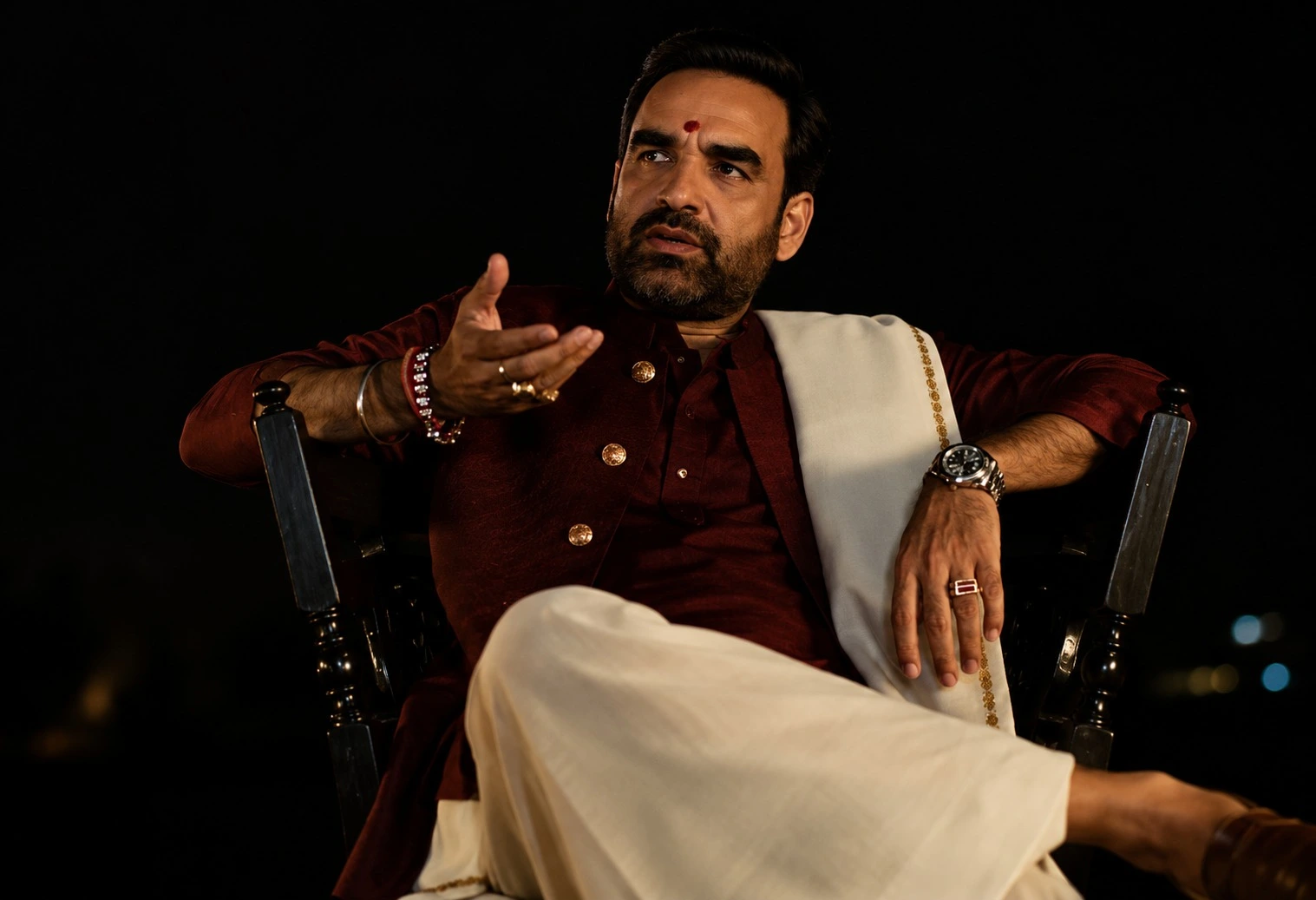
Pankaj Tripathi, Ali Fazal and Divyenndu bring back the chaos, humour and violence of Mirzapur in a big-screen prequel that plays heavily to its loyal fan base.
Mirzapur: The Movie arrives with a difficult job: take one of India's most recognisable OTT crime franchises and make it work inside a cinema hall without losing the personality that made the series popular.
Directed by Gurmmeet Singh and written by Puneet Krishna, the film brings back Pankaj Tripathi as Kaleen Bhaiya, Ali Fazal as Guddu Pandit and Divyenndu as Munna Tripathi. Jitendra Kumar, Ravi Kishan, Shweta Tripathi, Rasika Dugal and other familiar faces also return. The film released in theatres on September 4, 2026.
The Editorial Team of Behind The Headlines reports that the film's biggest advantage is also its biggest risk: it knows exactly what its audience wants.
There is violence. There is dark humour. There are power games. There are family rivalries. And, above everything else, there is the never-ending battle for the gaddi.
A story that goes back to the beginning
Rather than simply continuing from where the third season left off, the movie takes audiences back to an earlier point in the Mirzapur timeline.
That gives the makers an opportunity to bring several familiar characters together while they are still at their most volatile.
Kaleen Bhaiya remains at the centre of the power structure, while Munna continues to struggle with his father's expectations.
Guddu and Bablu Pandit occupy another important part of the equation, with their intelligence and physical strength making them increasingly important players in the power game.
The prequel structure is a clever decision.
It means audiences already know where many of these characters eventually end up, but the film can still explore the relationships and rivalries that shaped them.
Pankaj Tripathi is the anchor
The biggest reason the film works is Pankaj Tripathi.
As Kaleen Bhaiya, Tripathi doesn't need to constantly shout or dominate a scene.
His character's power comes from his calmness.
A pause, a look or a quiet sentence can carry more weight than an elaborate action sequence.
The film understands that.
After the character had comparatively less presence in the third season, his return gives the franchise some of its old energy back.
Kaleen Bhaiya once again feels like the man everyone wants to impress, defeat or replace.
And that makes the gaddi war interesting again.
Divyenndu gets some of the best moments
If there is one actor who appears to be having enormous fun with the material, it is Divyenndu.
Munna Tripathi remains one of the franchise's most entertaining characters because he combines arrogance, insecurity, aggression and unexpected humour.
The film uses that combination effectively.
His scenes are often among the most energetic parts of the movie, and the actor appears completely comfortable slipping back into the character.
The return of Munna is particularly important because his absence had been one of the major talking points around the later part of the series.
Here, he gets the kind of larger-than-life moments that fans have come to expect.
Ali Fazal brings a different Guddu
Ali Fazal's Guddu has also changed.
He remains physically intimidating, but the film allows more room for humour and unpredictability.
That works surprisingly well.
Guddu is not simply the muscle anymore. His relationship with Bablu, Munna and Kaleen Bhaiya creates several layers within the larger conflict.
Fazal handles both the action and comic moments comfortably, giving Guddu a slightly different energy from what audiences may remember.
His performance becomes one of the film's pleasant surprises.
The violence is bigger, but the humour remains intact
Moving Mirzapur from a streaming platform to theatres could easily have resulted in a film that simply throws bigger explosions and more violence at the audience.
Thankfully, the movie does more than that.
The violence is certainly present, but much of the entertainment comes from the characters.
The insults, ego clashes, awkward family dynamics and absurd confidence of the gangsters remain central to the experience.
That is important because Mirzapur has never been only about guns.
Its real attraction has always been the personalities holding those guns.
The film knows its audience
There is a clear understanding that people buying tickets already have an emotional connection with these characters.
The movie therefore doesn't spend excessive time trying to reinvent the franchise.
Instead, it amplifies what already works.
For long-time viewers, that can be hugely satisfying.
For someone completely unfamiliar with the series, however, the experience may not be as rewarding.
The film assumes a certain familiarity with the characters and their histories.
That makes it much more naturally suited to existing fans.
Where the film struggles
The biggest problem is length.
At close to three hours and twenty minutes, the film demands considerable patience from its audience.
There are stretches where the story appears to circle around familiar conflicts rather than move decisively forward.
The makers clearly have several characters and rivalries they want to service, and that sometimes makes the narrative feel heavier than necessary.
A tighter edit could have made some sequences more effective.
The film occasionally mistakes more for bigger.
And because the Mirzapur universe is already packed with characters, introducing or expanding additional players can make the narrative feel crowded.
Does it feel like a movie?
Yes, but with an important qualification.
It still feels unmistakably like Mirzapur.
The language, locations, characterisation and power struggles retain the identity of the original franchise.
At the same time, the theatrical setting allows the action sequences to feel larger.
The film has clearly been designed for an audience that wants to experience the familiar world collectively in a cinema hall.
That theatrical quality is one of its strengths.
The story itself may not always be radically new, but the presentation gives familiar characters a larger canvas.
What about Ravi Kishan?
Ravi Kishan's presence adds another layer to the power struggle.
His character brings a different kind of threat into the story and prevents the conflict from becoming completely predictable.
Several reviews have highlighted his performance as one of the film's standout elements, particularly because he brings a distinct energy to the already crowded world.
He fits naturally into the rough, unpredictable environment of Mirzapur.
The real strength: nostalgia
The movie's strongest weapon may not be its screenplay.
It is nostalgia.
For viewers who watched the first season when it arrived in 2018, seeing Kaleen Bhaiya, Munna and Guddu together again has an obvious emotional pull.
The franchise created a vocabulary and style that became part of Indian pop culture.
The movie understands that history.
Rather than pretending Mirzapur needs to become something completely different for cinema, it takes the opposite approach.
It says:
This is Mirzapur. Just bigger.
And that confidence works more often than it doesn't.
Is it better than the third season?
That depends on what a viewer wants from the franchise.
The third season was criticised by many viewers for losing some of the urgency and freshness of the earlier instalments.
The movie benefits from bringing back several of the characters who made the original series so popular, particularly Kaleen Bhaiya and Munna.
The result feels more energetic and more focused on the character chemistry that originally made Mirzapur stand out.
But it is not a complete reinvention.
It is essentially a return to the formula that worked.
Should you watch it?
If you have followed the Mirzapur series, the answer is fairly simple:
Yes.
The movie delivers enough violence, humour, character drama and nostalgia to justify the theatrical experience.
If you are expecting a completely fresh crime saga, you may find the story familiar.
If you are expecting Kaleen Bhaiya, Munna, Guddu and the gaddi war, the film gives you exactly that.
The biggest warning is the runtime.
At nearly 200 minutes, the film could have benefited from sharper editing and greater restraint.
But when the characters click, the film becomes highly entertaining.
Behind The Headlines Verdict
Mirzapur: The Movie doesn't try to escape its past.
It embraces it.
Pankaj Tripathi brings back the quiet menace of Kaleen Bhaiya. Divyenndu once again makes Munna impossible to ignore. Ali Fazal gives Guddu a more playful edge, while the supporting cast adds fresh fuel to the familiar power struggle.
The film occasionally becomes too long and sometimes relies heavily on fan service.
But there is enough energy, humour and big-screen spectacle to keep the franchise alive.
Verdict: A bloody, loud and entertaining return to the Mirzapur universe — made primarily for the fans, and likely to satisfy them.
Rating: ⭐⭐⭐½ / 5