
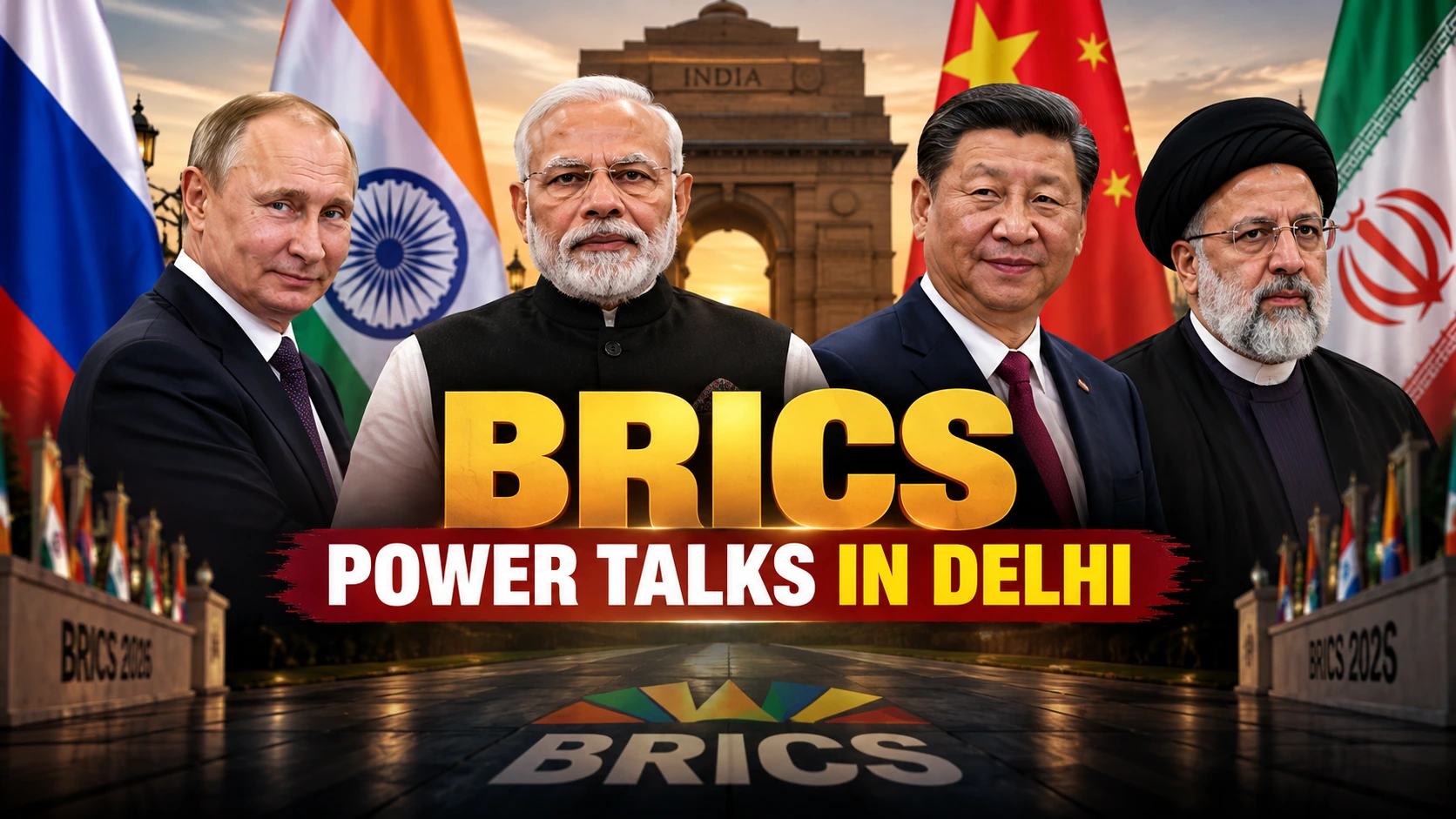
The New Delhi summit places India at the centre of a changing global order, with diplomacy, trade and regional conflicts dominating the agenda.
Prime Minister Narendra Modi held key bilateral meetings with Chinese President Xi Jinping, Russian President Vladimir Putin and Iranian President Masoud Pezeshkian during the BRICS Summit in New Delhi.
The Editorial Team of Behind The Headlines reports that India’s diplomatic balancing act was on full display as the 11-member grouping discussed global conflicts, economic cooperation and the future of the Global South.
Modi-Xi talks focus on border peace and trade
The meeting between Modi and Xi was one of the most closely watched moments of the summit. It marked Xi Jinping’s first visit to India in seven years and came after years of tension following the 2020 military clash along the Line of Actual Control.
Both leaders stressed that differences should not turn into disputes. Modi underlined that peace and stability along the border remain essential for the broader improvement of India-China relations.
The two sides also discussed the revival of economic and people-to-people ties, including trade, transport links, visas, flights and cultural exchanges. However, concerns over the trade imbalance, market access, supply chains and China’s support for Pakistan remain unresolved.
India-Russia ties remain strategically important
Modi also met Russian President Vladimir Putin on the sidelines of the summit. The discussions came as India continues to maintain close energy, defence and diplomatic ties with Moscow despite pressure from the changing global geopolitical environment.
Trade, investment, energy security, defence cooperation and connectivity are expected to remain central to the India-Russia relationship. The two countries are also looking at expanding cooperation in areas such as nuclear energy, transport corridors, manufacturing and technology.
Putin’s presence at the summit underlined Russia’s continued importance to India’s strategic calculations, particularly at a time when the Ukraine conflict continues to influence global energy markets and international diplomacy.
Iran and West Asia add urgency to the summit
Iranian President Masoud Pezeshkian’s participation brought the ongoing West Asia crisis into sharper focus. BRICS members faced the difficult task of expressing concern over the conflict while managing differences between countries within the grouping.
A joint statement called for restraint and warned against actions that could further escalate tensions in the region. The bloc also voiced concern over threats to civilian infrastructure, energy security and international stability.
For India, the crisis has direct implications. Instability in West Asia can affect oil prices, shipping routes, trade flows and the safety of Indian citizens working across the region. New Delhi therefore has a strong interest in promoting dialogue while protecting its own strategic and economic interests.
BRICS seeks a larger role in global affairs
The 2026 BRICS Summit brought together 11 full members: Brazil, Russia, India, China, South Africa, Egypt, Ethiopia, Indonesia, Iran, Saudi Arabia and the United Arab Emirates.
The grouping is seeking a greater voice for developing countries in global institutions, including the United Nations and international financial systems. Discussions also covered trade in national currencies, maritime safety, development cooperation and reducing dependence on Western-led financial structures.
However, internal differences remain a major challenge. Members have different positions on the wars in Ukraine and West Asia, relations with the United States and the future of the global economic system.
India’s diplomatic balancing act
India’s approach at the summit was not about choosing one camp over another. New Delhi is attempting to maintain strategic ties with Russia, manage competition with China, engage Iran and the Gulf countries, and preserve working relations with the United States and Europe.
This balancing act gives India diplomatic flexibility, but it also brings difficult choices. Stronger economic engagement with China must be accompanied by progress on the border. Relations with Russia must be managed alongside energy, defence and sanctions-related concerns. At the same time, India must ensure that BRICS does not become an openly anti-Western platform.
What happens next?
The success of the summit will depend on whether its declarations lead to practical cooperation. Improved India-China communication, stronger trade arrangements, safer transport corridors and a coordinated response to regional conflicts could give BRICS greater credibility.
For India, the summit has offered an opportunity to project itself as a bridge between competing global powers. But the real test will come after the leaders leave Delhi—when diplomatic commitments must be converted into measurable progress.