
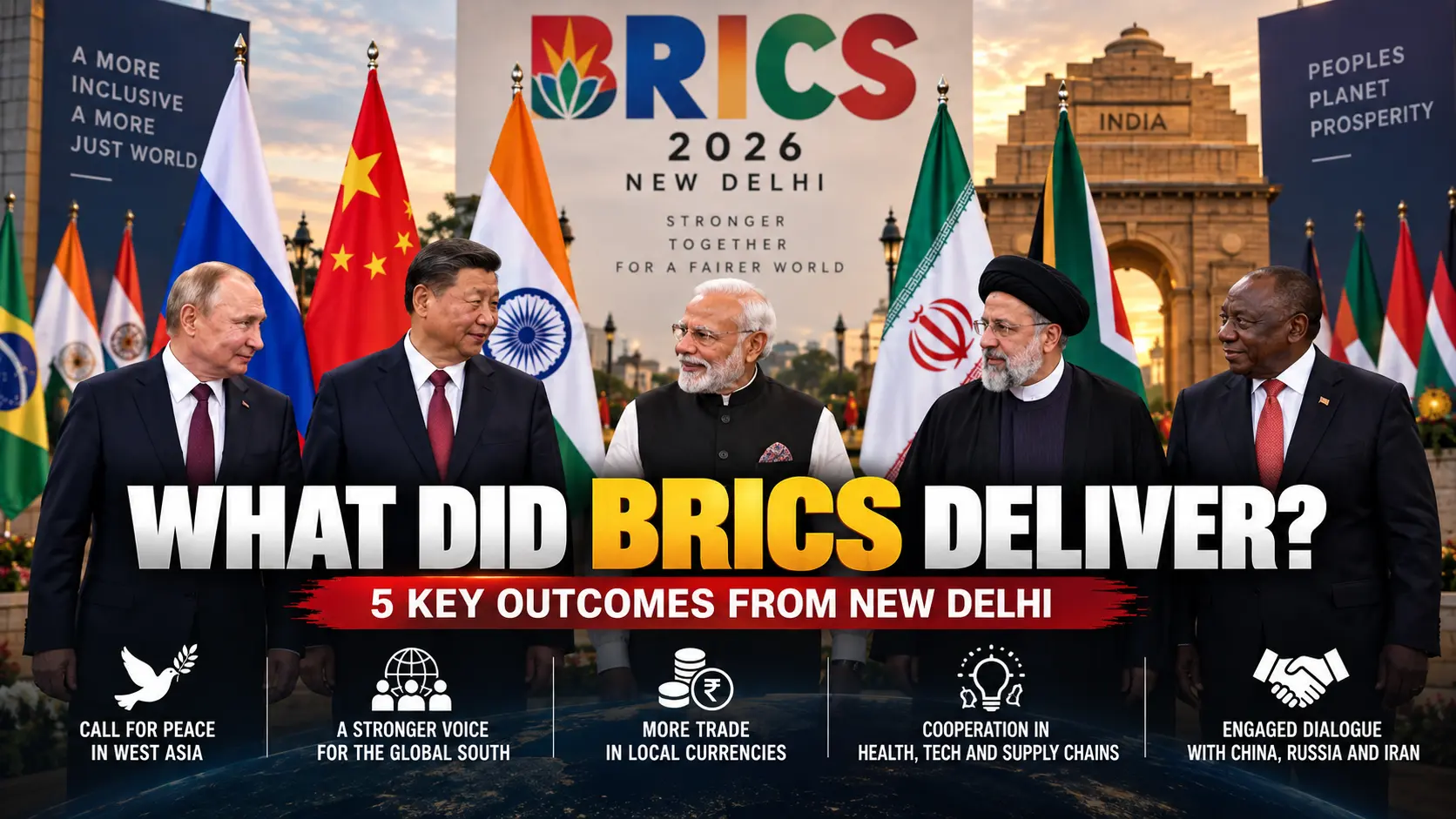
The summit produced a broad diplomatic consensus on global conflicts, economic cooperation, technology and a greater role for the Global South.
The 2026 BRICS Summit in New Delhi ended with a joint declaration focused on peace, economic resilience, global governance reform and deeper cooperation among developing countries.
The Editorial Team of Behind The Headlines reports that India used its BRICS presidency to push for practical initiatives while positioning itself as a bridge between competing global powers.
1. BRICS calls for restraint in West Asia
One of the most significant outcomes was the adoption of a common position on the worsening conflict in West Asia.
The New Delhi Declaration called for maximum restraint and urged countries to avoid actions that could further escalate tensions. It also backed dialogue, diplomacy and a multilateral approach to international disputes.
Reaching a common position was diplomatically important because BRICS includes countries with sharply different regional interests, including Iran and the UAE.
2. Push for a stronger voice for the Global South
Prime Minister Narendra Modi called for reforms in global institutions so that developing countries become “rule-shapers” rather than merely “rule-takers.”
India proposed a BRICS reform roadmap focused on:
Greater representation in global institutions
More responsive decision-making
Fairer participation in the United Nations system
Reform of international financial institutions
Stronger representation for Africa, Asia and Latin America
The declaration also reiterated support for a more representative and multipolar global order.
3. More cooperation in trade and local currencies
BRICS members agreed to continue discussions on improving cross-border payments and encouraging trade settlements in local currencies.
The aim is not an immediate common BRICS currency. Instead, the focus is on making payments between member countries easier and reducing dependence on a single international payment system.
The bloc also raised concerns over unilateral tariffs, protectionist measures and sanctions that can disrupt trade and global supply chains.
For India, this could support stronger trade links with emerging markets, although implementation will depend on banking systems, currency stability and political agreement among members.
4. New initiatives in health, technology and supply chains
India announced several initiatives aimed at making BRICS cooperation more practical.
These included:
An integrated early-warning system for infectious diseases
A logistics and supply-chain cooperation framework
A startup innovation fund
Centres of excellence in agro-ecology and energy storage
Greater cooperation in artificial intelligence
Collaboration on critical minerals and food security
Stronger support for small businesses, startups and young innovators
The proposals reflect India’s attempt to move BRICS beyond political statements and towards projects that could deliver visible benefits to citizens.
5. India-China engagement continued alongside wider diplomacy
The summit also created space for a cautious improvement in India-China relations.
Prime Minister Modi and Chinese President Xi Jinping discussed the need for peace and stability along the border, along with trade, market access and people-to-people exchanges.
The meeting did not erase differences over the Line of Actual Control, trade imbalances or strategic competition. However, continued communication could help prevent tensions from escalating and create room for limited economic cooperation.
At the same time, India maintained engagement with Russia and Iran, reinforcing its strategy of working with multiple power centres rather than joining a fixed geopolitical camp.
What the summit means for India
The summit strengthened India’s image as a country capable of bringing together partners with conflicting interests. New Delhi managed to keep discussions focused on development, technology, economic resilience and global governance while also addressing major security crises.
However, the real impact will depend on implementation. Payment mechanisms, supply-chain projects, health initiatives and institutional reforms will require funding, coordination and political commitment.
BRICS also continues to face internal divisions. Its members differ over the Ukraine conflict, West Asia, relations with the United States and the future of the global economic system.
Conclusion
The New Delhi Summit did not create a single dramatic breakthrough, but it produced several important diplomatic and economic signals. BRICS members backed restraint in West Asia, called for reforms in global governance, expanded cooperation in technology and health, and continued discussions on trade in local currencies.
For India, the biggest outcome was strategic: New Delhi strengthened its role as a diplomatic bridge while pushing BRICS towards a more practical and development-focused agenda.