
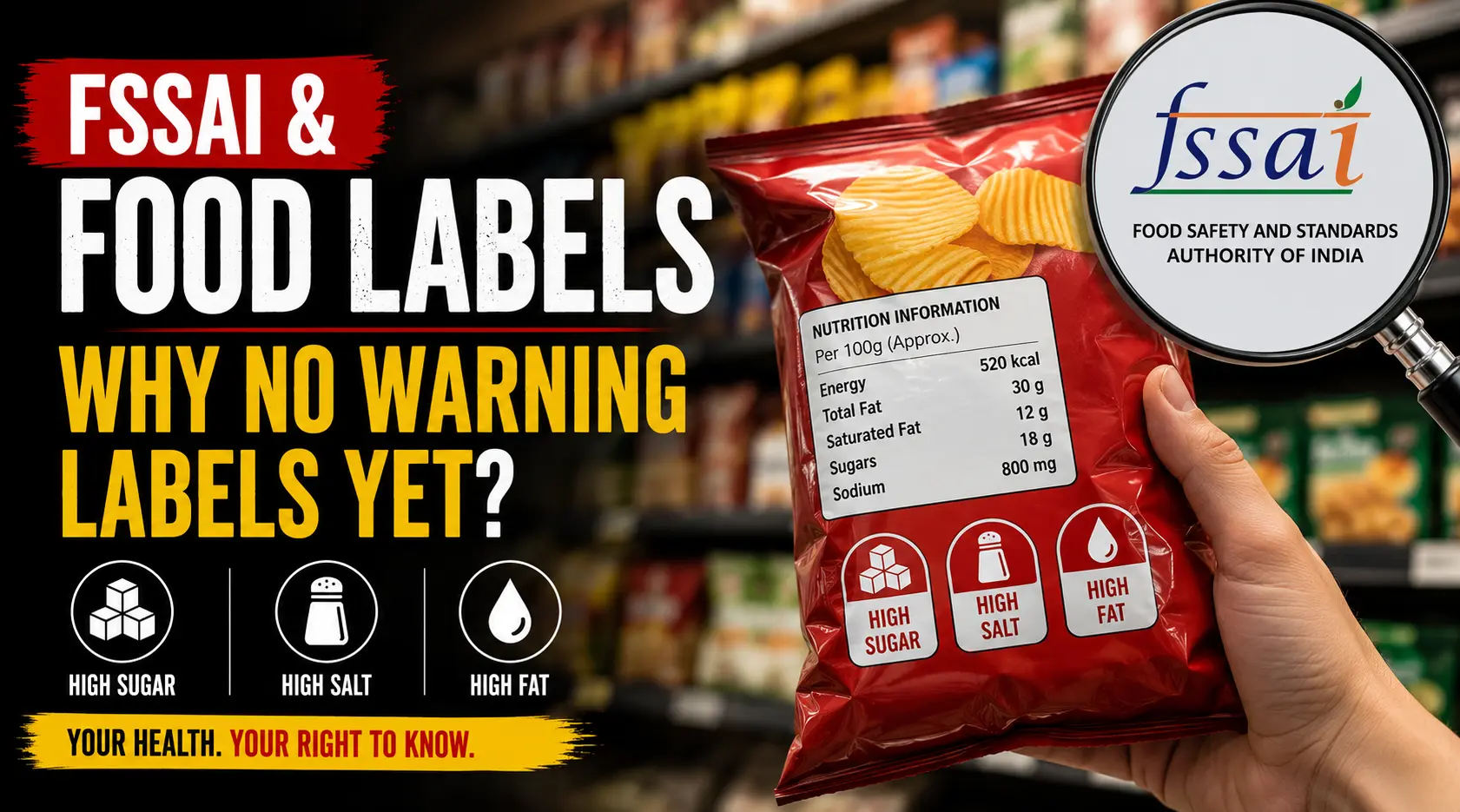
Walk into any supermarket and look at the front of a packet of chips, biscuits, breakfast cereal or a sugary drink. The packaging is usually designed to make the product look attractive — “high protein”, “natural”, “healthy”, “zero added sugar” or “made with whole grains”.
But one thing is often much less visible: how much sugar, salt and saturated fat the product actually contains.
That is at the heart of the growing debate over front-of-pack warning labels in India. Questions on why the Food Safety and Standards Authority of India (FSSAI) has been so cautious about adopting a simple warning system for unhealthy packaged foods. The criticism comes at a time when the Supreme Court has asked FSSAI to seriously consider front-of-pack warnings, while a parliamentary committee has also pushed for clearer nutrition information.
But calling FSSAI “afraid” is an opinion, not an established fact. The real story is more complicated — and it involves consumers, food companies, public health and a regulatory process that has been running for years.
What exactly are warning labels?
The idea is fairly simple.
Instead of making consumers turn the packet around and study a complicated nutrition table, the front of the package would carry an easy-to-understand indication when a product contains high levels of nutrients such as sugar, sodium or saturated fat.
The intention is not necessarily to ban the product. It is to make the health risk visible before the consumer buys it.
FSSAI has considered different approaches over the years, including front-of-pack nutrition information and rating systems. Its earlier draft framework even proposed an Indian Nutrition Rating, which would rate packaged foods from half a star to five stars based on factors including energy, sugar, saturated fat and sodium, along with positive nutritional factors.
That approach, however, is different from a straightforward warning label.
And that distinction matters.
Why has this become a big issue now?
The issue has received fresh attention in 2026.
In February, the Supreme Court asked FSSAI to seriously consider front-of-pack warning labels for packaged foods containing excessive sugar, saturated fat and sodium. The court's intervention has added considerable pressure to a regulatory discussion that has been going on for years.
Then, in July, a parliamentary standing committee recommended that packaged foods should have clear, easily understandable information on the front of the pack. It specifically suggested interpretative labels, including colour indicators or warnings for products high in sugar.
So this is no longer just a debate among nutrition experts.
It has reached the Supreme Court, Parliament and the country's food regulator.
Why do health experts want warning labels?
The argument is that consumers don't always have the time, knowledge or patience to decode a nutrition table.
Imagine standing in a supermarket with two packets of breakfast cereal.
One package says: “Rich in vitamins • High in fibre • Healthy breakfast”
The other says: “High in sugar.”
The second message immediately changes how the consumer looks at the product.
That is precisely what warning-label advocates want — simple information at the moment of purchase.
Consumer groups have argued that a warning system could make it easier for people to identify products high in sugar, salt and unhealthy fats without having to interpret technical nutritional information.
Why is the food industry uncomfortable with warning labels?
This is where the debate gets complicated.
A prominent warning placed on the front of a packet can change how consumers perceive a product.
Food companies therefore have a strong commercial reason to prefer systems that provide more detailed information rather than a blunt warning.
Industry representatives have argued that warning-style labels can be overly simplistic and may not provide the complete nutritional picture of a food. They have favoured approaches that give consumers more information rather than reducing the nutritional profile to a simple warning.
There is also a practical question: Where should the threshold be?
How much sugar is “high”? How much sodium?
Should the calculation be made per 100 grams, per serving or per package?
Should protein, fibre, fruits, nuts and other positive nutrients also be considered?
These decisions can dramatically change which products receive a warning.
What has FSSAI already done?
It would be incorrect to say that FSSAI has completely ignored nutrition labelling.
In 2024, FSSAI announced that information relating to total sugar, salt and saturated fat on packaged food labels should be displayed in bold letters and a larger font to make it more visible to consumers.
FSSAI has also been working on broader front-of-pack nutrition concepts for years.
The problem is that visibility is not the same thing as a warning.
Making a number bigger still requires the consumer to understand what that number means.
A red warning symbol saying “HIGH SUGAR” is much harder to miss.
Why does the Supreme Court's intervention matter?
The Supreme Court's intervention has changed the pressure on the regulator.
The court's February 2026 direction came against the backdrop of concerns about the health impact of diets containing excessive sugar, salt and saturated fat. It asked the regulator to seriously examine front-of-pack warnings rather than leaving the issue indefinitely unresolved.
That doesn't mean every packaged food product in India suddenly has a warning label.
It means the regulator has been put under greater scrutiny to address the issue.
What about India's growing lifestyle disease problem?
This is perhaps the strongest argument for clearer labelling.
India is dealing with rising concerns around obesity, diabetes and cardiovascular disease, while packaged and ultra-processed foods have become increasingly common in urban diets.
FSSAI itself has previously called on states and Union Territories to strengthen efforts to address obesity and promote healthier food choices.
The argument from public-health advocates is therefore straightforward:
If a product contains unusually high levels of nutrients associated with health risks, why shouldn't the consumer be told clearly before buying it?
Is a warning label enough to solve the problem?
No.
A warning label cannot turn an unhealthy diet into a healthy one.
People may still buy products carrying warnings. Price, taste, convenience, advertising and habits often matter more than nutritional information.
There is also the danger of oversimplifying food.
A product isn't automatically “good” or “bad” based on one nutrient. That's one reason regulators have considered broader nutrition-rating systems rather than only warning symbols.
But that doesn't eliminate the argument for clearer warnings.
The two approaches can coexist: detailed nutrition information for those who want it and simple warnings for consumers who need a quick decision.
So, is FSSAI really 'afraid' of warning labels?
There is no evidence that FSSAI has officially said it is opposed to warning labels.
In fact, the regulator has repeatedly worked on nutrition-labelling proposals, and its own earlier drafts have included front-of-pack nutrition systems.
The stronger criticism is about delay.
India has been discussing front-of-pack nutrition labelling for years. Meanwhile, food companies continue to compete for consumers' attention with attractive health claims and marketing language.
That is why critics are asking a simple question:
If consumers can be persuaded to buy a product in seconds, why should it take years to give them equally visible information about its nutritional risks?
The bigger question: Whose side should the label be on?
At its core, this isn't simply a fight between FSSAI and the food industry.
It is about how much information consumers should receive before they spend their money.
A food company naturally wants its product to look appealing.
A regulator has a different responsibility — ensuring that consumers aren't misled and can make informed choices.
The challenge for FSSAI is to design a system that is scientifically sound, easy to understand, difficult to manipulate and practical for the food industry to implement.
The debate over warning labels is therefore unlikely to disappear anytime soon.
And perhaps the most important question isn't whether a packet should carry a red warning symbol.
It is this: When a food product is marketed as healthy, should the consumer have to turn the packet around to discover what might make it unhealthy?